
AI-powered agent turns Rs 11.08 lakh into Rs 40.47 lakh overnight, claims X userAn AI powered agent reportedly generated $43,800 (about Rs 40.47 lakh) overnight by identifying time zone arbitrage opportunities on Polymarket, according to an X post.
An X user, 0x_Discover, has claimed that an AI-powered trading agent generated $43,800 (about Rs 40,47,120) in profit overnight by identifying time zone arbitrage opportunities on Polymarket. Sharing details on X, the user explained that their OpenClaw agent sent an alert at 3:47 AM asking for approval to deploy $12,000 (about Rs 11,08,800) across six prediction markets set to resolve within the next 90 minutes. The trader reportedly approved the trade and returned to sleep, later waking up to a profit of $43,800 (around Rs 40.47 lakh). According to the post, the AI agent had been operating for nine days and was designed to detect time zone arbitrage opportunities on Polymarket. It was connected to several global information sources, including Japanese government RSS feeds, European Parliament livestreams, Australian financial wires, Middle East flight trackers and Asian central bank announcements.
The user said the agent was programmed with a simple rule. It would send an alert if a market set to resolve during US sleep hours between 2 AM and 6 AM EST showed more than 30 per cent edge.
At 3:47 AM, the system reportedly detected six markets in which local sources had already indicated the outcome, while Polymarket prices were yet to adjust. The post mentioned examples such as Japan’s rate decision, where signals reportedly showed about 68 per cent chance while the market price was still around 23 cents, and a European Parliament vote where a livestream showed a “YES” result before the market reacted. The post also mentioned a South Korea policy update, an Australia trade deal announcement, notes from OPEC on a production cut linked to the United Arab Emirates, and a Singapore regulation vote seen during a live parliamentary session.
The trader said entries were placed between 15 cents and 31 cents, and the payouts later ranged from 95 cents to $1 once the markets resolved.
According to the post, the strategy depends on the fact that most Polymarket traders are based in the United States. As a result, global events often take place during US night hours, leaving a short gap before market prices react. Lucky guess or insider knowledge? Mystery trader turns Polymarket bet into Rs 4 crore after US-Israel strikes on Iran Blockchain records show the wallet committed $235,947 to the bet at that stage. Once the strikes were confirmed, the market settled and the trader collected more than $431,000.

A cryptocurrency trader has drawn intense scrutiny after making a large profit on a prediction market bet tied to the recent US-Israel strikes on Iran, raising questions about the timing of the trades and whether advance knowledge of geopolitical events could have been involved. Blockchain data from the prediction platform Polymarket shows that a wallet identified as “Magamyman” earned $431,146 (approx. Rs 4 crore) after correctly betting that a military strike on Iran would occur. The wager was placed weeks before the operation took place, when markets suggested only a modest likelihood of such action. On Polymarket, users buy and sell shares tied to real-world outcomes. Prices range from $0 to $1 and represent the crowd’s estimated probability of an event. If the outcome occurs, each winning share pays out $1. In this case, the trader bought “YES” shares when they were trading at 27 cents, implying a 27 percent chance that a strike would happen.
Blockchain records show the wallet committed $235,947 to the bet at that stage. Once the strikes were confirmed, the market settled and the trader collected more than $431,000.
The profit has drawn additional attention because analysts tracking the account say it has repeatedly focused on Iran-related scenarios. According to crypto watchers, the wallet has made 88 predictions tied to Iran since October 2024, many of them centered on escalating tensions, deadlines or potential strike scenarios. One earlier trade cited by traders allegedly produced a profit of $278,079 after the wallet wagered that Israel would strike Iran before January 31. The same account is still active on similar markets, including a position worth about $78,000 on a market predicting that the United States would strike Iran by March 1.
Some observers say the timing of certain trades has raised questions. Separate posts on X claim that one key position was placed roughly 71 minutes before news of the strikes became public. According to those posts, the trader invested about $87,000 when market odds were around 17 percent and later saw the value surge past half a million dollars once the attack was confirmed.
Polymarket operates as a decentralized prediction market that allows users to connect cryptocurrency wallets, deposit USDC stablecoins and trade outcome-based contracts. Supporters say such markets help aggregate information and often predict real-world outcomes more accurately than traditional analysis. Critics argue that markets linked to military action or geopolitical crises can create incentives for speculation and raise the risk of insider trading if participants gain access to privileged information.
The controversy has also drawn attention to Polymarket’s political connections. Donald Trump Jr. sits on the platform’s advisory board and his investment firm backed the company last year.
The platform previously faced investigations by the US Department of Justice and the Commodity Futures Trading Commission. According to public statements cited online, those probes were dropped after Donald Trump returned to office.
There is no public evidence linking the “Magamyman” wallet to any government official or insider. However, the pattern of highly accurate bets and the timing of some trades have fueled calls for closer scrutiny of prediction markets tied to sensitive geopolitical developments.
“Prediction markets cannot be a vehicle for profiting off advance knowledge of military action,” an analyst said on X. “We need answers, transparency, and oversight.”
Here are the details of this viral incident:
- The Incident: The trader was woken up at 3:47 a.m. EST by an alert from their AI agent, “OpenClaw,” requesting approval to deploy $12,000 in capital across six prediction markets.
- The Platform: The trades were executed on Polymarket, a decentralized prediction market platform.
- The Strategy: The AI utilized “timezone arbitrage.” It analyzed Asian and European news feeds—such as Japanese government RSS feeds, European Parliament livestreams, and Australian financial wires—during US sleeping hours, identifying that markets were mispriced because US traders were not yet active.
- The Result: The AI, which had been operating for nine days, identified markets expected to resolve within 90 minutes. It entered positions at low prices (15-31 cents) and closed them near full value (95 cents to $1), creating roughly 3x returns overnight.

Aviral post on social media has ignited debate after a user claimed that an AI-powered trading agent turned ₹11 lakh into nearly ₹40 lakh overnight , highlighting the growing influence of artificial intelligence in financial markets.
How the overnight trade happened
According to the post, the user deployed an AI agent named OpenClaw, which specializes in identifying short-term opportunities in prediction markets such as Polymarket.
At 3:47 AM, the system reportedly sent an alert:
- It identified 6 prediction markets set to resolve within 90 minutes
- Requested approval to invest $12,000 (≈ ₹11 lakh)
- The user approved the trade and went back to sleep
By morning, the AI had generated a profit of $43,800 (≈ ₹40 lakh).
How the AI made money
The system used a strategy known as Timezone Arbitrage, which exploits pricing gaps caused by global market timing differences.
The AI reportedly:
- Monitored global data sources (government feeds, financial news, flight data, central bank updates)
- Identified markets with over 30% expected returns
- Bought positions at low prices (15-31 cents)
- Cashed out near full value (95 cents to $1) once markets settled
Why this is going viral
The story has captured attention because it showcases:
- The speed and efficiency of AI-driven trading
- The possibility of automated profit-making with minimal human input
- The increasing role of AI in real-time decision-making
However, it has also raised skepticism.
Experts urge caution
While the claim sounds impressive, many users and analysts have pointed out:
- Such high returns in a short time are rare and risky
- Prediction markets can be volatile and unpredictable
- AI systems depend heavily on data quality and assumptions
There are also concerns about over-reliance on automation and the lack of transparency in such systems.
A glimpse into the future of trading?
Whether fully accurate or not, the incident reflects a broader trend – AI is rapidly transforming trading strategies, from stock markets to prediction platforms. While many in the crypto community found the feat impressive, others expressed skepticism, calling it a potentially risky strategy or a “scam” used to generate referrals. However, if real, it highlights the increasing capability of AI agents to manage high-speed, 24/7 trading strategies. AI Turns ₹11 Lakh into ₹40 Lakh via “Timezone Arbitrage” In a demonstration of the growing efficacy of autonomous finance, an AI trading agent recently transformed an ₹11.08 lakh ($12,000) investment into approximately ₹40.47 lakh ($43,800) in a single night. The agent, part of a toolset called OpenClaw, achieved this by identifying inefficiencies on the decentralized prediction platform Polymarket while its operator was asleep. At 3:47 AM, the bot alerted the trader for approval to allocate capital across six specific markets; upon receiving a simple “yes,” the AI executed the high-speed strategy autonomously.

The success of the trade relied heavily on “timezone arbitrage,” a strategy that exploits price discrepancies occurring when liquidity thins in one region while another remains active. By monitoring Asian and European market hours while U.S. traders were offline, the agent spotted mispricings in short-term event markets set to resolve within 90 minutes. The trader noted that this event was part of a nine-day streak, stating, “For the past 9 days I’ve been running an agent that hunts timezone arbitrage on Polymarket.”
While the incident highlights the potential for AI to navigate complex datasets and execute trades faster than humanly possible, financial experts urge caution. Prediction markets are subject to sudden sentiment shifts and liquidity risks that can lead to significant losses. Nevertheless, this milestone illustrates a shift toward 24/7 autonomous wealth management in the decentralized finance (DeFi) ecosystem. New York: A shocking example of the growing power of artificial intelligence (AI) in the financial markets has emerged. A US trader claims his autonomous AI agent woke him up at 3:47 a.m. to request approval for a major investment. A US-based trader, identified by some sources as an X user named “0x_Discover,” has claimed that their autonomous AI agent woke them up at 3:47 a.m. to request approval for a major investment. The incident, occurring around mid-March 2026, highlights the increasing use of “agentic” AI in financial markets. X user says AI alert helped him turn Rs 11 Lakh Into Rs 40 Lakh, Internet Reacts AI agent woke the trader at 3:47 am to seek approval for an investment across six prediction markets.

An artificial intelligence-powered trading agent has sparked widespread debate online after an X user claimed it generated a massive overnight profit by spotting time-zone arbitrage opportunities on a prediction market. The claim, shared on X, quickly gained traction as users reacted with a mix of curiosity, excitement, and scepticism. The user explained that his OpenClaw agent sent an alert at 3:47 AM requesting approval to deploy $12,000 (around Rs 11.08 lakh) across six prediction markets that were set to resolve within the next 90 minutes. After approving the trade, the user reportedly went back to sleep and later woke up to a profit of $43,800 (about Rs 40.47 lakh).
According to the viral post, the AI agent had been running for nine days and was designed to detect time-zone arbitrage opportunities on Polymarket. The system monitored several global information sources, including Japanese government RSS feeds, livestreams of the European Parliament, Australian financial news wires, Middle East flight-tracking data, and announcements from Asian central banks.
The agent followed a simple rule: it would send an alert whenever a prediction market scheduled to resolve during US night hours (between 2 AM and 6 AM Eastern Time) showed more than a 30 percent edge. At 3:47 am, the system reportedly identified six such markets where local news sources had already hinted at the outcomes, but the prices on Polymarket had not yet adjusted. These included signals linked to a Japanese interest rate decision, a European Parliament vote, a policy update in South Korea, an Australian trade announcement, production-related notes from OPEC involving the United Arab Emirates, and a regulatory vote in Singapore.
The user said the trades were placed at prices ranging from 15 cents to 31 cents, while the final payouts were between 95 cents and $1 once the markets resolved.
“My OpenClaw agent woke me up at 3:47 AM with one message: “6 markets resolving in the next 90 minutes. Need approval for $12K.” I typed “yes” and went back to sleep. Woke up to +$43,800. For the past 9 days I’ve been running an agent that hunts timezone arbitrage on Polymarket,” the user wrote.
According to the post, the strategy works because many traders on Polymarket are based in the United States, meaning important developments occurring in other time zones can sometimes take longer to be reflected in market prices during US sleeping hours.
The post quickly spread across the platform, drawing thousands of views and comments. Some users were impressed by the potential of AI-driven trading tools, saying such systems could reshape how people participate in financial markets.
However, many others expressed doubts about the claim. A few users warned that extraordinary profits in such a short period are highly unusual and may involve extremely risky strategies, leveraged trading, or even selective presentation of results. Several users also noted that screenshots alone are not enough proof of real trading performance, while others called it a “scam.”
One user said, “This is a scam (or at least a highly deceptive fake testimonial used to farm referrals).”
Another commented, “If that workflow is real, it’s a great example of how information latency across time zones can create temporary market inefficiencies.”
Here are the key details of the incident:
- The Investment: The AI, reportedly using a custom framework named “OpenClaw,” requested approval to invest $12,000 (roughly ₹11 lakh) across six different prediction markets on the platform Polymarket.
- The Strategy (Time-zone Arbitrage): The AI identified that these markets, which were set to resolve within 90 minutes of the alert, were trading at an inefficient price during US night hours. The agent was connected to global feeds, including Japanese government RSS updates and European Parliament livestreams, allowing it to act on information before Polymarket prices adjusted.
- The Result: The trader approved the trade and went back to sleep. By the time they woke up, the $12,000 investment had reportedly generated a total value of $43,800 (around ₹40 lakh).
- Context: The AI was programmed to alert the trader if a market showed more than a 30% edge during the 2 a.m. to 6 a.m. EST window.
AI trading bot wakes trader at 3:47 am, turns Rs 11 lakh into Rs 40 lakh overnight while most of the users around the world are using AI to write code, articles, plan trips and research, an X user has used it to double down on the corpus within a few hours. An X user has claimed that an AI agent has helped him gain overnight profits by spotting time-zone arbitrage opportunities on the prediction platform Polymarket.

Taking to X, a user named 0x_Discover claimed that an AI agent alerted him in the early hours of the morning about a set of markets that were close to resolution. According to the post, the notification arrived at around 3:47 AM, requesting approval to deploy $12,000 (about Rs 11.08 lakh) across six prediction markets expected to settle within the next 90 minutes. The user said he approved the trade and went back to sleep. By the time the markets resolved later in the morning, the system had reportedly generated profits of $43,800, which is roughly Rs 40.47 lakh.
Talking about how it happened, the user stated that the trading agent was built using an AI framework called OpenClaw and had been running for about nine days. Its primary purpose was to identify time zone arbitrage opportunities on Polymarket, situations where the real-world outcome of an event becomes known in one region while market prices have not fully reacted elsewhere.
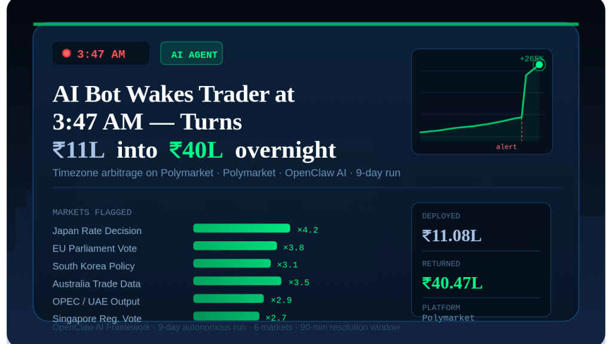
AI trading bot wakes trader at 3:47 AM, turns Rs 11 lakh into Rs 40 lakh overnight
To get this, the agent was connected to several global data sources. These sources include – Japanese government RSS feeds, livestreams of the European Parliament, Australian financial news wires, Middle East flight tracking data and announcements from Asian central banks.
The system then followed a simple rule- sending an alert whenever a market was scheduled to resolve during US night hours, specifically between 2 AM and 6 AM Eastern Time. As per the post, the AI flagged six such markets that night. He also shared the examples, which included signals around a Japanese interest rate decision, a vote in the European Parliament, a policy update in South Korea, an Australian trade announcement, production-related notes from OPEC involving the United Arab Emirates, and a regulatory vote in Singapore. The user also stated that the trades were entered at prices between 15 cents and 31 cents, while the final payouts ranged between 95 cents and $1 once the markets resolved. The post argued that the strategy works because many traders on Polymarket are based in the United States.
Of course, the claim has sparked a massive buzz around on X with users talking about whether AI agents can actually help in trading strategies and predictions.
Here are the key details of the incident:
- The Investment: The AI, reportedly using a custom framework named “OpenClaw,” requested approval to invest $12,000 (roughly ₹11 lakh) across six different prediction markets on the platform Polymarket.
- The Strategy (Time-zone Arbitrage): The AI identified that these markets, which were set to resolve within 90 minutes of the alert, were trading at an inefficient price during US night hours. The agent was connected to global feeds, including Japanese government RSS updates and European Parliament livestreams, allowing it to act on information before Polymarket prices adjusted.
- The Result: The trader approved the trade and went back to sleep. By the time they woke up, the $12,000 investment had reportedly generated a total value of $43,800 (around ₹40 lakh).
- Context: The AI was programmed to alert the trader if a market showed more than a 30% edge during the 2 a.m. to 6 a.m. EST window.
An X user, 0x_Discover, has claimed that an AI-powered trading agent generated $43,800 (about Rs 40,47,120) in profit overnight by identifying time zone arbitrage opportunities on Polymarket. Sharing details on X, the user explained that their OpenClaw agent sent an alert at 3:47 AM asking for approval to deploy $12,000 (about Rs 11,08,800) across six prediction markets set to resolve within the next 90 minutes. The trader reportedly approved the trade and returned to sleep, later waking up to a profit of $43,800 (around Rs 40.47 lakh). While many in the community saw this as a revolutionary example of AI, others expressed caution, calling it a potential “referral-farming” gimmick or an extremely risky strategy that may not be sustainable.
