
Google Maps has received a significant AI update, powered by the Gemini family of models, transforming the app into a conversational assistant. This update is available on mobile (Android and iOS) in the United States and India as of mid-March 2026. Google Maps brings an AI-powered ‘Ask Maps’ and immersive navigation features AI upgrades with new immersive and conversational features. Here’s everything you need to know.
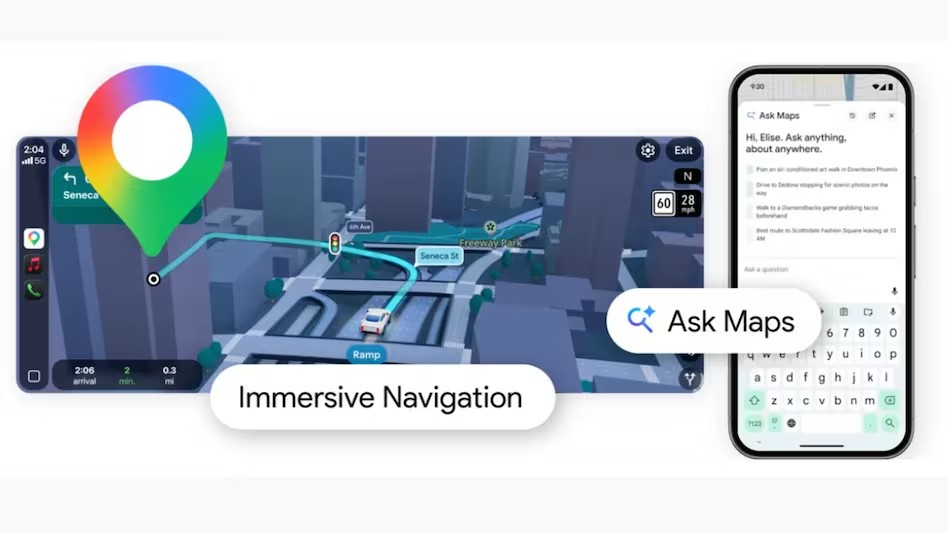
Google Maps is getting smarter and more immersive with new AI-powered features. On March 12, the tech giant announced “Ask Maps,” a Gemini-powered chat tool that can provide answers to real-world questions. The app also gets a revamped “Immersive Navigation” mode that will offer 3D views, improved road detail, and more. According to Google’s blog post, the “Ask Maps” features bring a conversational experience to users that can resolve real-world user queries. Using these features, users will not have to search each location, as they can just voice command the AI in natural language.
Google provide a couple example such as “My phone is dying — where can I charge it without having to wait in a long line for coffee?” or “Is there a public tennis court with lights on that I can play at tonight?”
It is also stated that the “Ask Maps” feature can help users plan trips with directions, ETAs, and tips from real people.
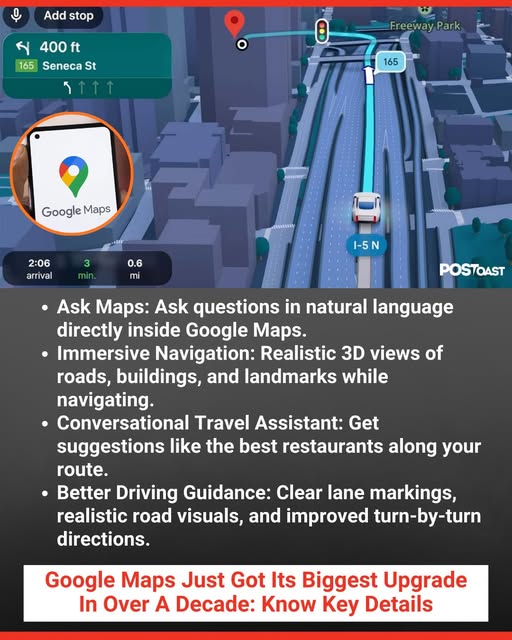
Google has also redesigned Immersive Navigation, which it says is “the biggest update in over a decade.” Now Maps will show a vivid 3D view that reflects the buildings, overpasses, and terrain. In addition, it will also highlight critical road details such as lanes, crosswalks, traffic lights, and stop signs. Google said, “This spatial understanding of your route is made possible with help from Gemini models, which analyse fresh, real-world imagery from Street View and aerial photos to give you an accurate view of things along your route, like landmarks and medians.”
It will also provide alternate routes with less traffic, toll information, road construction and crashes. Lastly, Maps’ voice direction is more conversational and less robotic.
The Immersive Navigation is rolling out today in the U.S. with global availability expected in the coming months to iOS and Android devices, CarPlay, Android Auto and cars with Google built-in.
Whereas the Ask Maps feature is rolling out in the U.S. and India on Android and iOS devices. The feature is also said to come to the desktop soon.
The new AI-powered features include:
1. “Ask Maps” (Conversational Search)
Instead of keyword searches, users can now use natural language to ask complex questions. Google Maps is rolling out a major update that brings both visual and functional changes. One of the key additions is “Ask Maps,” a feature that allows users to search for places using natural, conversational questions. Instead of typing keywords, you can ask something like, “My phone is about to die. Where can I charge it without waiting in line for coffee?” and the app will suggest relevant spots.
The update also introduces Immersive Navigation, offering a more detailed 3D view of streets, buildings, and surroundings along your route. This enhanced visualization aims to make navigation clearer and more accurate while giving users a better sense of the environment ahead.
- Situational Queries: For example, users can ask, “Where can I charge my phone without waiting in line for coffee?” and receive relevant locations.
- Personalized Trip Planning: Users can ask for “highly rated vegetarian restaurants to try in the area,” and the AI will tailor suggestions based on previous saved or visited places.
- Multi-stop Trip Planning: Full itineraries with multiple stops are possible.
Google Maps AI update: Ask Maps and immersive navigation launched update introduces Ask Maps, which offers conversational suggestions for nearby services, cafes, device charging points, and multi-stop road trips, leveraging data from over 300 million places and 500 million reviews gets a major AI upgrade with Gemini; Immersive Navigation offers 3D views of roads, landmarks, and parking for easier navigation.
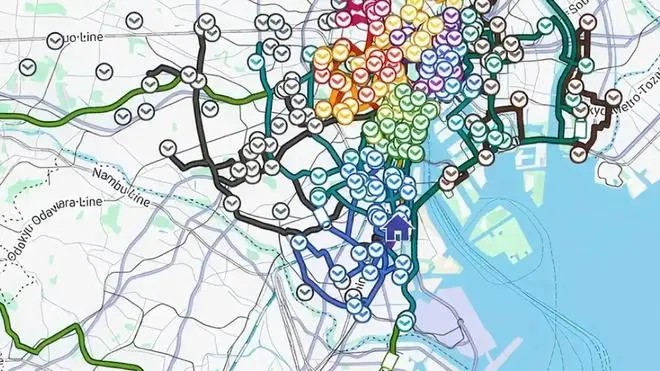

Google Maps will depend more heavily on artificial intelligence to help people figure out where they want to go and the best way to get there as part of a major redesign unveiled on Thursday.
The overhaul driven by Google’s Gemini technology will introduce two AI features into a digital mapping service used by more than 2 billion people worldwide.
Ask Maps suggests local spots, itineraries
One tool called Ask Maps will expand upon conversational abilities that Google brought to the service last November, giving suggestions to users looking for things such as nearby places to charge their devices, cafes with short lines or a detailed itinerary for a road trip involving several stops and excursions.
Gemini’s recommendations will draw upon a database spanning more than 300 million places and reviews from more than 500 million contributors that have been accumulated since Google Maps’ debut more than 20 years ago.
Availability in US and India first
Ask Maps initially will be available on Google Maps’ mobile app for iPhones and Android software in the US and India, before expanding to personal computers and other countries. In what Google executives are billing as the biggest change to the maps’ driving directions, Gemini has also created a new tool dubbed Immersive Navigation that will present a three-dimensional perspective designed to give users a better grasp of where they are at any moment in time.
AI prevents fabricated navigation details
Google believes its AI guardrails are now strong enough to prevent the Gemini technology underlying Immersive Navigation from fabricating bogus places to go, a malfunction known within the industry as a “hallucination.” Immersive Navigation is also supposed to help Google Maps more clearly explain the pros and cons of different driving routes to the same recommendation, as well as point to the best places to park once a user arrives at a designated destination.
The new AI-powered navigation will only be available in the US initially, on Google Maps’ mobile app for the iPhone and Android, as well as cars equipped with options to activate CarPlay and Android Auto.
Gemini expands across Gmail, Chrome too
The increased reliance on AI in Google Maps follows the company’s introduction of more Gemini technology to make two of its other most popular products — Gmail and the Chrome web browser — more proactive and helpful to their billions of users.
The expansion underscores Google’s confidence in the Gemini 3 model that the Mountain View, California, company released late last year as part of an intensifying battle for AI supremacy with up-and-coming rivals such as OpenAI and Anthropic.
2. Immersive Navigation (3D Views)
This feature replaces 2D maps with 3D renderings of the route.
Realistic Visuals: It provides a 3D preview of the itinerary, including realistic buildings, lanes, traffic signals, stop signs, and crosswalks to improve navigation.
Building Transparency: Buildings are transparent to better visualize intersections.
Smarter Voice Directions: The AI provides conversational directions, such as: “Keep this exit and take the following exit to Illinois 43 South,” sounding more like a passenger. Google Maps’ Biggest Update In A Decade: Gemini AI Brings ‘Ask Maps’ And Real-Time 3D Navigation In a move that could dramatically change the way people find their way around the globe, Google Maps is about to undergo its largest upgrade in more than ten years.
So, you’re saying, now I don’t have to rotate my neck 360 degrees to check ki “left lena hai ya right?”
Aww Google Maps, you’re such a girl’s girl and a boy’s boy! (inserts bow emojis). Rolling out first within the coming months are a series of new and improved features powered by Gemini, which will shift Maps from a basic map app for getting directions, to a competent companion for helping you navigate your travels.
The most significant change includes “Ask Maps,” which is built on Gemini and allows users to communicate with Maps through speech or text using natural language processing; and “Immersive Navigation,” which will enhance driving directions with realistic 3D imagery and augmented by smarter spoken directions.
Aura farming on top, Google!
These enhancements will work together to create less hassle when planning your trip and making your way there by vehicle, as well as providing you with guidance for finding places.
“Ask Maps” leverages Gemini’s AI models to assist users when navigating from one place to another.
Previously when using Google Maps, users had to either search through multiple menus or put incomplete requests into the system to obtain an answer to their query about getting from Point A to Point B.
Now, users can ask Google Maps specific questions using natural language, either via voice or written input. The system will analyse the user’s request and provide the user with comprehensive and personalised recommendations based on their query.
“Ask Maps” retrieves data on over 300 million places around the world and takes into account reviews left by over 500 million users of these locations when determining what to present to the user as an answer to his or her request.
As a result, a response produced by Ask Maps will include contextual information that incorporates directions for how to reach the user-requested location, recommendations concerning activities to do there or things to see, and other travel-related recommendations.
Users are able to ask questions about directions like “I want to travel to Noida Sector 18 from Connaught Place. Tell me how to get there and where to eat veg dinner”, and the app will provide the following:
• Travel routes
• Transport types
• Travel times
• Restaurant information
• Google Review Data
Jab google ka ask maps ho saath, toh khud ka dimaag lagaane ki kya hai baat?
As a result of this, the app is moving from route-planning to trip-planning.
Tailored Recommendations Based Upon Your Previous Searches
A pivotal attribute of “Ask Maps” is its ability to provide tailored recommendations.
Once users allow Google Maps access to their previous searches (places searched previously, saved previously, or visited previously), the app can tailor trip recommendations based upon the previous information.
Users, for example, who frequently search for vegetarian restaurants, cafes, or inexpensive restaurants will receive recommendations for these, even if they do not request them when asking about a location.
Sounds like a treat for chatpata khana paglus.
According to Google, this helps make the user’s experience with the app more intuitive and less repetitive; the app learns a user’s behavior over time.
Kuch saalon me AI reh jaayega, aur mai execute ho jaaunga.
Ask Maps has begun to be made available in the U.S. and India on both Android and iOS devices, and will be available on desktop shortly.
Immersive Navigation: A New Way to Navigate
The new update includes Immersive Navigation. This completely changes the way people drive using Google Maps.
Instead of traditional 2D map views, users will now view a more realistic view of their environment in real-time using 3D graphics.
Users will see visual representations of buildings, bridges, elevations, and landmarks in a very realistic manner. By displaying these representations, it allows users to get a better feel for the spatial relationship of their surroundings compared to just viewing icons on a map in an abstract manner.
Google recognises my bad directions, and wants me to be a better person. Google yaaaaar!
Google wants to give drivers a view of the road similar to what they would see in front of them while driving, thereby lessening confusion at complicated intersections and while driving on unfamiliar roads.
Mmhmm, good technology is closer than it may appear, people!
Real-World Road Information Is Now Included
Immersive Navigation also provides improved information about important road features through Maps.
The redesigned interface now shows information about the following:
• Lane markings on the road
• Locations of crosswalks
• Locations of traffic lights
• Locations of stop signs
• Road islands
With this information being provided, users will have the ability to prepare for turns or lane changes with more confidence while driving.
Google has stated that this is all made possible by having Gemini AI models analyzing new photographs taken from both Street View and aerial views regularly. This creates an up-to-date and accurate image of the road users will be travelling on.
Intelligent Zoom Levels and Broader Route Views
The new map change gives you more of an overview of your route than before.
Google Maps will now make automatic adjustments to how far you can zoom into your map using intelligent zoom, so that as you drive along the route, you will have better views of intersections and complicated turns that you may be approaching.
You will also have a better understanding of what is located near the turns or exits you come to, as you will be able to see through buildings in the area using building transparencies.
Human-sounding Voice Directions
Google has completely changed the way you receive voice directions from Google Maps.
Previously, you would have received directions in a robotic tone like, “At 500 metres, use the exit”.
Now, you will receive conversational route guidance similar to how passengers would direct people when they were driving:
Keep this exit and take the following exit to Illinois 43 South.
We have a yapper on the way, and we are loving it!
Describing Alternate Routes and Traffic Trade-offs
Google Maps processes more than 5 million traffic updates each second via crowd-sourced driver information from around the world.
The new update to Google Maps now provides context on different routes. Rather than just suggesting an alternative route, it will provide some of the reasons behind why you might take that route. For example, rather than saying, “Go this way,” it will say, “This way is three minutes longer but is all surface streets and has no construction on the freeway.”
Providing this level of context will help you to choose a route that is best for you.
Drivers will continue to receive live updates about:
1. Traffic and the possible areas of congestion,
2. Road construction,
3. Accidents on the road,
4. Any route delays.
The Last-Mile Navigation Issue
One of the most challenging aspects of any journey is the last few steps; locating the correct building, identifying the entrance, and determining where to park.
The number of ragebaiting I have done to my delivery bhaiya saying “Bhaiya aapke saamne khada hoon,” while not being able to locate him is INSANE.
Immersive Navigation directly addresses this issue too.
As you approach your destination, Google Maps will show you:
1. Which entrance you need to use,
2. The side of the street that the entrance is located on,
3. Your options for parking nearby.
The goal is to eliminate confusion at the last moments of navigation.
Google says this redesign represents the largest update to the Maps driving experience in over ten years. We have said it before and we’ll say it again, Aura farming on top, Google!
3. Smarter Route Planning
- Route Context: Maps will explain why a route is recommended, such as avoiding tolls or traffic.
- Arrival Assistance: The app guides users to nearby parking spots and shows the street side of the destination as they approach.
Google Maps introduces AI-powered ‘Ask Maps’ and immersive navigation upgrade
Google has introduced major upgrades to Google Maps, including a conversational “Ask Maps” feature powered by Gemini AI and a redesigned immersive navigation system. The update aims to provide personalised search results, enhanced route guidance and a more intuitive driving experience. Hyderabad: Google has unveiled major upgrades to Google Maps, introducing a new conversational feature called Ask Maps and a redesigned navigation system powered by its Gemini artificial intelligence models. The technology giant said the update aims to transform the way people explore places and navigate roads by turning map searches into a conversational experience and offering more intuitive driving guidance. The Ask Maps feature allows users to ask complex, real-world questions directly within the app. Instead of searching through multiple reviews and listings, users can ask questions such as where to charge a phone without waiting in a café queue or where to find a public tennis court with lights available at night. The system then generates personalised answers along with a customised map showing relevant options. According to Google, the feature analyses information from more than 300 million places listed on Maps and incorporates reviews from a community of over 500 million contributors. Responses are also personalised based on a user’s past searches, saved locations and preferences.
For instance, users planning trips can ask for recommended stops along travel routes and receive suggested destinations along with directions, estimated travel times and tips shared by other users.
In addition to conversational search, Google has introduced Immersive Navigation, which the company described as its most significant navigation upgrade in more than a decade.
The update introduces a dynamic 3D map view that displays surrounding buildings, terrain, overpasses and landmarks. The system also highlights important road elements such as traffic lights, crosswalks, stop signs and lane markings to help drivers navigate more confidently.
Google said the feature is powered by its Gemini models, which analyse real-world imagery from Street View and aerial photos to generate accurate route visuals. The update also brings several new driving features, including smarter route previews, improved voice guidance and insights into alternate routes. The app will now show users trade-offs between route options, such as shorter travel times with tolls or longer routes with less traffic.
Drivers will also receive alerts about disruptions such as road construction and accidents, based on real-time information contributed by millions of users worldwide.
To assist during the final part of a journey, Maps will highlight building entrances, nearby parking options and the correct side of the street for arrival.
Google said the Immersive Navigation feature is beginning to roll out across the United States and will expand to other regions and supported devices, including iOS, Android, CarPlay and Android Auto, in the coming months.
The company said combining Gemini AI with its extensive mapping data could significantly change how people discover places and navigate their daily journeys. This update allows Google Maps to act as a “smart travel assistant” using artificial intelligence. Google Maps has rolled out its biggest upgrade in more than a decade, introducing several AI-powered features to make navigation smarter and more helpful.
Here are the key updates:
Major AI Upgrade: Google Maps now uses advanced AI to improve search, navigation, and travel recommendations.
Ask Maps Feature: Users can ask questions directly in the app using natural language, and Google’s AI will provide relevant answers and suggestions.
Smart Travel Assistant: The app can recommend places like restaurants, scenic routes, or cafes based on your query.
Immersive 3D Navigation: Navigation now shows realistic 3D views of roads, buildings, and landmarks to make directions easier to follow.
Improved Driving Guidance: Drivers will see clearer lane markings, better road visuals, and more accurate turn-by-turn instructions.
Smarter Route Suggestions: Google Maps can explain why a route is better, such as less traffic, fewer tolls, or faster travel time.
Parking And Arrival Help: The app will guide users to nearby parking spots and provide walking directions to the final destination.
Rolling Out On Mobile: These new features are first being released on Android and iOS, starting in India and the US.
Car Integration: The updated navigation system will also work with Android Auto and Apple CarPlay.
In simple terms: Google Maps is becoming more than just a navigation app — it’s turning into a smart travel assistant powered by AI.
Google Maps: Technology Key
The world is witnessing another major change. Globally renowned tech giant Google has launched a major AI upgrade for its popular navigation app, Google Maps. In March 2026, Google introduced the largest AI upgrade to Google Maps in over a decade. The update uses Gemini AI to transform the app into an active travel partner for its over 2 billion users. Google Maps Gets a Major AI Brain Boost: Meet ‘Ask Maps’ and 3D ‘Immersive Navigation’
New Delhi, March 5 : If you have ever felt overwhelmed trying to find the perfect restaurant, missed a tricky highway exit, or spent ten frustrating minutes scanning reviews just to find a café open past 9 PM, your daily commute and travel life are about to change forever.
On March 12, 2026, Google officially unveiled what industry experts and its own leadership are calling the biggest update to Google Maps in over a decade. This is not a minor feature drop. This is Google transforming Maps from a passive navigation tool into an active, intelligent travel partner — and the implications for how 2 billion+ people move through the world every day are staggering.
Powered by Google’s most advanced Gemini AI models, Maps is evolving from a digital road atlas into something closer to a brilliant local friend who knows every city, remembers your preferences, never gets tired, and has read every review ever written about every restaurant on Earth.
Two headline features drive this revolution: a conversational search engine called “Ask Maps” and a photorealistic driving experience called “Immersive Navigation.”
The Numbers Behind the Magic
Before diving into the features, consider the scale at which these tools operate — because the numbers are genuinely mind-bending:
Google Maps draws from over 300 million places worldwide.
Its review database is powered by more than 500 million contributors globally.
The community submits over 10 million real-time road updates every single day — accidents, road closures, construction zones — feeding the system live.
Gemini AI analyzes fresh Street View and aerial imagery continuously to keep the visual data accurate and current.
This isn’t AI layered on top of a map. It is AI fused into the very bones of the world’s most-used navigation platform.
Feature 1 — ‘Ask Maps’: Your Personal Concierge
Think about the last time you searched for something specific on Google Maps. You probably typed something bland like “coffee near me” or “Italian restaurant open now.” You got a list. You had to filter, scroll, read, compare, and eventually guess.
Ask Maps kills that entire process.
This is a fully conversational AI interface embedded directly into the Maps app. You type or speak in plain, natural language — the way you’d talk to a smart friend — and Gemini understands your intent, cross-references 300 million places and half a billion reviews, and hands you a personalized, ready-to-act answer.
Real queries the system is designed to handle:
“My phone is dying — where can I charge it without having to wait in a long line for coffee?”
“Is there a public tennis court with lights on that I can play at tonight?”
“My friends are coming from Midtown East to meet me after work. Any spots with a cozy aesthetic and a table for four at 7 tonight?”
“I’m headed to the Grand Canyon, Horseshoe Bend, and Coral Dunes — any recommended stops along the way?”
For each of these, Ask Maps doesn’t just return a list — it builds you a custom map, provides directions and ETAs, surfaces tips from real users (like how to find a hidden trail or score a free entry ticket), and even books a restaurant reservation for you directly from the chat.
What makes this genuinely revolutionary for the everyday user:
Personalization at depth: The system remembers what you’ve previously searched, saved, and visited. If you’re a regular at vegan spots, it already knows. No re-explaining your preferences every time.
Follow-up conversations: Unlike a standard search, Ask Maps accepts follow-up prompts. If the first suggestion doesn’t suit you, just say “something less crowded” or “closer to the subway” — and it refines.
Action, not just information: Ask Maps doesn’t stop at recommendations. It lets you save places to a list, share them with friends, get directions, and book — all within the same conversation window.
Trip itineraries on demand: Planning a multi-city road trip? Ask Maps can build a full itinerary, with stops, estimated travel times, and suggested detours, pulling data from millions of real traveler reviews.
Industry Insight Worth Knowing: This is a direct strike at an entire category of apps — TripAdvisor, Yelp, OpenTable, and even AI travel startups are now facing a formidable competitor embedded in an app that most people already have open on their phone every day. Google Maps already has the distribution advantage of 2 billion users. Now it has a conversational AI brain on top. That is a very difficult combination to compete with.
Feature 2 — ‘Immersive Navigation’: The End of the Flat Map
For nearly two decades, driving with Google Maps meant staring at a flat, cartoon-like 2D diagram of roads — colored lines on a gray background, with robotic voice prompts counting down meters. Functional, yes. Intuitive, not always.
Immersive Navigation changes the fundamental visual language of driving guidance.
What you now see on your screen:
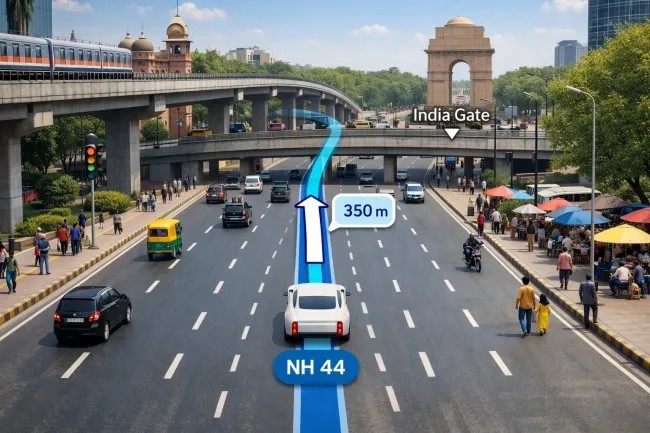
Vivid 3D Views: Buildings, overpasses, bridges, and terrain appear as they actually look in the real world. The gap between your screen and your windshield is dramatically reduced.
Transparent Buildings: If a building is blocking your view of an upcoming turn or road curve, the building becomes translucent on your screen, so you can see the road continuing behind it. No more last-second lane swerves.
Granular Road Detail: The map now clearly displays individual lanes, crosswalks, traffic lights, and stop signs. You know exactly which lane to be in — well before you need to be in it.
Smart Zoom: The camera intelligently zooms in and out based on road complexity. On a highway, it stays wide. Approaching a tricky interchange, it tightens for precision.
Pre-Trip Destination Preview: Before you even start driving, you can preview your destination and surrounding area using Street View imagery. Maps will also recommend where to park and, as you approach, will highlight the building’s entrance and which side of the street it is on.
Real-Time Disruption Alerts: Powered by live community reports — over 10 million daily contributions — the system flags road construction, accidents, and closures along your specific route, not just in your region.
Route Trade-Off Intelligence: Choosing between routes is no longer guesswork. Maps now explains the actual trade-offs: “This route is 6 minutes longer but has no traffic.” “This route is faster but includes a toll.” You make an informed choice, not a blind one.
The voice guidance upgrade is subtler but remarkably important. Instead of the mechanical “In 500 meters, take the exit,” you now hear something human: “Go past this exit and take the next one for Illinois 43 South.” The difference sounds small. Cognitively, while driving in an unfamiliar city at night in the rain, it is enormous.
What powers the visuals? Gemini AI models work continuously behind the scenes, analyzing fresh imagery from Street View cameras and aerial photography to ensure what you see on screen closely matches what is actually outside your window. Landmarks, medians, construction changes — the system updates its visual model from the real world, not just static map data.
The CarPlay and Android Auto angle: Immersive Navigation is confirmed to be expanding to Apple CarPlay, Android Auto, and cars with Google built-in. This matters for business travelers and frequent commuters who live in their cars — high-quality 3D navigation will soon display on in-car screens, not just phones.
The Bigger Picture: Why This Update Is a Strategic Masterstroke
Google is not just improving a navigation app. It is executing a carefully considered strategy to make Maps the default decision-making tool for physical-world choices — where to eat, where to park, what route to take, where to stop on a road trip.
Every query that goes through Ask Maps is a signal. Every recommendation clicked, every reservation booked, every saved place — these are all rich behavioral data points that make the personalization engine smarter and more valuable. The more you use it, the better it gets. The better it gets, the more you use it. That is a powerful flywheel.
For businesses, the implications are significant. Being recommended by Ask Maps — rather than just appearing in a keyword search — is a fundamentally different type of visibility. It means a business isn’t just being found; it is being endorsed by an AI that has read thousands of its reviews, analyzed its photos, assessed its busyness patterns, and matched it to a specific user’s taste profile in real time.
Google Maps VP Miriam Daniel stated that the team’s goal was to remove the guesswork from trips entirely. With Ask Maps and Immersive Navigation working together, they have come remarkably close to that goal.
Availability: Who Gets It and When
Ask Maps: Rolling out now in the United States and India on Android and iOS. Desktop version coming soon.
Immersive Navigation: Rolling out now across the United States on iOS and Android. Expanding over the coming months to CarPlay, Android Auto, and vehicles with Google built-in. India and further global regions to follow.
One Final Thought
Twenty years ago, printed maps were replaced by GPS devices. Ten years ago, standalone GPS units were replaced by smartphone apps. What we are watching now is the next transition: the dumb navigation app being replaced by an intelligent spatial assistant.
Google Maps is no longer just telling you how to get somewhere. It is helping you decide where to go, why to go there, what to expect when you arrive, and how to get in the door — all in one seamless conversation.
The map has always been a mirror of the world. Now, for the first time, it is starting to think about it. Tagged 3D navigation maps, AI navigation app, AI travel planner, Ask Maps, Gemini AI Google Maps, Google Maps 3D view, Google Maps AI features, Google Maps conversational search, Google Maps update, Immersive Navigation, Latest In Google Developemnt, new Google Maps 2026, real-time driving alerts, smart route planning, Technology and Innovation News
