
The recent reports of the Sun’s intense activity and warnings from the Indian Space Research Organisation (ISRO) are related to potential disruptions of satellite communications and navigation systems, not a direct physical danger to people on Earth. The “fierce form” refers to powerful solar flares and coronal mass ejections (CMEs) that disrupt the Earth’s ionosphere, potentially causing a severe radio sun emitting powerful flares since February 1. Will India be affected? The Sun has been emitting powerful solar flares since February 1. The star on Wednesday released a powerful explosion that peaked at 5:43 pm, briefly disrupting radio signals in parts of Africa and Europe. Isro has also warned about their possible impact on India. How worried should we be?
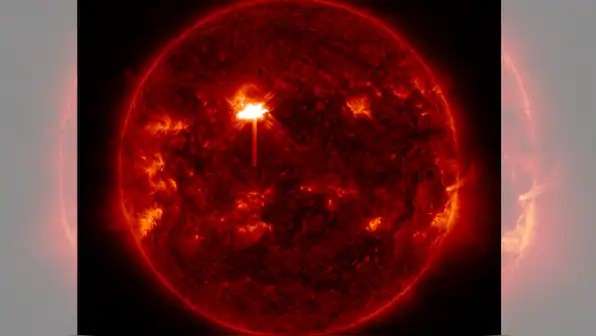
The Sun is shooting solar flares, which are causing radio blackouts on Earth. The hot star unleashed a powerful flare on Wednesday (February 4) that peaked at 7:13 am EST (5:43 pm IST).
As intense radiation entered Earth’s upper atmosphere, radio communications were briefly disrupted across parts of Africa and Europe. The Indian Space Research Organisation (Isro) has also warned about possible radio blackouts.
Let’s take a closer look.
What are solar flares?
The sun is reaching solar maximum: What does this mean? What should the Earth be prepared for?
Solar maximum might arrive in 2024, a year earlier than expected. The sun will reach the peak of its current solar cycle. It can lead to large-scale blackouts and disrupt radio communications across the world. The increased radiation activity can have serious health consequences for astronauts
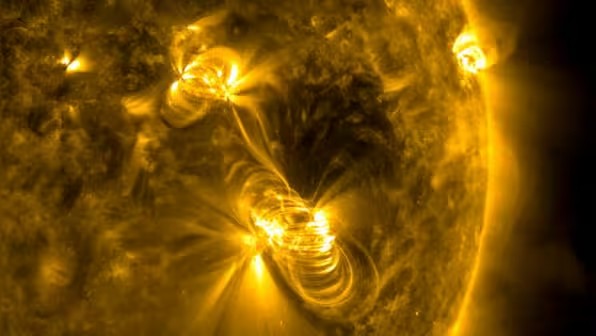
These powerful explosions can reach the Earth in just over eight minutes.
As per Space.com, solar flares are ranked by strength, starting from A, B, C and going up to M and X. Each letter represents a tenfold surge in energy, which means X-class flares are the most powerful explosions the sun generates. The sun is bright, shiny and full of surprises. A lot of activity is going on on the hot star. There have been three notable solar flares and more are expected. There has been an increase in sunspots on its surface. All this means that the sun is approaching a solar maximum. The next solar maximum was predicted to begin in 2025. But now new research shows that the sun may reach the peak of its current cycle in 2024, a year ahead.
What is solar maximum?
Researchers at NASA were baffled when they saw a piece of the Sun, breaking off from its surface and creating a vortex around its North Pole. Scientists are still trying to understand what impact this event will have on Earth, and when.
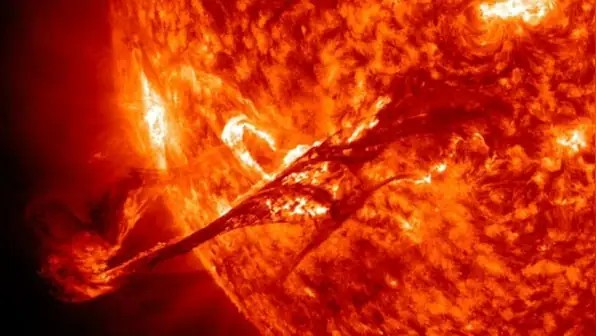
Scientists have been perplexed by a new development on the Sun’s surface. A massive chunk of the Sun’s surface broke off, and formed a tornado-like whirl around its North Pole. Though scientists are still attempting to figure out how this happened, the footage of the event has startled the space community. Space weather forecaster Tamitha Skov shared a video sequence to Twitter late last week that shows a huge filament of solar plasma breaking free from the Sun’s surface.
“Talk about polar vortex! Material from a northern prominence just broke away from the main filament & is now circulating in a massive polar vortex around the north pole of our star,” she tweeted of the footage, taken by NASA’s Solar Dynamics Observatory.
“Over 55° here, the implications for understanding the sun’s atmospheric processes cannot be emphasised!” According to Space.com, this is the first time such a vortex has been spotted, due to the James Webb Space Telescope’s exceptional capabilities. While scientists have seen filaments break out from the Sun before, this is the first time they’ve seen one generate a polar whirlwind. Scott McIntosh, a solar physicist and deputy director of the National Center for Atmospheric Research in Boulder, Colorado, told Space.com that while he’s never seen a vortex like this, he does know that something weird happens once every solar cycle, or 11 years, near the Sun’s 55 degree latitude. According to McIntosh, the most recent prominence is similar to a “hedgerow in the solar plasma” that arises in the same position near the sun’s polar crown every 11 years. The ejection of solar material, sunspots, solar radiation, and solar flares vary over this time period.
“It originates at 55 degrees latitude once every solar cycle and begins to march north to the solar poles,” McIntosh said to Space.com. “It’s pretty strange. It raises a lot of ‘why’ questions. Why does it only migrate towards the pole once before disappearing and reappearing three or four years later in the same region?” The cycle is marked by the increase and decrease of sunspots, visible as dark blemishes on the sun’s surface, according to the National Aeronautics and Space Administration (NASA), the US government agency responsible for the civil space programme and research. A magnetic field is generated by the movement of charged particles in the sun’s interior. This extends beyond the surface, creating a heliosphere, a vast region of space that is influenced by the solar wind. As the sun rotates, the magnetic field lines are tangled, leading to the formation of sunspots, which are dark, cooler regions on its surface. The sun is dying: Here’s how long it has before exhausting its fuel new study has estimated the sun’s evolutionary process will continue for billions of more years before it runs out of its fuel and turns into a red giant. It has revealed the past and future of the sun, how the sun will behave at what stage and when it will enter the dusk of its life. The sun is very likely going through its middle age, a recent study published in June this year by the European Space Agency (ESA), based on the observations from its Gaia spacecraft, has revealed. The ESA’s Gaia telescope has revealed information that could help determine when the sun will die, which was formed around 4.57 billion years ago.
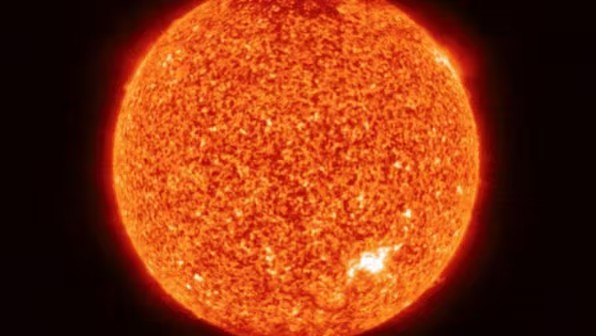
The greatest number of sunspots in any given solar cycle is designated as “solar maximum”. The lowest number is “solar minimum”. But there is more to the solar cycle than just increased sunspots. In the sun’s atmosphere or corona, bright active regions appear, which are rooted in the lower sunspots.
What are solar flares that can reach temperatures up to 100 million degrees?
A single solar flare can have as much energy as 2.5 million nuclear bombs. While most of this energy is dissipated across space, some portion of it can also reach the Earth has been on the receiving end of an increasing number of solar flares and coronal mass ejections as the Sun slowly enter its solar maximum over the next two years during Solar Cycle 25. With reports about possible solar flare impacts emerging nearly every week, the frequency is only set to increase further as the Sun heads into a flurry of increased activity. Solar flares, sun spots, coronal mass ejections, solar storms and other similar events are all set to increase in frequency. What is a solar flare? A solar flare is a burst of explosive force that erupts out of the surface of the Sun. These incredibly potent bursts of radiation are thought to be caused due to the uneven flow of plasma due to different speeds, directions and temperatures. The uneven flow causes the magnetic field on the Sun’s surface to become twisted and bound up. This stores energy akin to an electromagnetic spring. Much like a spring, once too much energy is stored up in the electromagnetic spring they burst with incredible energy all at once. These bursts are what we call solar flares. Solar flares produce electromagnetic radiation across the electromagnetic spectrum at all wavelengths, including the highly dangerous gamma rays. The same release of energy can also result in the release of solar matter in the form of coronal mass ejections. A single solar flare can have as much energy as 2.5 million nuclear bombs and can reach temperatures of up to 100 million degrees. While most of this energy is dissipated across space, some portion of it can also reach the Earth. The Earth’s magnetosphere can repel some of the energy, while the ionising radiation can pass through into the upper parts of the atmosphere (called the ionosphere for this very reason). Particularly powerful solar flares can adversely affect satellites, communication and electronic systems on Earth by increasing the ionization in the atmosphere. Solar flares are classified into five classes according to their strength. A,B,C,M, and X, with A-class solar flares being the weakest and the X-class solar flares being the strongest. Flares also occur on other stars though they are termed stellar flares in such cases. When do they happen? The frequency of solar flares is variable across the 11-year solar cycle that the Sun goes through. During the solar maximum, when the Sun’s magnetic field flips and the Sun’s surface sees the maximum number of solar flares, the solar frequency can be high as 20 per day. While scientists can’t yet predict solar flares with much accuracy, the presence of a large sunspot that is directed toward the Earth suggests a general possibility of a solar flare heading towards the Earth.
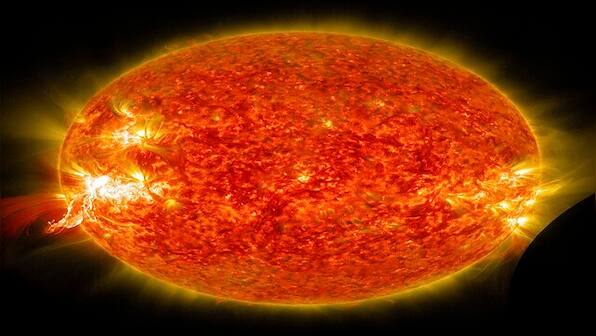
As Sun enters ‘solar cycle 25’, experts foresee below-average solar activity till July 2021 This period of space weather can have some wide-ranging implications for technology on Earth as well as astronaut safety.
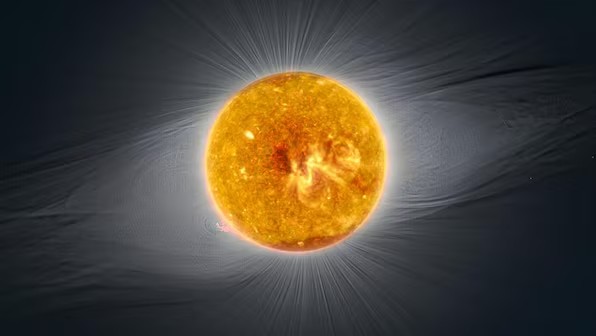
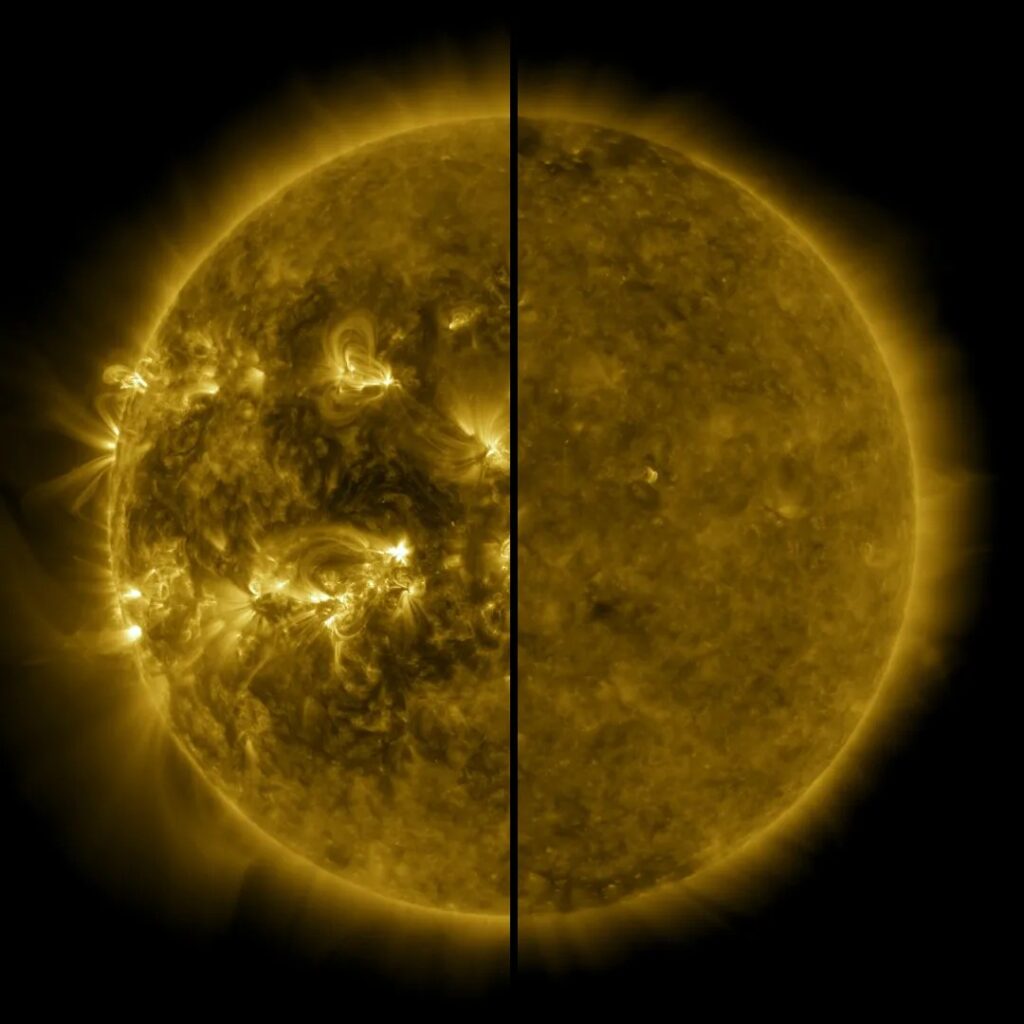
The sun takes eleven years to complete a solar cycle before beginning a new one. The sun has started a new solar cycle, according to National Aeronautics and Space Administration (NASA) – a period of space weather that can have some wide-ranging implications for technology on Earth as well as astronaut safety. According to NASA, the solar minimum (the period between two cycles when the sun is the least active) occurred in December 2019, marking the start of a new solar cycle. Solar Cycle 25 Is Here. NASA, NOAA Scientists Explain What That Means split image shows the difference between an active Sun during solar maximum (on the left, captured in April 2014) and a quiet Sun during solar minimum (on the right, captured in December 2019). December 2019 marks the beginning of Solar Cycle 25, and the Sun’s activity will once again ramp up until solar maximum, predicted for 2025.
Solar Cycle 25 has begun. During a media event on Tuesday, experts from NASA and the National Oceanic and Atmospheric Administration (NOAA) discussed their analysis and predictions about the new solar cycle – and how the coming upswing in space weather will impact our lives and technology on Earth, as well as astronauts in space.
Analysis determines we are in Solar Cycle 25
September 15, 2020 – The solar minimum between Solar Cycle 24 and 25 – the period when the sun is least active – happened in December 2019, when the 13-month smoothed sunspot number fell to 1.8, according to the Solar Cycle 25 Prediction Panel, co-chaired by NOAA and NASA. We are now in Solar Cycle 25 with peak sunspot activity expected in 2025, the panel said.
Solar Cycle 24 was average in length, at 11 years, and had the 4th-smallest intensity since regular record keeping began with Solar Cycle 1 in 1755. It was also the weakest cycle in 100 years. Solar maximum occurred in April 2014 with sunspots peaking at 114 for the solar cycle, well below average, which is 179.
Solar Cycle 24’s progression was unusual. The Sun’s Northern Hemisphere led the sunspot cycle, peaking over two years ahead of the Southern Hemisphere sunspot peak. This resulted in solar maximum having fewer sunspots than if the two hemispheres were in phase.
Solar Cycle 25
For the past eight months, activity on the sun has steadily increased, indicating we transitioned to Solar Cycle 25.
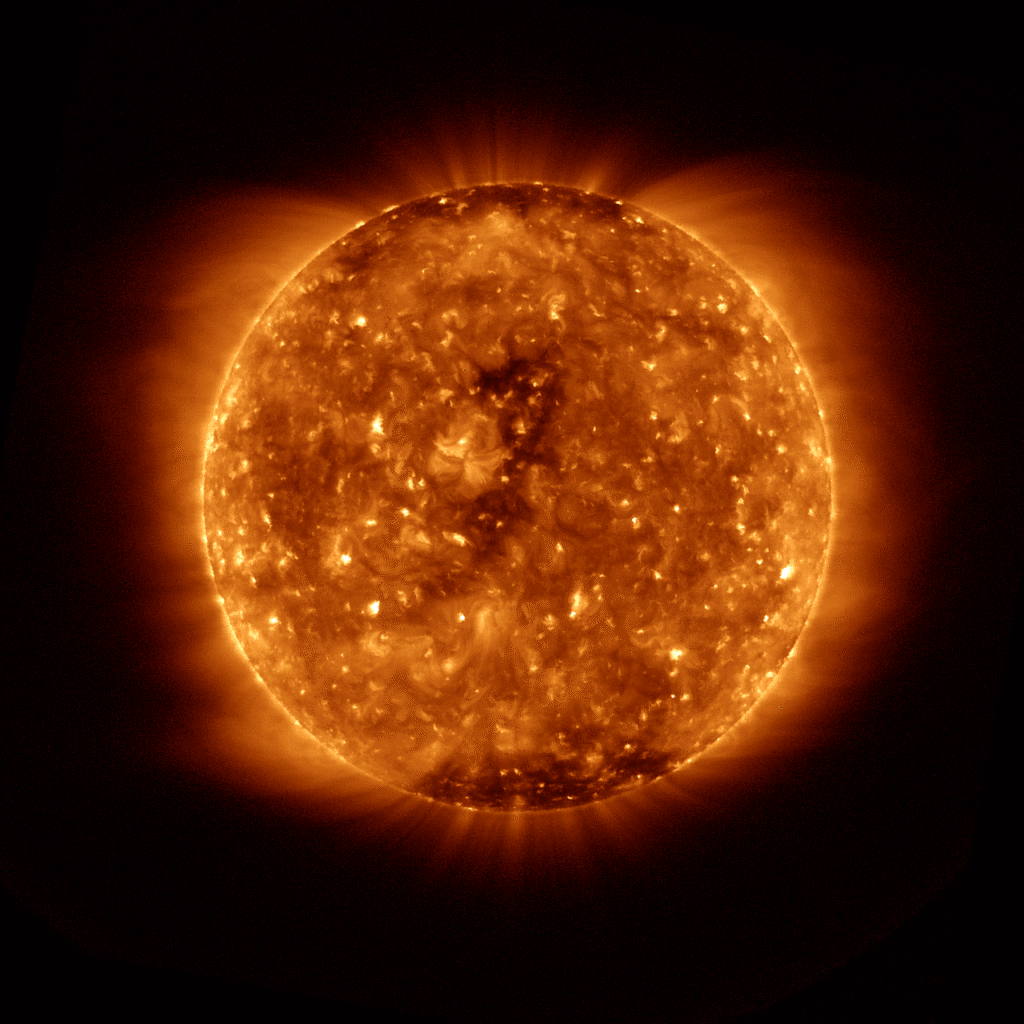
Solar Cycle 25 Forecast Update
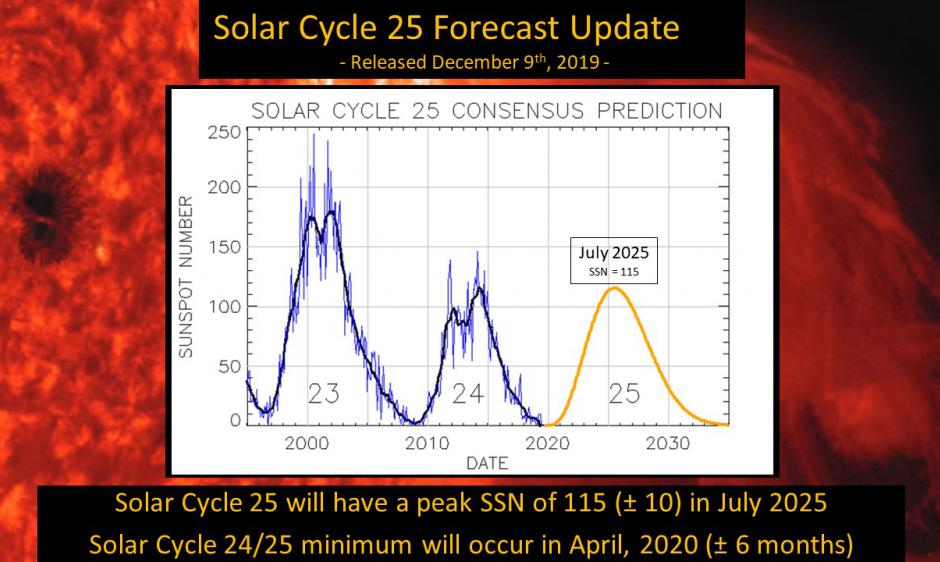
Solar Cycle 25 Forecast Update
The NOAA/NASA co-chaired, international panel to forecast Solar Cycle 25 released their latest forecast for Solar Cycle 25. The forecast consensus: a peak in July, 2025 (+/- 8 months), with a smoothed sunspot number (SSN) of 115. The panel agreed that Cycle 25 will be average in intensity and similar to Cycle 24.
Additionally, the panel concurred that solar minimum between Cycles 24 and 25 will occur in April, 2020 (+/- 6 months). If the solar minimum prediction is correct, this would make Solar Cycle 24 the 7th longest on record (11.4 years). “How quickly solar activity rises is an indicator on how strong the solar cycle will be,” said Doug Biesecker, Ph.D., panel co-chair and a solar physicist at NOAA’s Space Weather Prediction Center. “Although we’ve seen a steady increase in sunspot activity this year, it is slow.”
The panel has high confidence that Solar Cycle 25 will break the trend of weakening solar activity seen over the past four cycles. “We predict the decline in solar cycle amplitude, seen from cycles 21 through 24, has come to an end,” said Lisa Upton, Ph.D., panel co-chair and solar physicist with Space Systems Research Corp. “There is no indication we are approaching a Maunder-type minimum in solar activity.”
“While we are not predicting a particularly active Solar Cycle 25, violent eruptions from the Sun can occur at any time,” Biesecker added.
Space weather: Storms from the Sun Solar storms can disrupt technologies on Earth NOAA issues Alerts, Watches and Warnings from the Sun’s surface can cause space weather storms that affect technology here on Earth. The Sun is the center of the solar system and the most important energy source for life on Earth. From time to time, the Sun emits bursts of radiation, high-speed electrons and protons, and other highly energetic particles into space — phenomena known as space weather. If a large burst is directed at Earth, these particles and radiation can disrupt the technologies we depend upon. These storms have the potential to interfere with radio transmitters, satellite operations and communications, navigation and GPS, and the electric power grid.
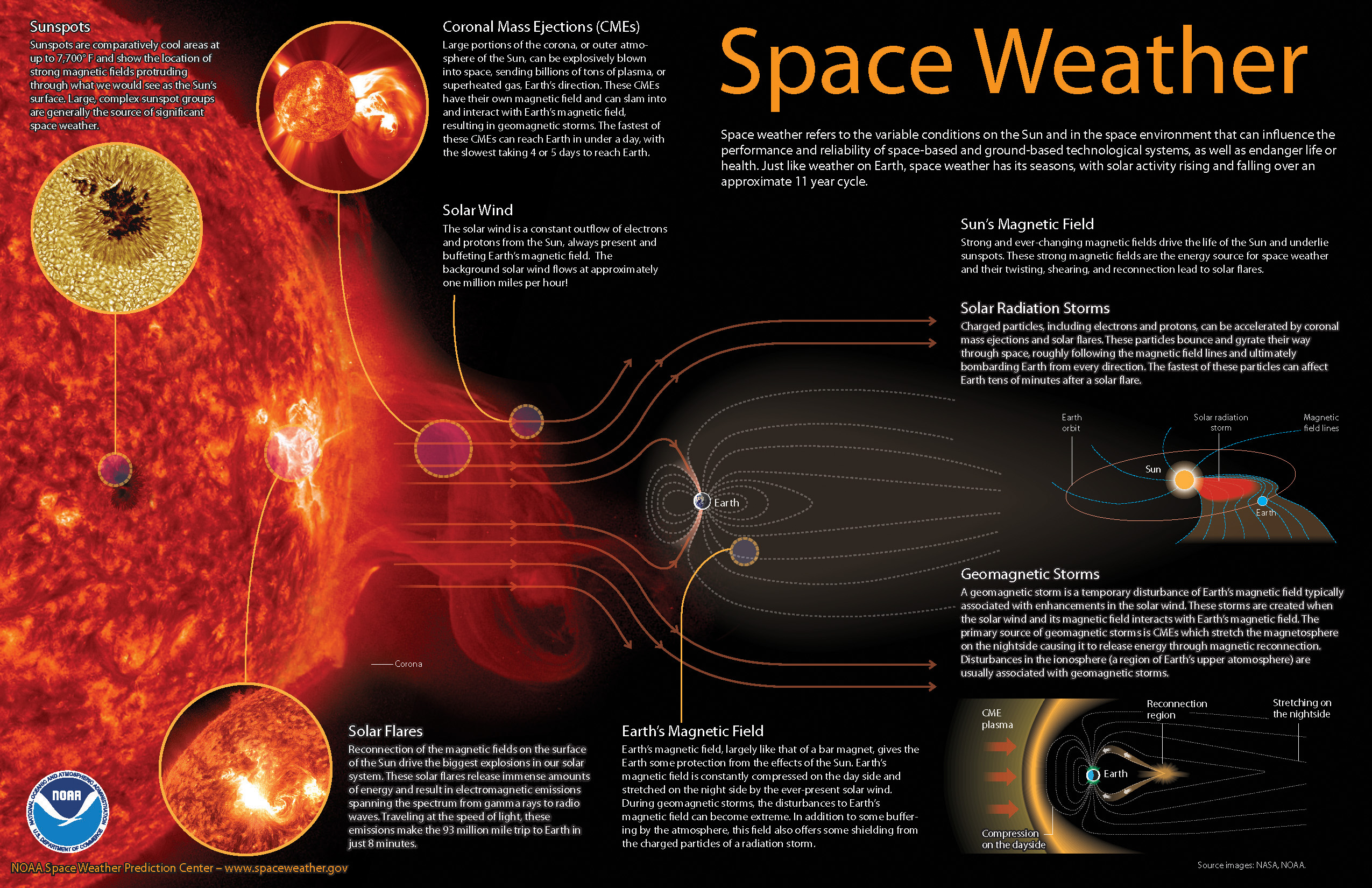
Extreme geomagnetic storms can damage high-voltage power transformers, causing damage that could take days, weeks, or even longer to be repaired, depending on the size of the power grid.
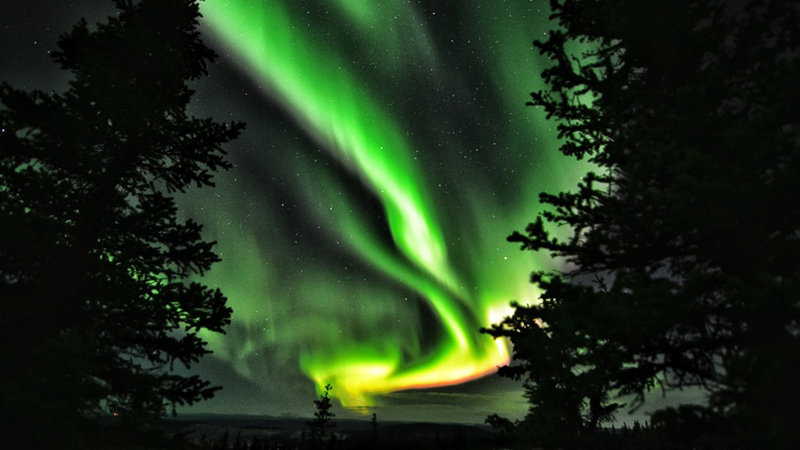
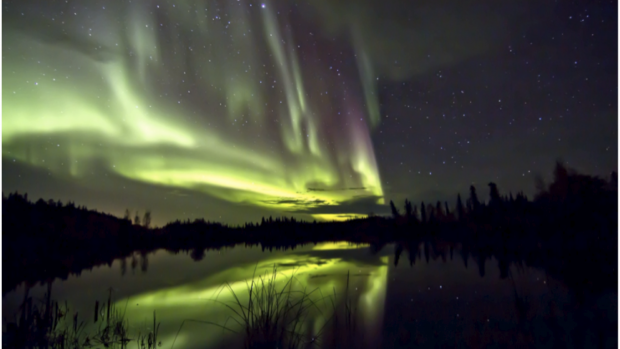
Space weather can also produce spectacular aurora borealis (northern and southern lights). These colorful beams of dancing lights, typically seen moving across the polar skies, are the result of electrons colliding with the upper reaches of the Earth’s atmosphere.
Geomagnetic Storms
Geomagnetic Storms
A geomagnetic storm is a major disturbance of Earth’s magnetosphere that occurs when there is a very efficient exchange of energy from the solar wind into the space environment surrounding Earth. These storms result from variations in the solar wind that produces major changes in the currents, plasmas, and fields in Earth’s magnetosphere. The solar wind conditions that are effective for creating geomagnetic storms are sustained (for several to many hours) periods of high-speed solar wind, and most importantly, a southward directed solar wind magnetic field (opposite the direction of Earth’s field) at the dayside of the magnetosphere. This condition is effective for transferring energy from the solar wind into Earth’s magnetosphere.
The largest storms that result from these conditions are associated with solar coronal mass ejections (CMEs) where a billion tons or so of plasma from the sun, with its embedded magnetic field, arrives at Earth. CMEs typically take several days to arrive at Earth, but have been observed, for some of the most intense storms, to arrive in as short as 18 hours. Another solar wind disturbance that creates conditions favorable to geomagnetic storms is a high-speed solar wind stream (HSS). HSSs plow into the slower solar wind in front and create co-rotating interaction regions, or CIRs. These regions are often related to geomagnetic storms that while less intense than CME storms, often can deposit more energy in Earth’s magnetosphere over a longer interval.
Storms also result in intense currents in the magnetosphere, changes in the radiation belts, and changes in the ionosphere, including heating the ionosphere and upper atmosphere region called the thermosphere. In space, a ring of westward current around Earth produces magnetic disturbances on the ground. A measure of this current, the disturbance storm time (Dst) index, has been used historically to characterize the size of a geomagnetic storm. In addition, there are currents produced in the magnetosphere that follow the magnetic field, called field-aligned currents, and these connect to intense currents in the auroral ionosphere. These auroral currents, called the auroral electrojets, also produce large magnetic disturbances. Together, all of these currents, and the magnetic deviations they produce on the ground, are used to generate a planetary geomagnetic disturbance index called Kp. This index is the basis for one of the three NOAA Space Weather Scales, the Geomagnetic Storm, or G-Scale, that is used to describe space weather that can disrupt systems on Earth.
During storms, the currents in the ionosphere, as well as the energetic particles that precipitate into the ionosphere add energy in the form of heat that can increase the density and distribution of density in the upper atmosphere, causing extra drag on satellites in low-earth orbit. The local heating also creates strong horizontal variations in the in the ionospheric density that can modify the path of radio signals and create errors in the positioning information provided by GPS. While the storms create beautiful aurora, they also can disrupt navigation systems such as the Global Navigation Satellite System (GNSS) and create harmful geomagnetic induced currents (GICs) in the power grid and pipelines.
Aurora – 30 Minute Forecast
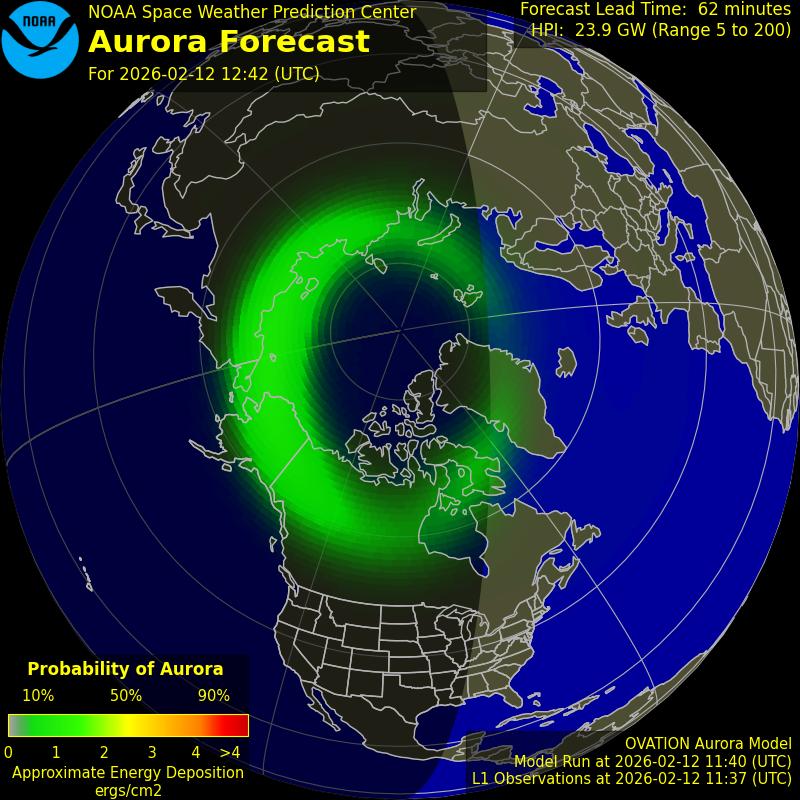
This is a short-term forecast of the location and intensity of the aurora. This product is based on the OVATION model and provides a 30 to 90 minute forecast of the location and intensity of the aurora. The forecast lead time is the time it takes for the solar wind to travel from the L1 observation point to Earth.
The two maps show the North and South poles of Earth respectively. The brightness and location of the aurora is typically shown as a green oval centered on Earth’s magnetic pole. The green ovals turn red when the aurora is forecasted to be more intense. The sunlit side of Earth is indicated by the lighter blue of the ocean and the lighter color of the continents. Aurora can often be observed somewhere on Earth from just after sunset or just before sunrise. The aurora is not visible during daylight hours. The aurora does not need to be directly overhead but can be observed from as much as a 1000 km away when the aurora is bright and if conditions are right.
The aurora is an indicator of the current geomagnetic storm conditions and provides situational awareness for a number of technologies. The aurora directly impacts HF radio communication and GPS/GNSS satellite navigation. It is closely related to the ground-induced currents that impact electric power transmission.
For many people, the aurora is a beautiful nighttime phenomenon that is worth traveling to arctic regions just to observe. It is the only way for most people to actually experience space weather.
Aurora
Aurora
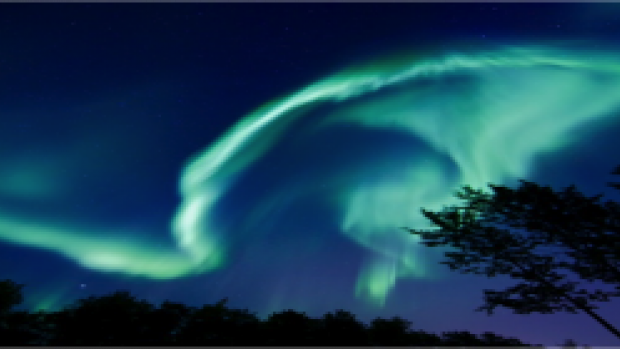
The Aurora Borealis (Northern Lights) and Aurora Australis (Southern Lights) are the result of electrons colliding with the upper reaches of Earth’s atmosphere. (Protons cause faint and diffuse aurora, usually not easily visible to the human eye.) The electrons are energized through acceleration processes in the downwind tail (night side) of the magnetosphere and at lower altitudes along auroral field lines. The accelerated electrons follow the magnetic field of Earth down to the Polar Regions where they collide with oxygen and nitrogen atoms and molecules in Earth’s upper atmosphere. In these collisions, the electrons transfer their energy to the atmosphere thus exciting the atoms and molecules to higher energy states. When they relax back down to lower energy states, they release their energy in the form of light. This is similar to how a neon light works. The aurora typically forms 80 to 500 km above Earth’s surface.
Earth’s magnetic field guides the electrons such that the aurora forms two ovals approximately centered at the magnetic poles. During major geomagnetic storms these ovals expand away from the poles such that aurora can be seen over most of the United States. Aurora comes in several different shapes. Often the auroral forms are made of many tall rays that look much like a curtain made of folds of cloth. During the evening, these rays can form arcs that stretch from horizon to horizon. Late in the evening, near midnight, the arcs often begin to twist and sway, just as if a wind were blowing on the curtains of light. At some point, the arcs may expand to fill the whole sky, moving rapidly and becoming very bright. This is the peak of what is called an auroral substorm.
Then in the early morning the auroral forms can take on a more cloud-like appearance. These diffuse patches often blink on and off repeatedly for hours, then they disappear as the sun rises in the east. The best place to observe the aurora is under an oval shaped region between the north and south latitudes of about 60 and 75 degrees. At these polar latitudes, the aurora can be observed more than half of the nights of a given year.
When space weather activity increases and more frequent and larger storms and substorms occur, the aurora extends equatorward. During large events, the aurora can be observed as far south as the US, Europe, and Asia. During very large events, the aurora can be observed even farther from the poles.
Of course, to observe the aurora, the skies must be clear and free of clouds. It must also be dark so during the summer months at auroral latitudes, the midnight sun prevents auroral observations.
Of course, to observe the aurora, the skies must be clear and free of clouds. It must also be dark so during the summer months at auroral latitudes, the midnight sun prevents auroral observations.
Tips on Viewing the Aurora
Tips on Viewing Aurora:
Viewing the aurora depends on four important factors
- Geomagnetic Activity: If the geomagnetic field is active, then the aurora will be brighter and further from the poles. Geomagnetic activity is driven by solar activity and solar coronal holes and thus it waxes and wanes with time. The level of geomagnetic activity is indicated by the planetary K index or Kp. The Kp index ranges from 0 to 9.
- For Kp in the range 0 to 2, the aurora will be far north, quite dim in intensity, and not very active.
- For Kp in the range of 3 to 5, the aurora will move further from the poles, it will become brighter and there will be more auroral activity (motion and formations). If you are in the right place, these aurora can be quite pleasing to look at.
- For Kp in the range 6 to 7, the aurora will move even further from the poles and will become quite bright and active. At this geomagnetic activity level, it might be possible to see the aurora from the northern edge of the United States.
- For Kp in the range 8 to 9, the aurora will move even further towards the equator and it will become very bright and very active. These are the events that create the best aurora and the extended auroral oval will be observable by the most people. At these levels, aurora may be seen directly overhead from the northern states of the USA.
- Location: Go towards the magnetic poles. The north magnetic pole is currently about 400 km (250 miles) from the geographic pole and is located in the islands of north east Canada. Find a place where you can see to the north ( or south if you are in the southern hemisphere). Given the right vantage point, say for example on top of a hill in the northern hemisphere with an unobstructed view toward the north, a person can see aurora even when it is 1000 km (600 miles) further north. It should be noted that if you are in the right place under the aurora, you can see very nice auroral displays even with low geomagnetic activity (Kp = 3 or 4).
- It must be dark: Go out at night. Get away from city lights. The full moon will also diminish the apparent brightness of the aurora (not the actual brightness). One caveat that people often neglect to think of is that the high latitudes where aurora occur are also latitudes where it doesn’t get dark in the summer. So combining a summer vacation to the arctic with aurora watching usually doesn’t work. The aurora may still be there but it is only visible when it is dark.
- Timing: Best aurora is usually within an hour or two of midnight (between 10 PM and 2 AM local time). These hours of active aurora expand towards evening and morning as the level of geomagnetic activity increases. There may be aurora in the evening and morning but it is usually not as active and therefore, not as visually appealing.The best Seasons for aurora watching are around the spring and fall equinoxes. Due to subtleties in the way the solar wind interacts with Earth’s magnetosphere, there is a tendency towards larger geomagnetic storms, and thus better auroras, to occur near the equinoxes. However, the number of hours of darkness decreases (increases) rapidly near the spring (fall) equinox so this caveat must be considered for those traveling to see the aurora.
Below are maps showing the most southern extent of where aurora might be observable for different levels of the geomagnetic Kp index (and the NOAA G scale). It should be noted that the aurora can often be observed hundreds of kilometers (miles) equatorward of the actual aurora so these figures do not indicate where the aurora may be but rather the point from which it may be observed.
Solar Flares (Radio Blackouts)
Solar Flares (Radio Blackouts)
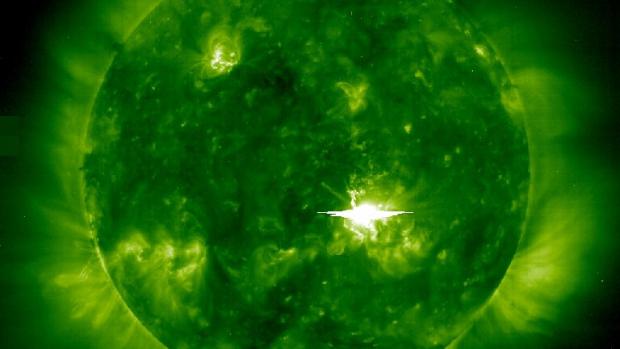
Solar flares are large eruptions of electromagnetic radiation from the Sun lasting from minutes to hours. The sudden outburst of electromagnetic energy travels at the speed of light, therefore any effect upon the sunlit side of Earth’s exposed outer atmosphere occurs at the same time the event is observed.
Ionosphere
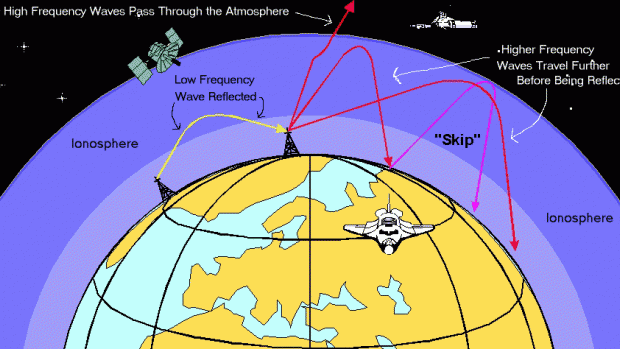
Ionosphere
The Ionosphere is part of Earth’s upper atmosphere, between 80 and about 600 km where Extreme UltraViolet (EUV) and x-ray solar radiation ionizes the atoms and molecules thus creating a layer of electrons. the ionosphere is important because it reflects and modifies radio waves used for communication and navigation. Other phenomena such as energetic charged particles and cosmic rays also have an ionizing effect and can contribute to the ionosphere.
The atmospheric atoms and molecules are impacted by the high energy the EUV and X-ray photons from the sun. The amount of energy (photon flux) at EUV and x-ray wavelengths varies by nearly a factor of ten over the 11 year solar cycle. The density of the ionosphere changes accordingly. Due to spectral variability of the solar radiation and the density of various constituents in the atmosphere, there are layers are created within the ionosphere, called the D, E, and F-layers. Other solar phenomena, such as flares, and changes in the solar wind and geomagnetic storms also effect the charging of the ionosphere. Since the largest amount of ionization is caused by solar irradiance, the night-side of the earth, and the pole pointed away from the sun (depending on the season) have much less ionization than the day-side of the earth, and the pole pointing towards the sun.
Impacts
Radio Communication
Radio Navigation (GPS)
Satellite Communication
D Region Absorption Predictions (D-RAP)
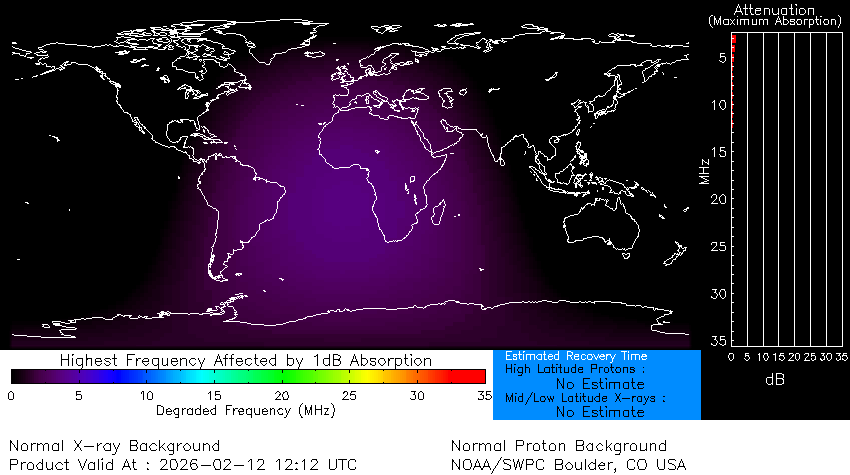
The D-Region Absorption Product addresses the operational impact of the solar X-ray flux and SEP events on HF radio communication. Long-range communications using high frequency (HF) radio waves (3 – 30 MHz) depend on reflection of the signals in the ionosphere. Radio waves are typically reflected near the peak of the F2 layer (~300 km altitude), but along the path to the F2 peak and back the radio wave signal suffers attenuation due to absorption by the intervening ionosphere.
The D-Region Absorption Prediction model is used as guidance to understand the HF radio degradation and blackouts this can cause.
Sunspots/Solar Cycle
Sunspots/Solar Cycle
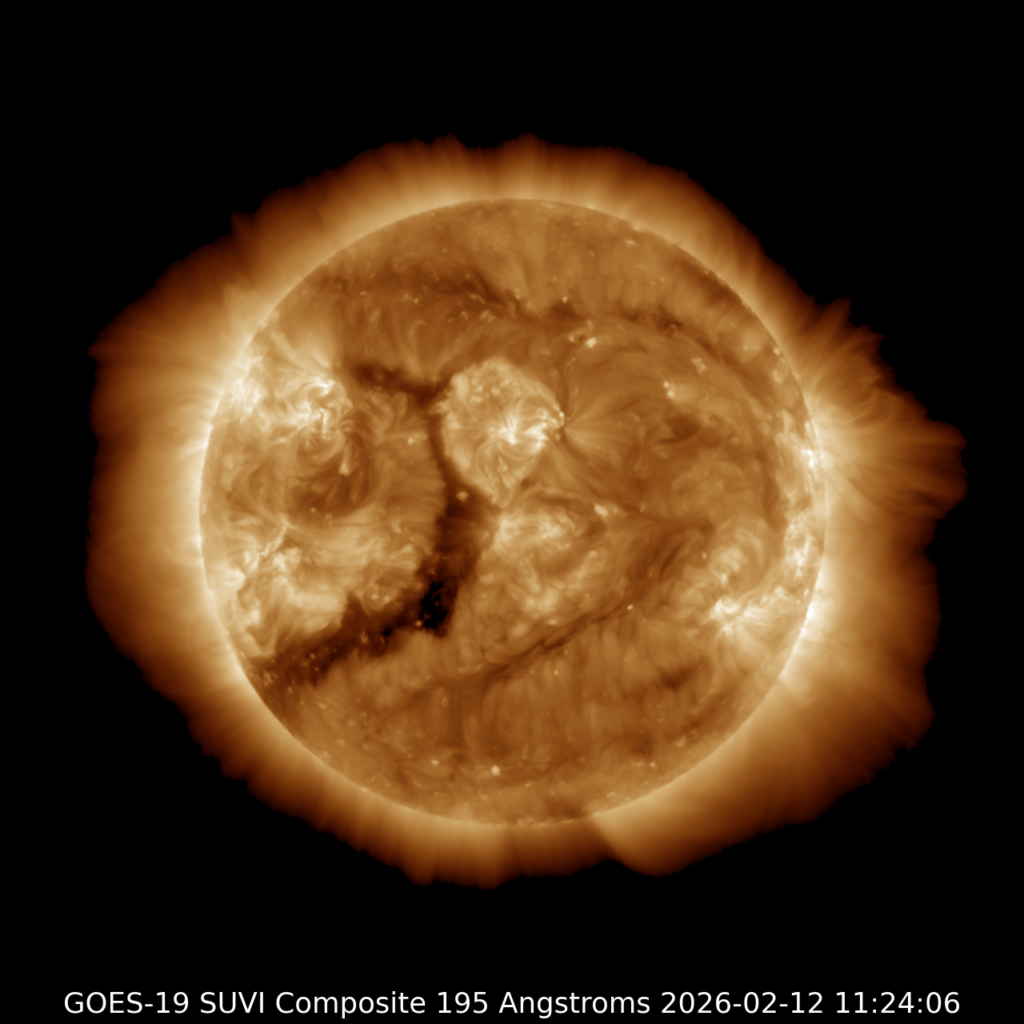
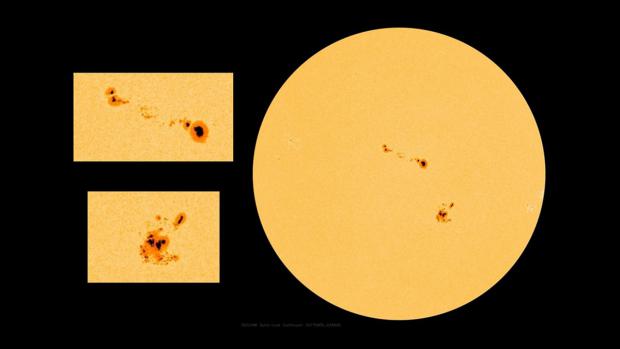
Sunspots are dark areas that become apparent at the Sun’s photosphere as a result of intense magnetic flux pushing up from further within the solar interior. Areas along this magnetic flux in the upper photosphere and chromosphere heat up, and usually become visible as faculae and plage – often times termed active regions. This causes cooler (7000 F), less dense and darker areas at the heart of these magnetic fields than in the surrounding photosphere (10,000 F) – seen as sunspots. Active regions associated with sunspot groups are usually visible as bright enhancements in the corona at EUV and X-ray wavelengths. Rapid changes in the magnetic field alignment of sunspot groups’ associated active regions are the most likely sources of significant space weather events such as solar flares, CMEs, radiations storms, and radio bursts.
Sunspots appear in a wide variety of shapes and forms. The darkest area of a sunspot (also the first to be observed) is called the umbrae. As the sunspot matures (becomes more intense), a less dark, outlying area of well-defined fibril-like structure develops around the umbrae – called penumbra. Sunspots can grow from an individual unipolar spot into more organized bipolar spot groups; or even evolve into immense, very complex sunspot groups with mixed magnetic polarities throughout the group. The largest sunspot groups can cover large swaths of the Sun’s surface and be many times the size of Earth.
Sunspot groups that are clearly visible and observed by designated ground-based observatories, are assigned a NOAA/SWPC 4-digit region number to officially record and track the sunspot group as it rotates across the visible solar disk. Sunspot groups are analyzed and characterized based on their size and complexity by SWPC forecasters each day using the modified Zurich classification scale and Mount Wilson magnetic classification system. Sunspots can change continuously and may last for only a few hours to days; or even months for the more intense groups. The total number of sunspots has long been known to vary with an approximately 11-year repetition known as the solar cycle. The peak of sunspot activity is known as solar maximum and the lull is known as solar minimum. Solar cycles started being assigned consecutive numbers. This number assignment began with solar cycle 1 in 1755 and the most recent being cycle 24 – which began in December, 2008 and is now nearing solar minimum. A new solar cycle is considered to have begun when sunspot groups emerge at higher latitudes with the magnetic polarities of the leading spots opposite that of the previous cycle.
F10.7 cm Radio Emissions
F10.7 cm Radio Emissions
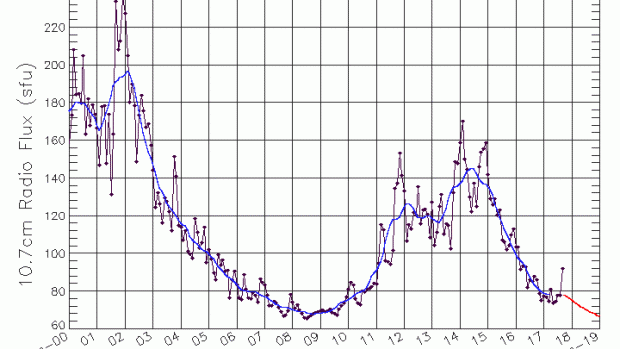
The solar radio flux at 10.7 cm (2800 MHz) is an excellent indicator of solar activity. Often called the F10.7 index, it is one of the longest running records of solar activity. The F10.7 radio emissions originates high in the chromosphere and low in the corona of the solar atmosphere. The F10.7 correlates well with the sunspot number as well as a number of UltraViolet (UV) and visible solar irradiance records. The F10.7 has been measured consistently in Canada since 1947, first at Ottawa, Ontario; and then at the Penticton Radio Observatory in British Columbia, Canada. Unlike many solar indices, the F10.7 radio flux can easily be measured reliably on a day-to-day basis from the Earth’s surface, in all types of weather. Reported in “solar flux units”, (s.f.u.), the F10.7 can vary from below 50 s.f.u., to above 300 s.f.u., over the course of a solar cycle. These F10.7 measurements are provided courtesy of the National Research Council Canada in partnership with the Natural Resources Canada.
The figure above shows the monthly-averaged F10.7 index from Natural Resources Canada (black line) between the years 2000 and 2019 (the year is indicated by the labels on the horizontal axis). The blue line shows the same data smoothed over a period of 13 months. One s.f.u. is defined as 10-22 W m-2 Hz-1.
The F10.7 Index has proven very valuable in specifying and forecasting space weather. Because it is a long record, it provides climatology of solar activity over six solar cycles. Because it comes from the chromosphere and corona of the sun, it tracks other important emissions that form in the same regions of the solar atmosphere. The Extreme UltraViolet (EUV) emissions that impact the ionosphere and modify the upper atmosphere track well with the F10.7 index. Many Ultra-Violet emissions that affect the stratosphere and ozone also correlate with the F10.7 index. And because this measurement can be made reliably and accurately from the ground in all weather conditions, it is a very robust data set with few gaps or calibration issues. The figure above shows the monthly-averaged F10.7 index from Natural Resources Canada (black line) between the years 2000 and 2019 (the year is indicated by the labels on the horizontal axis). The blue line shows the same data smoothed over a period of 13 months. One s.f.u. is defined as 10-22 W m-2 Hz-1.
The F10.7 Index has proven very valuable in specifying and forecasting space weather. Because it is a long record, it provides climatology of solar activity over six solar cycles. Because it comes from the chromosphere and corona of the sun, it tracks other important emissions that form in the same regions of the solar atmosphere. The Extreme UltraViolet (EUV) emissions that impact the ionosphere and modify the upper atmosphere track well with the F10.7 index. Many Ultra-Violet emissions that affect the stratosphere and ozone also correlate with the F10.7 index. And because this measurement can be made reliably and accurately from the ground in all weather conditions, it is a very robust data set with few gaps or calibration issues. The predicted progression for the current solar cycle (Cycle 25) is given by the magenta line, with associated uncertainties shown by the shaded regions. This prediction is based on a nonlinear curve fit to the observed monthly values for the sunspot number and F10.7 Radio Flux and is updated every month as more observations become available. The shaded regions show the uncertainty in the prediction, obtained by applying the same prediction method to previous cycles at the same stage in each cycle. In particular, the three shades show the first three quartiles (25, 50, and 75%) of the deviations from previous predictions.
This should be interpreted as follows. There is roughly a 25% chance that the smoothed sunspot number will fall within the darkest shaded region at a particular time in the future. Similarly, there is a 50% chance the smoothed sunspot number will fall in the medium-shaded region and a 75% chance it will fall in the lightest of the shaded regions.
These plots, like many on the SWPC website, are interactive.
- Mousing your cursor over the plots will display the data values applicable to the date the cursor is over.
- Left clicking on the data and holding while you drag will define a zoom window.
- Use the buttons above each plot to return to the default zoom showing the current cycle or to show the entire available data set.
- There is also an option to toggle the solar cycle numbering on/off.
- Beneath each main plot window, the entire time series is shown and you can click/hold on either side of the blue shaded region to expand or contract the zoom window or if you click/hold on the blue shaded region itself, you can slide it to anywhere in the time series.
- A drop down menu above and to the right of each plot allows you to PRINT, or download PNG, PDF, or SVG format images of the associated plot
- Another drop down menu in the lower left to allows the user to plot the prediction made for Solar Cycle 25 by an international NOAA/NASA/ISES Panel in 2019, as well as the stated uncertainty in this prediction.
Note that both the updated prediction and the 2019 NOAA/NASA/ISES Panel prediction apply only to Solar Cycle 25. Solar Cycle 26 is expected to begin some time between January 2029 and December 2032. We do not yet produce a prediction for Solar Cycle 26.
Solar cycle predictions are used by various agencies and many industry groups. The solar cycle is important for determining the lifetime of satellites in low-Earth orbit, as the drag on the satellites correlates with the solar cycle, especially as represented by F10.7cm. A higher solar maximum decreases satellite life and a lower solar maximum extends satellite life. Also, the prediction gives a rough idea of the frequency of space weather storms of all types, from radio blackouts to geomagnetic storms to radiation storms, so is used by many industries to gauge the expected impact of space weather in the coming years.
SILSO
Sunspot number series: latest update
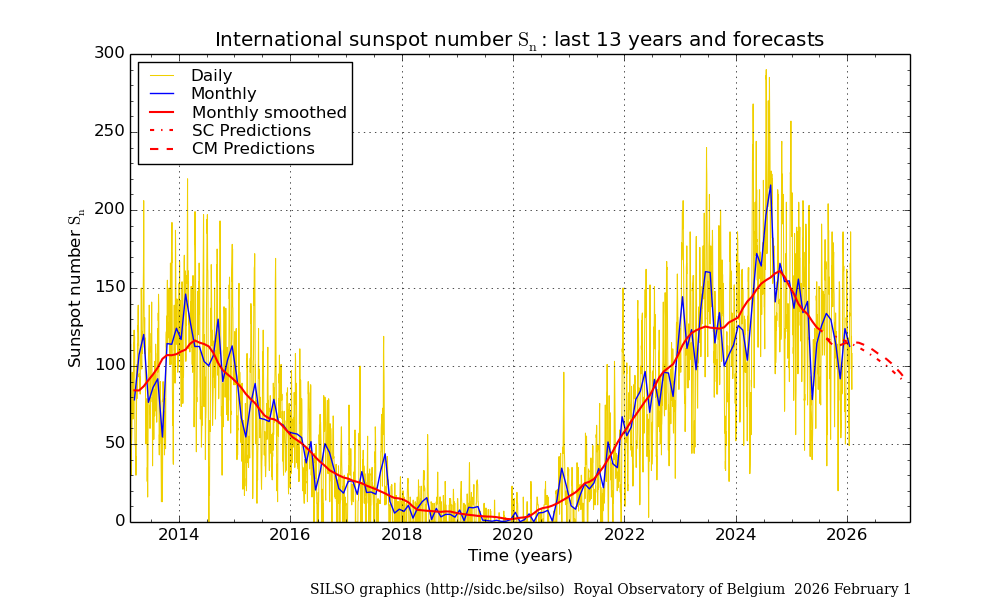
The Sun has been very active during the last few months. Since April 2024, many large and complex sunspot groups have adorned the solar disk driving the daily sunspot number regularly to well above 250. These active regions often were the source of strong solar flares, and the associated solar eruptions -if earth-directed- eventually would rattle the Earth’s magnetic field. The majestic aurorae thus created were sometimes visible from countries further away from the polar regions, such as in May this year when the colorful display was also visible from Belgium.
