
Qualcomm Technologies, Inc. (QTI) is a primary subsidiary of Qualcomm Incorporated that handles nearly all of the company’s engineering, research and development, and product and service businesses. While the parent company, Qualcomm Inc., manages the extensive patent portfolio and licensing business (QTL), Qualcomm Technologies operates the QCT semiconductor division, which produces well-known brands like Snapdragon. Intelligent computing everywhere leading-edge AI, high performance, lower-power computing, and unrivaled connectivity is foundational to innovation, sparking digital transformation across major industries and catalyzing business growth.
Our Vision
Qualcomm is the company bringing data processing and intelligence to the edge, enabling cloud edge convergence. We will drive the transformation of industries and growth of the digital economy by powering the billions of smart connected devices at the edge, utilizing our One Technology Roadmap, with leadership in wireless connectivity, high performance, low power computing, and on device AI.
Mobile
We enable powerful functionality for the world’s smartest phones. Snapdragon® mobile platforms are at the center of extraordinary experiences, including ultra-fast 5G and Wi-Fi connectivity, professional-quality image and video capture, desktop-level gaming, AI-accelerated capabilities, and much more. We are the leading processor brand for premium Android smartphones1.

Internet of Things
We continue to drive innovation and opportunities across the IoT through our extensive portfolio of technologies and solutions. In consumer IoT, we’re enabling next-generation experiences across PCs, XR devices, wearables, and consumer electronics. For industrial IoT, we’re helping our customers accelerate their digital transformation strategies to transform, optimize, and innovate their businesses by delivering end-to-end, ready-to-deploy solutions. Our Edge Networking IoT solutions provide the foundation to connect an ever-increasing number of devices with innovations across the modern 5G network, 5G wireless fiber, and high-performance Wi-Fi access points.

Automotive
Vehicles are being redefined for the 21st century. Our in-car experience is changing with cloud connectivity, the move to electrification, advanced driver assistance and path to autonomy, new mobility services, and intelligent transportation systems. We are working with all leading automakers to accelerate the digital transformation of automotive. The Snapdragon® Digital Chassis is powering a new era of connected and intelligent vehicles. This comprehensive, open, and upgradeable solution meets evolving industry and consumer demand for premium multimedia, new services and applications, and greater safety.
Technology Licensing
Qualcomm’s inclusive, flexible, and transparent licensing program makes our fundamental technology inventions broadly available to the ecosystem. This reduces barriers to entry, fosters greater competition, and empowers companies to create innovative products and solutions that transform industries and experiences, and enrich lives around the world. Qualcomm Technology Licensing supports significant activities that help both licensees and the mobile ecosystem grow. We achieve this by working with industry, academic, and public partners around the world to create a globe-spanning network of technology innovation leadership.
Core Business Divisions
- QCT (Qualcomm CDMA Technologies): The largest segment, developing integrated circuits and system software for mobile devices, automotive, and IoT.
- QSI (Qualcomm Strategic Initiatives): Focuses on strategic investments in early-stage tech companies across AI, 5G, and automotive sectors.
Qualcomm is advancing its position in the telecommunications sector through a collaboration with Ericsson for 6G development. Despite this progress, the company faces challenges with declining earnings estimates and underperformance in its stock price compared to the industry.
- Previous Close142.36
- Open137.52
- Bid133.37 x 100
- Ask147.88 x 100
- Day’s Range136.89 – 141.28
- 52 Week Range120.80 – 205.95
- Volume5,038,610
- Avg. Volume9,538,881
- Market Cap (intraday)150.397B
- Beta (5Y Monthly)1.24
- PE Ratio (TTM)28.45
- EPS (TTM)4.95
- Earnings Date (est.)Apr 29, 2026
- Forward Dividend & Yield3.56 (2.50%)
- Ex-Dividend DateMar 5, 2026
- 1y Target Est161.04
Major Product Platforms
- Snapdragon: The flagship mobile platform powering premium Android smartphones. Recent expansions include the Snapdragon X series for Windows PCs and the Snapdragon Wear Elite for AI-capable wearables.
- Qualcomm Dragonwing: A suite of platforms for networking and industrial IoT, including the newly debuted Wi-Fi 8 portfolio.
- Snapdragon Digital Chassis: An open and upgradeable solution for automakers, providing technology for digital cockpits and automated driving.
Innovation starts with Qualcomm® products.
Qualcomm is enabling a world where everyone and everything can be intelligently connected.
As the world’s leading wireless technology innovator, we continue to push the boundaries of what’s possible across devices and networks to enable next-generation experiences and drive digital transformation.
We deliver breakthroughs in 5G, Wi-Fi and AI. But that’s just the beginning. We design platforms, chipsets, software, tools, and services that help OEMs and developers bring those technologies into products and create experiences that change how we live and work. And we do this at scale, building technologically advanced, in-demand end products that support everything from low- to high-complexity devices, helping us serve virtually every industry at the connected intelligent edge.
Qualcomm® Platforms
Our one technology roadmap allows us to efficiently scale our leading portfolio of mobile innovations to help you commercialize your next great product.
Whether you’re building a mobile phone or laptop, VR device, robot or Wi-Fi routers, Qualcomm Technologies’ purpose-built platforms help you build your next product and get it to launch efficiently. This connected, whole-system approach provides our customers with a competitive advantage by streamlining the engineering process and enabling development of intelligently connected experiences.
All Qualcomm® Products
We invent foundational technologies that are designed to make your inventions possible. Our product catalog includes processors, modems, RF systems, 5G, 4G and legacy connectivity solutions, and optimized software—everything you need to build premium wireless products and applications.
Qualcomm® Products by Technology

5G
All components of our 5G mobile platforms are designed to work together to deliver high cellular speeds, superior coverage, and outstanding power efficiency in sleek form factors.
Artificial Intelligence
Our Qualcomm® Artificial Intelligence (AI) Engine along with our AI software and hardware development tools help developers create and accelerate their AI applications and devices.
Qualcomm® Products by Type

Bluetooth
Our portfolio of Bluetooth technologies enables a wide range of low-energy applications, including wearables, smart audio, and smart home products.
Modem-RF systems
Our modem-RF systems, LTE modems and RF products are designed to maximize performance for the 5G era, delivering unprecedented speeds and advanced mobility.
Processors
Our processors deliver best-in-class security, AI, and connectivity solutions.
Wi-Fi
Deliver blazing fast speed and massive capacity with our Wi-Fi 6, 6E, and 7 products.
Qualcomm® Products by Application

Audio
Deliver high-fidelity audio and crystal-clear acoustics with our smart audio technology.
Automotive
Create innovative automotive solutions that support the latest industry trends.
Cameras
Our camera solutions combine powerful image-processing and AI with machine learning.
Industrial & Commercial
Our IoT solutions transform industries with our 4G and 5G computing and connectivity solutions.
Laptops
Build Always On, Always Connected PCs (ACPCs) laptops that enhance productivity and entertainment.
Wireless Networks
Keep up with the demand of the connected lifestyle with our premium wireless network solutions.
Smartphones
Build industry-leading smartphones and in-demand apps with incredible connectivity and speeds.
Smart Cities
Our smart city solutions enable intelligent network connectivity and edge processing solutions.
Smart Homes
Develop secure, low-power, end-to-end solutions for a wide range of smart home devices.
Major Product Platforms
- Snapdragon: The flagship mobile platform powering premium Android smartphones. Recent expansions include the Snapdragon X series for Windows PCs and the Snapdragon Wear Elite for AI-capable wearables.
- Qualcomm Dragonwing: A suite of platforms for networking and industrial IoT, including the newly debuted Wi-Fi 8 portfolio.
- Snapdragon Digital Chassis: An open and upgradeable solution for automakers, providing technology for digital cockpits and automated driving.
Qualcomm Debuts AI-Native Wi‑Fi 8 Portfolio Unifying Client and Network Connectivity for AI Era Performance

Highlights:
- Qualcomm Technologies unveils Wi-Fi 8 portfolio, laying a connectivity foundation for AI era performance spanning mobile devices, access points, and gateways.
- Qualcomm FastConnect 8800 is the first mobile connectivity system to offer a 4×4 radio configuration enabling 10+ Gbps peak speeds1 and up to three times the gigabit range of previous generations2.
- Five new Qualcomm Dragonwing Networking Infrastructure platforms will deliver today’s most comprehensive and scalable Wi-Fi 8 networking portfolio, featuring on-device AI compute, high-performance processing, and integrated 5G and Fiber broadband.
- Leading global partners are committed to commercial deployments of Qualcomm Technologies’ Wi-Fi 8 solutions.
Qualcomm Technologies, Inc. today announced its industry-leading Wi-Fi 8 portfolio, a key step toward building the connectivity foundation for the AI era. The comprehensive portfolio features the Qualcomm® FastConnect™ 8800 Mobile Connectivity System and five new Qualcomm Dragonwing™ Networking Platforms. Each is engineered to deliver the connectivity and compute performance required to anchor a new generation of products, leveraging unparalleled intelligence with breakthrough architecture for today’s AI demand realities.
“Today’s network traffic profile is fundamentally changing as AI-fueled demand requires a re-thinking of the core architecture. Qualcomm Technologies is redefining that architecture to enable AI everywhere,” said Gautam Sheoran, Senior Vice President and General Manager, Connectivity, Broadband and Networking, Qualcomm Technologies, Inc. “Next-gen networks and devices not only need to be AI-native, but they need a new breed of intelligent, high performance connectivity. Qualcomm Technologies’ Wi-Fi 8 generation of products is the whole package: faster speeds, higher reliability, longer range, and powerful AI.”
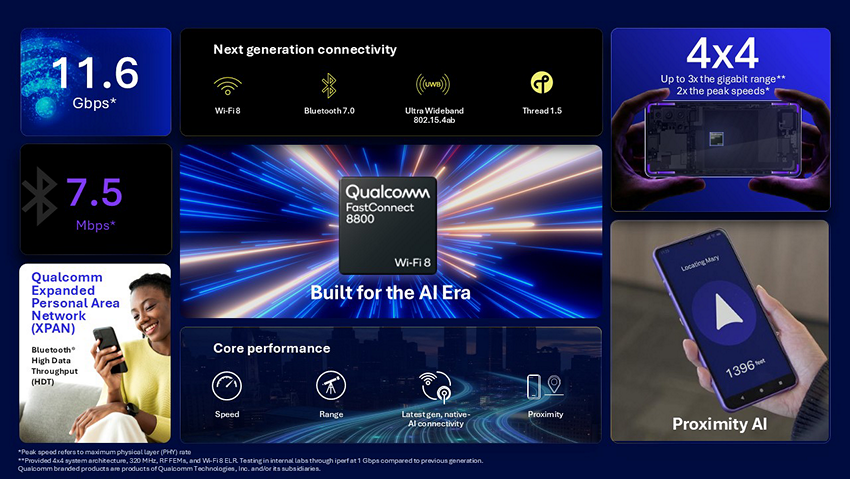
Qualcomm® Fast connect™ 8800 Mobile Connectivity System FastConnect8800 Next‑generation Wi‑Fi 8, Bluetooth® 7 wireless technology, Ultra Wideband (UWB), and Thread mobile connectivity system for the fastest peak speeds¹ ³, up to 3× longer gigabit range², and seamless proximity experiences.
FastConnect 8800 is designed to bring unmatched speeds and range for the agentic AI era.
This delivers up to twice the performance of our previous Wi-Fi 7 generation and up to three times the gigabit wireless range2. In addition, through Bluetooth High Data Throughput (HDT), Bluetooth speeds are also greatly increased from 2 Mbps to 7.5 Mbps.
FastConnect 8800 is also the only mobile connectivity system to offer Wi-Fi 8, Bluetooth 7.0, Ultra Wideband 802.15.4ab, and Thread 1.5 in a single chip solution3. The system also features Proximity AI, utilizing UWB, Bluetooth Channel Sounding, Wi-Fi Ranging and other sensing technologies for accurate tracking down to centimeter accuracy. FastConnect 8800 is not only going to revolutionize smartphone connectivity, it will also benefit other form factors and industries including tablets, laptops, robotics, and more.
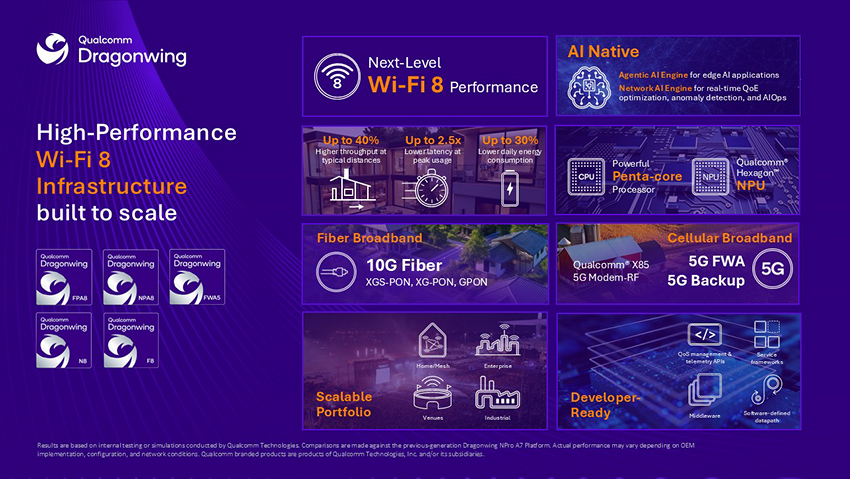
Qualcomm Technologies’ Wi-Fi 8 Dragonwing Networking Platforms establish a new class of networking infrastructure that elevates routers, broadband gateways and enterprise access points into AI-native systems with intelligent, high-performance wireless networking. The portfolio includes:
Elevate wireless networking with ultra-reliable Wi-Fi 8 performance and advanced edge intelligence.
The Dragonwing NPro A8 Elite Platform is Qualcomm Technologies’ most advanced Wi‑Fi 8 infrastructure solution, bringing together superior compute and native edge AI to support low‑latency, high‑capacity connectivity across home and enterprise deployments.
Purpose‑built for high‑performance enterprise access points and premium home routers, the Dragonwing NPro A8 Elite Platform pairs Wi‑Fi 8 with on‑device AI processing to excel in dense, demanding environments. Its penta‑core CPU, NPU‑based AI compute, and integrated Network AI Engine enable agentic AI at the edge while powering real‑time network intelligence and adaptive optimization. The Dragonwing NPro A8 Elite features a 5×5 Wi-Fi 8 radio system that increases throughput by up to 40% at typical distances, reduces latency by 2.5X during peak usage, while leveraging intelligent power optimization modes that sip up to 30% less energy per day – all compared to previous generation platforms4. A purpose-built platform for high-performance enterprise access points and premium home routers, the Dragonwing NPro A8 Elite is a compute powerhouse, featuring a next-gen penta‑core CPU, an integrated Qualcomm® Hexagon™ NPU enabling agentic AI at the edge, as well as cutting-edge network acceleration capabilities.
Premium fiber gateway platform with Wi‑Fi 8 and integrated edge intelligence.
The Dragonwing FiberPro A8 Elite Platform is a premium fiber broadband gateway solution designed to deliver ultra-reliable Wi‑Fi 8 connectivity, high‑capacity fiber access, and advanced edge intelligence for next‑generation residential and enterprise deployments. It combines Wi‑Fi 8, Passive Optical Network (PON) support, and native edge AI to enable low‑latency, high‑throughput experiences across dense residential and business environments.
Built for Passive Optical Network fiber access, the Dragonwing FiberPro A8 Elite Platform enables operators and OEMs to deliver premium fiber broadband experiences powered by on‑device AI compute that supports service innovation, intelligent optimization, and advanced, value‑added capabilities at the network edge. Leading 5G performance, native AI, and Wi-Fi 8 revolutionize network performance for the agentic AI era.
The Dragonwing FWA Gen 5 Elite Platform is designed for the future of FWA, featuring unmatched architecture with leading 5G performance, converged mmWave Sub-6, and tri-band Wi-Fi 8. The all-new Wi-Fi architecture boasts 5×5 radio systems with intelligent power optimization modes that preserve full Wi-Fi 8 speed, range, and reliability while reducing overall power draw.
The platform brings native AI compute to the FWA network edge, complete with the Dragonwing Network AI Suite. The groundbreaking on-device inference and local centralization unlock new levels of privacy, personalization, and reliability in real time.
The Dragon wings FWA Gen 5 Elite Platform features the Qualcomm® X85 Modem-RF with peak download speeds up to 12.5 Gbps and peak upload speeds up to 3.7 Gbps. It boasts advanced features such as network traffic coordination, AI-enhanced modem capabilities, and unrivalled coverage. Qualcomm® X85 5G Modem-RF System, and enhances it with the complete set of Wi‑Fi 8 capabilities featured across the Dragon wings A8 Elite platforms, bringing next‑generation reliability, capacity, and AI‑native intelligence to fixed wireless access deployments. Bring next‑generation wireless connectivity to a broad range of deployments with advanced Wi‑Fi 8 performance.
The Dragonwing N8 Platform is a versatile Wi‑Fi 8 networking solution built for home routers, mesh systems, and enterprise and SMB access points, enabling the latest Wi‑Fi 8 PHY and MAC enhancements, advanced radio configurations, and reliable multi‑client performance to support consistent connectivity across residential and business environments.
Designed for broad adoption of Wi‑Fi 8, the Dragonwing N8 Platform enables OEMs and service providers to deliver next‑generation connectivity with advanced performance, efficiency, and design simplicity across residential and enterprise environments. Bring next‑generation fiber broadband connectivity to a broad range of deployments with advanced Wi‑Fi 8 performance.
The Dragonwing F8 Platform is a versatile fiber broadband networking solution that integrates Wi‑Fi 8 connectivity with native support for Passive Optical Network (PON) architectures. Built for residential and small business gateways, it enables the latest Wi‑Fi 8 PHY and MAC enhancements, advanced radio configurations, and reliable multi‑client operation across residential and business environments.
Designed for broad adoption of Wi‑Fi 8, the Dragonwing F8 Platform provides a foundation for next‑generation connectivity with advanced performance, efficiency, and design simplicity. Support for both home gateway unit (HGU) and single‑family unit (SFU) configurations enables deployment across diverse fiber network topologies and service models. These platforms extend the core Wi-Fi 8 experience to high volume product segments such as mesh systems and home routers.
Qualcomm Partners
Arista:
“AI is accelerating the need for scalable, reliable connectivity across enterprise and
campus environments,” said Kumar Srikantan, VP and GM for Campus at Arista Networks.
“Qualcomm Technologies’ Wi‑Fi 8 portfolio advances the performance and resiliency
needed for data‑driven, client‑to‑cloud networking architectures supporting modern AI and
digital operations.”
EE:
“As customer expectations continue to grow, EE is focused on evolving our products and
networks to deliver more reliable, intelligent, and seamless connectivity across mobile and
in-home environments,” said Luciano Oliveira, Director of Product Home, EE. “As we enter
the AI era, engaging with technology leaders like Qualcomm Technologies on wireless
connectivity technologies such as Wi-Fi 8 and 5G+ unlocks stronger network and AI-
powered connectivity experiences for our customers.”
Foxconn:
“At Fii, we are driven to build technology that enhances people’s everyday lives. Together
with Qualcomm Technologies, we’re incredibly excited about what Wi-Fi 8 represents for
the future of connectivity,” said Steven Chang , VP of Networking Business Development,
Foxconn. “With a more reliable Wi-Fi experience, extended range, and multiple access
points working seamlessly together across the premises, Wi-Fi 8 eliminates the friction
customers often face in today’s connected environments. By combining this powerful new
feature set with the transformative potential of AI, we’re creating networks that are not just
faster, but smarter.”
Gemtek:
“Wi-Fi 8 marks an important step forward as connectivity requirements continue to rise
across performance, reliability, and system complexity” said James Lee, the CEO of
Gemtek. Qualcomm Technologies’ Wi-Fi 8 portfolio provides the platform depth and consistency needed to support increasingly sophisticated designs at scale. Our long-
standing partnership with Qualcomm Technologies empowers Gemtek to rapidly transform
wireless innovations into production-ready solutions.”
Google:
“The collaboration with Qualcomm Technologies to bring High Data Throughput (HDT)
support to Android marks a significant milestone in the evolution of Bluetooth
connectivity,” said Tiger Lan, Sr. Director, Android. “Through this work, we are delivering a
high-bandwidth link that transforms the wireless experience—enabling everything from
high-resolution lossless audio to ultra-low latency. This is a leap forward for the Android
ecosystem, unlocking a new frontier for seamless multi-device experiences.”
Inseego:
“In the AI era, connectivity is no longer just about speed,” said Vishal Donthireddy, Chief
Technology Officer at Inseego. “It’s about delivering a resilient, intelligent foundation that
enables real-time decision-making at the wireless edge. With Qualcomm Technologies’
advanced 5G and Wi-Fi 8 portfolio, we can better equip service providers to deliver fiber-
like experiences, expand coverage faster and meet the growing data demands of AI-
powered applications. This level of connectivity will enable operators to scale Fixed
Wireless Access with the performance, reliability, and efficiency required for the next
generation of connected services.”
Motorola:
“The launch of Wi-Fi 8 marks an important step in building the connectivity foundation for
the AI era. As networks become AI-native, smartphones will require faster speeds, greater
reliability, extended range, and intelligent sensing to deliver truly seamless experiences. At
Motorola, connectivity innovation is at the core of our portfolio. We are committed to
bringing next-generation technologies, including Wi-Fi 8, into our devices to power smarter,
AI-ready experiences for consumers around the world,” said Leo Liu, Motorola VP of
Product Development. Netgear:
“With connected homes setting a new benchmark for performance, WiFi 8 represents a
shift to AI-native networking, where reliability is intelligently engineered into every
connection,” said Jonathan Oakes, Senior Vice President and General Manager, Consumer
Networking, NETGEAR. “In close collaboration with Qualcomm Technologies, we’re
advancing a new era of intelligent connectivity, integrating real-time spectrum awareness
and AI-driven optimization to create a self-healing network. The result for consumers is
connectivity that continuously adapts in real time, delivering seamless streaming, gaming,
and dependable whole-home coverage. Beyond speed, this is about building a smarter,
more responsive foundation for the connected home.”
Sercomm
“With the deterministic low latency and carrier grade nature of Wi-Fi 8, Wi-Fi 8 becomes a
perfect technology for consumers to access the internet from home especially for 5G/6G
FWA, we are excited to collaborate with Qualcomm Technologies for Wi-Fi 8 technology,”
said Ben Lin, President and CTO of Sercomm.
TP-Link:
“AI-driven applications are increasing expectations for network performance and security,
reliability, and responsiveness across connected homes,” said Jeff Barney, President, TP-
Link Systems Inc. “Wi-Fi 8 represents the next evolution in delivering more consistent
performance, lower latency, and improved efficiency in increasingly dense environments.
Qualcomm Technologies’ Wi-Fi 8 solutions are helping advance this transition, and we look
forward to bringing these capabilities into future TP-Link products.”
Vantiva:
“As the demand for high-performance broadband continues to surge, Vantiva is excited to
partner with Qualcomm Technologies to bring Wi-Fi 8 to the forefront of Fixed Wireless
Access. By integrating this next-generation technology into our latest FWA solutions, we are
providing Network Service Providers with the AI-native intelligence and capacity needed to
deliver a truly premium, ultra-reliable home broadband experience. Together, we are redefining what is possible for wireless connectivity in the AI era,” said Ashwani Saigal,
Vantiva Senior Vice President, Global Product Management.
WNC:
“These next-generation innovations are foundational to realizing a more intelligent, high-
performance connected future, enabling seamless experiences and accelerating the
evolution of next-generation networks,” said Johnson Hsu, SVP & GM of WNC’s
Connectivity & Solutions BG.
Xiaomi:
“Xiaomi is dedicated to advancing premium mobile and smart home experiences through
leading edge connectivity. Qualcomm Technologies’ Wi Fi 8 portfolio delivers the high
performance, reliability, and intelligent networking capabilities required to support the next
generation of Xiaomi devices. We value our longstanding collaboration and look forward to
bringing these advanced Wi Fi 8 technologies to our products,” said Tony Huo, General
Manager of Product & Technology, Xiaomi International Business Department.
Industry Viewpoints:
IDC
“As AI-driven applications place unprecedented demands on wireless networks, Wi-Fi 8
represents a meaningful new protocol that is a made of many improvements that
collectively have a big impact,” said Phil Solis, Research Director at IDC. “There is a clear
focus on reliability, scale, intelligence, and higher data rates at longer ranges. Qualcomm
Technologies is positioning Wi-Fi to better support always-on, latency-sensitive workloads
across consumer, enterprise, and service provider environments and that’s showcased
through its Wi-Fi 8 portfolio and Qualcomm® FastConnect™ 8800 offerings.”
Wi-Fi Alliance:
“AI-driven applications and services demand unprecedented levels of reliability, efficiency,
and performance from the next generation of connectivity. Wi Fi Alliance members
continue to demonstrate industry leadership and innovation, and Qualcomm Technologies exemplifies this momentum by advancing Wi-Fi 8 solutions designed to meet the needs of
the AI era,” said Kevin Robinson, President and CEO of Wi-Fi Alliance. “Wi-Fi 8 will deliver
high-performance, ultra-reliable connectivity, enabling intelligent devices, real-time
responsiveness, and seamless AI experiences across homes, enterprises, and industrial
environments. Qualcomm Technologies’ leadership helps ensure Wi-Fi remains the
essential connectivity foundation for the AI era.” All solutions in Qualcomm Technologies’ Wi-Fi 8 portfolio are sampling to customers now with commercial products expected in late 2026. Advancing wireless through ultra-reliability Wi-Fi 8 is designed to support the future of connected technology. AI‑driven systems, busy mobile environments, and immersive apps demand ultra‑fast, interference‑resilient, intelligently coordinated connectivity. Wi‑Fi 8 delivers, and Qualcomm Technologies is leading the way, driving wireless innovation to meet tomorrow’s demands. Smarter, faster and more reliable – Wi-Fi 8 builds on the critical advancements of Wi-Fi 6, 6E and 7 to deliver faster, more responsive and resilient connectivity in the most challenging network environments. Wi-Fi 8 introduces intelligent coordination, seamless mobility, and enhanced edge performance to meet the demands of mission-critical applications and real-world conditions.
Wi-Fi 8 Key capabilities at a glance

Seamless roaming
Sustained performance while on the move, with virtually uninterrupted handoffs across access points. Wi-Fi 8 introduces Single Mobility Domains that can enable truly seamless roaming – eliminating the drops, delays, or disruptions of legacy Wi-Fi.

Reliable edge performance
Consistent connectivity even at the outer edges of coverage. Wi-Fi 8 adds advanced physical layer innovations that optimize performance in non-ideal signal conditions to help devices maintain links despite distance, interference, or power imbalance.

Coexistence optimization
Smoother multi-radio performance. Wi-Fi 8 delivers smarter coexistence mechanisms that minimize disruptions when technologies like Wi-Fi, Bluetooth, and Ultra-Wideband (UWB) share antennas or spectrum.

Smarter coordination
Better performance in crowded environments. Multi-AP coordination and smarter spectrum sharing innovations reduce latency and improve throughput in dense deployments. Wi-Fi 8 enables access points to work together—using novel techniques to minimize interference and optimize airtime.

Power efficiency
Energy-aware connectivity. Wi-Fi 8 introduces new power-saving features for devices and access points to reduce energy use—designed to extend battery life and lower overall consumption without sacrificing responsiveness.
Powerful connections at work, home, and on the go
Enterprise and industrial
Modern AI-powered intelligent environments, like vision-based quality inspection systems, collaborative robotics in manufacturing, and autonomous vehicles in logistics, demand reliable, responsive connectivity, to power automation, mobility and real-time intelligence. Wi-Fi 8 is designed to deliver wire-like reliability and performance, even in complex, high-mobility environments.
Connected homes
In high-density residential settings – from apartment towers to multi-dwelling complexes – where AR/VR, wearables, AI-driven IoT devices and virtual assistants operate in close proximity across many households, Wi-Fi 8 is designed to deliver high-speed, ultra-reliable connectivity for an ever-growing ecosystem of devices.
Public spaces and venues
Large scale venues — like airports, sports arenas, shopping centers, and convention halls—are hubs of intense network demand. Wi-Fi 8 can enhance the connected experience across devices by delivering seamless mobility, intelligent coordination and resource management across access points, ensuring consistent, high-performance connectivity even in the most congested environments.
About Qualcomm
Qualcomm relentlessly innovates to deliver intelligent computing everywhere, helping the world tackle some of its most important challenges. Building on our 40 years of technology leadership in creating era-defining breakthroughs, we deliver a broad portfolio of solutions built with our leading-edge AI, high-performance, low-power computing, and unrivaled connectivity. Our Snapdragon® platforms power extraordinary consumer experiences, and our Qualcomm Dragonwing™ products empower businesses and industries to scale to new heights. Together with our ecosystem partners, we enable next-generation digital transformation to enrich lives, improve businesses, and advance societies. At Qualcomm, we are engineering human progress.
Qualcomm Incorporated includes our licensing business, QTL, and the vast majority of our patent portfolio. Qualcomm Technologies, Inc., a subsidiary of Qualcomm Incorporated, operates, along with its subsidiaries, substantially all of our engineering and research and development functions and substantially all of our products and services businesses, including our QCT semiconductor business. Snapdragon and Qualcomm branded products are products of Qualcomm Technologies, Inc. and/or its subsidiaries. Qualcomm patents are licensed by Qualcomm Incorporated. Snapdragon platforms, developed by Qualcomm, are ARM-based Systems-on-Chip (SoCs) integrating CPU, GPU (Adreno), AI engines, and 5G modems into single, power-efficient units. They power smartphones, Windows laptops (X series), wearables, automotive, and handheld gaming (G series). Key series include the high-end 8 Gen, mid-range 7 Gen, and X-series compute, offering advanced wireless performance.
Key Snapdragon Platform Categories:
- Mobile Platforms (Snapdragon 8 & 7 Series): High-performance chips for flagship and mid-range smartphones.
- Mobile Compute Platforms (Snapdragon X Series): Designed for Windows laptops, focusing on performance, efficiency, and AI capabilities.
- Gaming Platforms (Snapdragon G Series): Dedicated platforms for handheld gaming devices (G1, G2, G3).
- Automotive Platforms (Snapdragon Digital Chassis): Technologies for vehicles, including infotainment and advanced driver assistance systems.
- Wearable & IoT Platforms: Solutions for smartwatches and other connected devices.
Key Features:
- Elite Gaming: Features for high-end mobile gaming graphics and sound.
- AI Engine: Integrated artificial intelligence for enhancing camera, voice, and user experience.
- Power Efficiency: Optimized for battery life in mobile devices.
What is Snapdragon Processor? Understanding ARM Technology in Modern Laptops For decades, the computer processor landscape was dominated by Intel and AMD as the only significant players. But recently, a new name has emerged on high-profile laptop builds: Snapdragon.
So what exactly is a Snapdragon processor? This guide unpacks the technology, contrasts it with traditional laptop chips, explains ARM architecture, details the technical advantages for modern laptops, and helps you understand which users benefit most from this emerging category of devices.
What is a Snapdragon Processor?
A Snapdragon processor is a family of ARM-based System-on-Chip (SoC) processors designed by Qualcomm. Originally developed for smartphones and tablets, Snapdragon processors now power modern Windows laptops, delivering mobile-like efficiency, integrated connectivity, and dedicated AI acceleration to traditional computing.
Breaking Down the Definition
This definition hides several crucial technological differences that distinguish Snapdragon from traditional laptop processors. First, Snapdragon is designed by Qualcomm with a mobile-first design philosophy, prioritizing power efficiency and integrated connectivity from the ground up.
The most critical difference is that Snapdragon processors are ARM-based, using the ARM instruction set architecture (ISA), a fundamentally different design philosophy than the x86 architecture used by Intel and AMD. Additionally, Snapdragon uses a System-on-Chip (SoC) design: while traditional laptop processors contain primarily the CPU and GPU, an SoC integrates critical components onto a single piece of silicon—essentially a complete computer on one chip.
From Mobile to Mainstream PC
Snapdragon’s journey from smartphone staple to laptop contender represents deliberate expansion strategy. Early implementations like the Snapdragon 7c and 8c series proved the concept for “Windows on ARM.” Today’s Snapdragon Elite and Plus series are specifically optimized for the performance and thermal constraints of thin-and-light laptop form factors, signaling genuine commitment to the PC market.
Key Components Integrated in Snapdragon SoCs
The SoC design enables unique capabilities by consolidating everything a modern computing device needs onto one chip:
- CPU Cores: Primary processing units for general computing tasks
- GPU (Adreno): Handles graphics and rendering workloads
- NPU (Neural Processing Unit): Dedicated accelerator for AI workloads like noise suppression, background blurring in video calls, and advanced security—traditionally processed less efficiently by CPU or GPU
- Integrated 5G/LTE Modem: Built-in connectivity providing always-connected capabilities
- Image Signal Processor (ISP): Manages camera data processing
- Security Processor: Dedicated element handling critical security functions
Understanding ARM Architecture
An ARM laptop is a device whose main processor uses the ARM instruction set architecture. ARM stands for Advanced RISC Machine, and it represents a design philosophy licensed by ARM Holdings, not a specific chip manufacturer. Understanding what makes ARM different requires examining its core design principles.
ARM vs. x86: Two Design Philosophies
The core distinction between these architectures reflects two opposing design philosophies: RISC and CISC.
RISC (Reduced Instruction Set Computing): The ARM Approach
ARM champions the RISC philosophy, using a smaller, simplified set of instructions. Each instruction executes quickly—often in a single clock cycle—with uniform length. Complex tasks require executing many simple instructions in sequence.
Key advantages of this approach:
- Simpler circuitry for instruction decoding reduces transistor count significantly
- Lower power consumption and heat generation
- Emphasis on power efficiency and high-speed execution through optimized pipelines
- Ideal for battery-powered mobile devices
CISC (Complex Instruction Set Computing): The x86 Approach
x86 architecture, used by Intel and AMD, is based on CISC. CISC instructions are complex and powerful, often performing multiple operations (memory access and computation) in a single instruction. This minimized instruction count was advantageous when memory was scarce in early computing.
However, CISC has trade-offs:
- Complex instructions require multiple clock cycles to execute
- More complex logic and significantly higher power consumption
- Inherently less efficient for mobile, battery-powered devices
- Better suited for peak computational performance scenarios
Why ARM Dominates Mobile
ARM’s dominance in mobile devices (powering virtually every iOS and Android smartphone and tablet) stems directly from RISC design prioritizing power management. This efficiency enables longer battery life and lower heat output—allowing thin, lightweight, fanless designs. Apple’s successful M-series chip transition has validated that ARM can deliver the computational power for mainstream PCs, making Windows on ARM increasingly practical as software ecosystems mature.
Key Advantages of Snapdragon Processors in Laptops
Snapdragon processors combine ARM’s inherent strengths with Qualcomm’s mobile connectivity expertise, creating distinct advantages for modern laptops.
Exceptional Battery Efficiency
The power-efficient nature of ARM’s RISC design is the single biggest differentiator. ARM instructions are simpler, execute rapidly, and require far less wattage than x86 counterparts—especially during idle periods or light tasks like browsing. This produces transformative real-world battery life gains, with many Snapdragon laptops achieving 15 to 20+ hours of continuous use—fundamentally changing how users think about carrying chargers.
This efficiency extends to always-on capability, allowing devices to remain instantly responsive without draining batteries.
Integrated Connectivity
A hallmark of Snapdragon’s System-on-Chip design is seamless 5G/LTE modem integration. Unlike traditional laptops relying on external, power-hungry cellular components, the built-in modem provides always-connected computing. Laptops switch between Wi-Fi and mobile networks instantly, like smartphones, offering true mobility without dongles or hotspot searching.
AI and NPU Acceleration
Snapdragon chips incorporate a dedicated Neural Processing Unit designed exclusively for the matrix math required by modern AI and machine learning workloads. By offloading these tasks from the general-purpose CPU and GPU, the system achieves vastly improved performance and efficiency. On-device AI processing enhances both privacy and speed since data doesn’t require cloud transmission.
Thermal Efficiency and Silent Operation
Lower power consumption inherently produces lower heat generation. This thermal efficiency allows manufacturers to design incredibly thin, sleek, entirely fanless laptops. Silent operation benefits quiet environments and ensures consistent performance without thermal throttling—a common issue with thin x86 laptops under sustained load.
Instant-On Computing
The combination of integrated SoC design and power efficiency delivers smartphone-like instant wake-up experience. Users no longer face boot delays or system resume waiting, providing an always-ready experience that maximizes productivity.
System-on-Chip Design Benefits
The unified SoC design delivers immediate physical and efficiency advantages. By integrating CPU, GPU, modem, and other components on a single chip, component count decreases significantly, simplifying overall design and lowering manufacturing complexity. Tight integration enables smaller physical footprints, essential for extremely thin, lightweight laptop designs, and contributes to improved power efficiency.
Understanding Windows on ARM
The arrival of Snapdragon in laptops required a crucial partner: the operating system. The platform is called Windows on ARM, representing Microsoft’s long-term commitment to optimizing Windows 11 for ARM architecture.
Windows on ARM: Operating System Maturity
Microsoft’s earlier attempt at ARM OS with Windows RT (2012) was less successful. Today’s Windows 11 implementation is far more advanced, re-engineered to manage ARM’s unique power profile and instruction set effectively. The platform’s viability depends on handling applications built for the older x86 architecture.
Application Compatibility: Three Pathways
Windows on ARM supports three primary application types:
Native ARM64 Applications: These applications are compiled specifically for ARM instruction sets and deliver optimal experience with exceptional speed, efficiency, and full low-power core utilization. Major applications like Microsoft Office suite and leading web browsers are increasingly being rewritten in ARM64 format.
Emulated x86/x64 Applications: For the vast library of existing software designed for Intel and AMD chips, Windows uses built-in emulation technology (like the Prism emulator in Windows 11 24H2) to translate x86 instructions into ARM instructions on-the-fly. This translation ensures good compatibility with a performance overhead, but the penalty shrinks with each Snapdragon generation and improved emulation software.
Web-Based Applications: Cloud-based productivity tools, services, and web applications accessed via ARM-native browsers (Chrome, Edge) run with full compatibility and no performance difference regardless of processor architecture.
Ecosystem Evolution
The compatibility situation improves rapidly. Developers increasingly release native ARM versions for critical productivity tools, including major Adobe Creative Cloud components and professional communication applications. Users with specialized or legacy software should verify compatibility beforehand, but for general computing tasks, the ecosystem is now highly practical.
Who Should Consider ARM Laptops with Snapdragon Processors?
Comparing x86 and ARM represents an evaluation of peak power versus mobility and efficiency. While x86 dominates peak computational throughput, Snapdragon excels in productivity and mobility-focused scenarios where efficiency is essential.
Ideal User Profiles for Snapdragon
Mobile Professionals & Business Travelers: If you prioritize all-day battery life for working across airports, client sites, and home offices without outlet concerns, ARM is a clear winner. Built-in 5G/LTE connectivity is invaluable for secure, instant connectivity while traveling.
Web-Based Workflow Users: Since browsers and cloud-based applications (Google Workspace, CRM systems, web-based email) run perfectly, users whose work resides primarily in the cloud experience maximum efficiency and speed.
Hybrid Workers & Students: Those spending significant time in video conferencing benefit from NPU acceleration enabling silent, high-quality camera and audio effects. Fanless operation is ideal for libraries, lecture halls, and meetings.
Content Consumers and Light Creators: Tasks like streaming, light photo editing, and document creation are well-supported, enjoying the reliability and instant-on features inherited from mobile platforms.
When Other Options Fit Better
ARM is less suited for workflows demanding absolute maximum multi-threaded computational throughput over extended periods. Users focused on intensive 3D rendering or high-end engineering simulations may find better performance elsewhere. While cloud gaming services bridge some gaps, running latest AAA titles locally remains challenging.
Reliance on specialized industry software or legacy hardware requiring kernel-level drivers not ported to ARM remains a significant limitation.
The Future of Snapdragon and ARM in Computing
Snapdragon’s emergence in the laptop market represents a fundamental technology sector transition driven by the confluence of AI, mobility, and efficiency needs.
ARM’s viability is firmly established, evidenced by Apple’s successful M-series transition validating the architecture’s high performance and efficiency in PC space. This accelerated Microsoft’s Windows on ARM development and spurred wider manufacturer adoption. Performance continuously improves, with each Snapdragon generation narrowing the gap with x86 chips while maintaining superior efficiency.
Crucially, the application ecosystem expands rapidly: developers target ARM platforms, and rising web technologies and cloud services reduce dependency on local processing. Coupled with integrated NPUs for dedicated AI computing, ARM devices are perfectly positioned for the next computing era, creating architectural competition that benefits users by offering choices aligned with specific needs—whether for untethered productivity or peak power.
Conclusion: ARM Technology Reshaping Laptop Computing
Snapdragon processors signal the successful evolution of ARM architecture into mainstream laptops. These System-on-Chip designs prioritize efficiency-focused philosophy—RISC—to deliver exceptional battery life, always-connected 5G/LTE, and integrated AI acceleration through dedicated NPUs.
While x86 chips dominate peak performance, the ARM ecosystem is rapidly maturing, making Snapdragon a valuable choice in today’s market. Understanding this architectural difference empowers you to choose the processor matching your workflow and mobility needs.
