

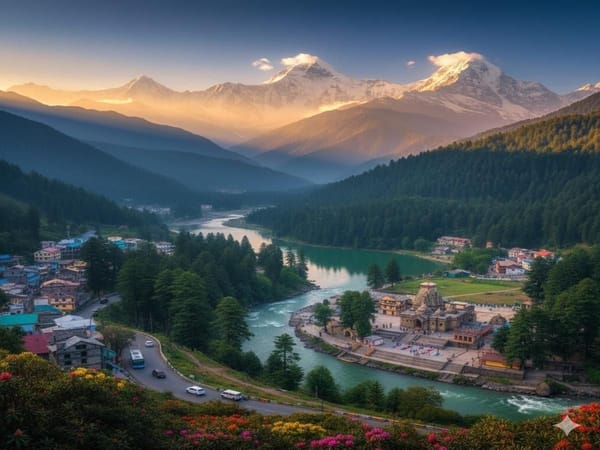
“Devbhoomi” (Land of the Gods), is a breathtaking state in northern India renowned for its majestic Himalayan peaks, sacred Hindu pilgrimage sites, and pristine natural beauty. Carved out of Uttar Pradesh on November 9, 2000, as India’s 27th state, it is globally celebrated as a premier hub for spirituality, eco-tourism, and adventure sports.
Uttarakhand: Brief Introduction
Uttarakhand is the 27th state of the Indian Union established on November 9, 2000 after being carved out from Uttar Pradesh. Nestled in the lap of the Himalayas, the state has been renowned since ancient times for its spiritual significance, tourism appeal and breathtaking natural beauty.It is the origin point of the sacred rivers Ganga and Yamuna which adds to its religious, cultural and ecological importance. The dense forests and rich biodiversity of the region make it an environmental treasure.Uttarakhand shares international borders with China (Tibet) and Nepal highlighting its strategic importance. The state is divided into two regions—Garhwal and Kumaon. In ancient scriptures Garhwal is referred to as “Kedarkhand” and Kumaon as “Manaskhand reflecting the region’s deep spiritual heritage.
Land of the Gods
Popularly known as Devbhoomi (Land of the Gods), Uttarakhand is home to the sacred shrines—Yamunotri, Gangotri, Kedarnath and Badrinath. Every year millions of devotees undertake the pilgrimage to these holy destinations. The pilgrimage season typically starts in April-May and continues till October-November. During winter when the temples closes worship continues at their winter abodes—Kharsali, Mukhwa, Ukhimath and Pandukeshwar. Starting in 2024, the Government of Uttarakhand has also launched a Winter Char Dham Yatra enabling pilgrims to visit the winter shrines during the colder months.
Religious and Cultural Heritage
Haridwar is the main religious city of Uttarakhand which is famous for Kumbh and the annual Kanwar Yatra. Rishikesh another spiritual hub has earned global fame as a center for yoga, meditation and spirituality. It also draws adventure seekers with its river rafting and other adrenaline-pumping activities.In the Kumaon region prominent religious sites include Naina Devi Temple, Jageshwar, Chitai Temple and Kainchi Dham. Under the Manaskhand Mandir Mala mission the state government is developing 48 key temples in the Kumaon region to promote religious tourism.
Nature, Wildlife, and Adventure Tourism
Uttarakhand boasts rich biodiversity with attractions like Jim Corbett National Park, Rajaji National Park, Valley of Flowers and high-altitude bugyals (alpine meadows). The state is rapidly emerging on the global adventure tourism map. Activities such as river rafting, trekking, bungee jumping, paragliding, rock climbing, mountaineering and camping are becoming increasingly popular. Rishikesh’s rafting and Auli’s skiing are particularly well-known among tourists.
Vibrant Cultural Traditions
Uttarakhand is culturally vibrant with traditional festivals like Harela, Igas, Bagwal, Phooldei, Ghughutiya, Bhitauli and Ghee Sankranti celebrated with great enthusiasm. The Nanda Raj Jat Yatra held once every 12 years is a grand expression of the region’s spiritual faith and cultural legacy in the high Himalayan terrain.Uttarakhand is a perfect destination for spiritual, natural, cultural and adventure tourism. Living up to its identity as Devbhoomi the state continues to promote sustainable development and tourism while preserving its unique heritage.
Administration & Geography
- Capitals: Dehradun acts as the winter capital, Bhararisain serves as the summer capital, and Nainital functions as the judicial capital.
Uttarakhand’s history dates back with archaeological evidence showcasing human habitation. It was part of the ancient kingdoms during the rise of dynasties like the influence of evidenced agriculture the state’s economy is now dominated by the service industry. The service sector comprises primarily travel, tourism, and hotel industry. The Gross State Domestic Product (GSDP) of Uttarakhand is Rs 3.78 Lakh crore (US$39 billion). The state contributes seats to the lower house Lok Sabha and three seats to the upper house Rajya Sabha.
Inhabitants of the state are called either depending on their region of origin. Most widely spoken language and is also the official language of the state, along with native regional languages. The state is often referred to as the “Devabhumi” (lit. ’Land of the Gods’), due to its religious significance layout, motifs, plan, and the building process recite ancient rituals and geometric symbolism, and reflect beliefs and values innate within various schools of Hinduism. Though initially, it was believed that due to harsh climate and mountainous terrain, this was a barren and uninhabited land. But after various excavations and the study of ancient literature, it is now established that the history of Uttarakhand goes back to Stone Age. Among the first major dynasties of Kumaon were the second century BCE who practised an early form of Kalsi show the early presence of tradition, the Buddha instructed his followers in a path of ‘unease’, ‘unsatisfactoriness’) by attaining the ‘blowing out’ (extinguishing) of the passions. He regarded this path as a extreme asceticism and also between the extremes of that dukkha arises alongside the Buddha advised cultivation of perfections many different textual collections in different languages vary in their interpretation of the relative importance and “canonicity” assigned to various specific teachings and practices.
Regions: The state is divided into two major socio-cultural and geographical divisions—Garhwal and Kumaon—which span across 13 districts. Among the first major dynasties of Garhwal and Kumaon were in the second century BCE who practised an early and traded salt with Western Tiban. It is evident from the Ashokan edict at Kalsi in Western Garhwal that Buddhism made inroads in this region. Practices deviating from Hindu orthodoxy also persisted here. However, Garhwal and Kumaon were restored to nominal rule due to the travels and the arrival of migrants from the plains.

Sun Temple constructed by the 9th century CE
.jpg)
Temples Complex are a group of over 100 Hindu temples dated between 7th and 12th century.
Between the 4th and 14th centuries, the Katyuri dynasty dominated lands of varying extents from the Katyur valley in Kumaon. The historically significant temples are believed to have been built by the Katyuris and later remodelled by the Chands. Other peoples of the group known as kirata thought to have settled in the northern highlands as well as in pockets throughout the region, and are believed to be ancestors of the modern day and people. During the medieval period, the region was consolidated under the Kumaon also known as ‘Kurmanchal Kingdom’.

Rope bridge across, 1784–94

Fort of Champawat, 1815 – the first capital of the Chand kings of Kumaon Kingdom
By the medieval period, the region was consolidated under the west and east. During this period, learning and new forms of painting developed. Modern-day Garhwal was likewise unified under the rule of Parma who, along with many other from the plains. In 1803, the Garhwal Kingdom also fell to the Gurkhas. After this region was ceded to the British as part of the erstwhile Kumaon Kingdom along with the eastern region of Garhwal Kingdom was merged. In 1816, the Garhwal Kingdom was re-established from a smaller region.

In the southern part of Uttarakhand in earlier part till 1988 the dominance and kingship (rajya) was exercises by some local Hindu rulers, the area was under control of Parmar (Panwar) chief in eastern Saharanpur including Haridwar in kingship of Raja Sabha Chandra of Jhabrera. The Panwar clan held more than 500 villages there in upper Doab, and that situation was confirmed in 1759 in a grant by a Rohilla governor of 505 villages and 31 hamlets to one Manohar Singh (written in some records as Raja Nahar Singh son of Sabha Chandra). In 1792 Sawai Singh were ruling the area but due to some family reasons Ramdayal left Jhabrera and went to Landhaura village, now some villages were under the control of Raja Ramdayal Singh at Landhaura, and some under his son Sawai Singh at Jhabrera. Hence, there were two branches of Jhabrera State (riyasat) main branch at Jhabrera and the second one at Landhaura, both father and son were ruling simultaneously without any conflicts till the death of Raja Sawai Singh of Jabarhera in 1803. After the death of Sawai Singh total control of powers transferred to Ram Dayal Singh at Landhaura, but some villages were given to descendants of Sawai Singh and her widow to collect revenue.
By 1803 the Landhaura villages numbered 794. Raja Ram Dayal Singh died on 29 March 1813. These holdings, at least those in the original grant made by the Rohilla governor, were initially recognised by the British in land settlements concluded with Ram Dayal and his heirs. As the years passed, more and more settlements appear to have been made with the village communities, however, and by 1850 little remained of the once vast estate of the Landhaura Khübars. There are many temples and Ghats on Ganga built by Rajas of Landhaura estate, therefore they also famous as ‘ Haridwari Rajas’ in folk history and literature. Famous Kankhal was built by Queen DhanKaur of Landhaura in 1810 A.D.

Next the Timli estate Founded in Dehradun mid-15th century by Chaudhari Ram Singh, a member of the Choker Hindu family, the estate remained under the rule of this dynasty until its eventual annexation. In 1548, two chieftains, Pohda Singh and Lal Karan, from the Titron region in Saharanpur district, conquered the entire Dehradun area established. They also founded a town named Timli Chaudhari Bhagwan Singh have power of magistrate.
Raja Ranjit Singh born in 1943, was married at a young age to a princess from the Chokar family, which ruled in Timli estate.

After India attained independence from the Garhwal Kingdom was merged into the state of where Uttarakhand composed the Garhwal and Kumaon Divisions. Until 1998, Uttarakhand was the name most commonly used to refer to the region, as various political groups, including the Uttarakhand Revolutionary Party, began agitating for separate statehood under its banner. Although the erstwhile hill kingdoms of Garhwal and Kumaon were traditional rivals the inseparable and complementary nature of their geography, economy, culture, language, and traditions created strong bonds between the two regions. These bonds formed the basis of the new political identity of Uttarakhand, which gained significant momentum in 1994, when demand for separate statehood achieved almost unanimous acceptance among both the local populace and national political parties.
The most notable incident during this period was the night of 1 October 1994, which led to a public uproar. On 24 September 1998, the Uttar Pradesh Reorganisation Bill, which began the process of forming a new state. Two years later, on 9 November 2000, Uttarakhand became the 27th state of the Republic of India.
Uttarakhand is also well known for the mass agitation of the 1970s that led to the formation of the
other social movements. Though primarily a movement rather than a forest conservation movement, it went on to become a rallying point for many future environmental protests, and movements the world over and created a precedent for non-violent protest. It stirred up the existing civil society in India, which began to address the issues of tribal and marginalised people. So much so that, a quarter of a century later, mentioned the people behind the “forest satyagraha” of the Chipko movement as among “100 people who shaped India”. One of Chipko’s most salient features was the mass participation of female villagers. It was largely female activists that played pivotal role in the movement. Gaura Devi was the leading activist who started this movement, other participants were Ghanshyam Raturi, the popular Chipko poet.
Geography

Uttarakhand has a total area of 53,483 km2 (20,650 sq mi), of which 86% is mountainous and 65% is covered by forest. Most of the northern part of the state is covered by high Himalayan peaks and glaciers. In the first half of the nineteenth century, the expanding development of Indian roads, railways, and other physical infrastructure was giving rise to concerns over indiscriminate logging, particularly in the Himalaya. Two of the most important rivers in Hinduism originate in the glaciers of Uttarakhand. They are fed by myriad lakes, glacial melts, and streams. These holy pilgrimage for the Hindus.
Uttarakhand lies on the southern slope of the Himalaya range, and the climate and vegetation vary greatly with elevation, from glaciers at the highest elevations to subtropical forests at the lower elevations. The highest elevations are covered by ice and bare rock. Below them, between 3,000 and 5,000 metres (9,800 and 16,400 ft). At 3,000 to 2,600 metres (9,800 to 8,500 ft) elevation they transition to the temperate, which lie in a belt from 2,600 to 1,500 metres (8,500 to 4,900 ft) elevation. The drier cover lowlands along the Uttar Pradesh border in a belt locally known as Bhabar. These lowland forests have mostly been cleared for agriculture, but a few pockets remain.
Climate
Uttarakhand has varies greatly from north to south. The climatic conditions experienced in the state vary in the southern part to the upper reaches of the Himalayan mountain in the northern parts. The winter season from December to February, is extreme with temperatures fluctuating anywhere between 5 °C (41 °F) to 20 °C (68 °F). In higher altitudes and mountainous regions, temperatures often drop below freezing point. Cold winds blow across Uttarakhand, especially in the higher altitudes and mountainous regions. These winds bring cold temperatures and often carry moisture, contributing to the heavy snowfall in places like the Himalayan ranges and hill stations.
During Pre-monsoon or hot weather season from March to May, temperature starts to rise and steadily rises till it reaches its peak in May to the middle of June, when the mean maximum temperature in southern parts and valleys of the state is at about 34 °C (93 °F) C to 38 °C (100 °F), But in recent days the maximum temperature has increased up to 40 °C (104 °F). and mean minimum temperature is at about 20 °C (68 °F) to 24 °C (75 °F) C. June to September constitutes the period of October and November is of post monsoon season. The state receives rainfall mainly due monsoon depressions originating during the southwest monsoon season. The total annual rainfall for the state as a whole is 133 cm and total annual number of rainy days are about 63 cm. Although, rainfall in the state varies from place to place due to its rugged topography. Precipitation is not heavy and occurs in the form of rain and snow. Winds are generally light of the order of 1 to 4 kmph in the valleys and 5 to 10 kmph at elevations of 2 km increasing further with higher altitudes.
Flora and fauna
| State animal | Alpine musk deer (Moschus chrysogaster) | |
| State bird | Himalayan monal (Lophophorus impejanus) | |
| State tree | Burans (Rhododendron arboreum) | |
| State flower | Brahma Kamal (Saussurea obvallata) | |
| State fruit | Kafal (Myrica esculenta) | |
| State sport | Football |
Uttarakhand has a diversity of flora and fauna. It has a recorded forest area of 34,666 km2 (13,385 sq mi), which constitutes 65% of the total area of the state. The vegetation of the state majorly comprises alpine trees and tropical rainforests. The state is home to rare species of plants and animals, many of which are protected by sanctuaries and reserves. Languages
The official language of Uttarakhand, which according to the 2011 census is spoken natively by 43% of the population, and is also used throughout the state as a lingua franca.
The major regional languages of Uttarakhand are which according to the 2011 census is spoken by 23% of the population, mostly in the western half of the state spoken in the eastern half and native to 20%, whose speakers are concentrated in Dehradun district in the southwest and make up 1.3% of the state’s population. These three languages are closely related, with Garhwali and Kumaoni in particular making up the language subgroup. The languages have been part of various scattered conservation efforts due to their active decline beginning in the later quarter of the 20th century. The decline is hypothesized to be the result of heavy state-sponsored promotion of Hindi as the official language. Among the prominent local crafts is, which appears most frequently of the Kumaon region in Uttarakhand. Intricately carved designs of floral patterns, deities, and geometrical motifs also decorate the doors, windows, ceilings, and walls of village houses. Paintings and murals are used to decorate both houses and temples.

Miniature painting that flourished in the region between the 17th and 19th century. Credited as the true father of the Garhwali Branch of the wider Pahari School. Kumaoni art often is geometrical in nature, while Garhwali art is known for its closeness to nature.
Aipan is a GI certified Kumaoni ritual folk art done mainly during special ceremonies, the festival of Diwali, marriages and other religious rituals. Its predominantly female practitioners believe that it invokes a divine power which brings about good fortune and deters evil. The art is special as it is done on empty walls, which are brick-red in colour, called geru. The actual art is done with a white paste.
Jyuti patta is a class of water color paintings done on rituals, called Jyuti. Some scholars also consider Jyuti to be synonymous with the word mother of the world. To give concrete form to the deity, two-dimensional geometry is given expression in the form of frescoes. This is a geometric or decorative semi-graphic structure in which different colours and symbols are used. This structure called Jyuti also gets a new dimension by the use of ochre or biswar of Tepan. Jyunti is prepared on the surface of wall or paper and the composition is given with cotton and a brush of limiter. In this artform, various qualities of a specific deity are shown.
Other crafts of Uttarakhand include handcrafted from Garhwal. The latter are mainly produced by the Bhotiyas of northern Uttarakhand.
Arts and literature

Uttarakhand’s diverse ethnicities have created a rich literary tradition in languages including Hindi, Garhwali, Kumaoni, Jaunsari, and Tharu. The primary food of Uttarakhand is vegetables with wheat being a staple, although non-vegetarian food is also served. A distinctive characteristic of Uttarakhand cuisine is the sparing use of tomatoes, milk, and milk-based products.
Coarse grain with high fibre content is very common in Uttarakhand due to the harsh terrain. Crops most commonly associated with Uttarakhand are (locally called Kotu or Kuttu) and the regional crops, Maduwa and Jhangora, particularly in the interior regions of Kumaon and Garhwal. Generally, used for the purpose of cooking food. Simple recipes are made interesting with the use of hash seeds is also a regional cuisine.
Bal Mithai is a popular fudge-like sweet. Other popular dishes include Dubuk, Chains, Kap, Bhatiya, Jaula, Phana, Paliyo, Chutkani and Sei. In sweets; Swal, Ghughut/Khajur, Arsa, Gatta and Gul gilas are popular.
Many regional variations called Jhoi or Jholi is also popular. Another staple of the Kumaon region is a black soybean dal referred to as Bhatt or chudkani. A grinded dal chaisu is also popular in the Garhwal region.
The state has a predominant non-vegetarian population, with some estimates suggesting 75% of the population being non-vegetarian. Various boar, chicken, mutton and hare recipes are popular in the region. A popular mutton dish bhutwa, is made from goat intestine and other offcuts.
Dances and music

The dances of the region are connected to life and human existence and exhibit myriad human emotions. Langvir Nritya is a dance form for males that resembles gymnastic movements. Barada Nati folk dance is another dance, which is practised during some religious festivals. Other well-known dances include Hurka Baul, Jhora-Chanchri, Chhapeli, Thadya, Jhumaila, Chauphula.
Music is an integral part of the Uttarakhandi culture. Popular types of folk songs include Mangal, Basanti, Khuder and Chhopati. Almora Dussehra is a regional variant of Dussehra, dating back to 1936. It is distinct for burning fifteen distinct effigies, each representing the members of the Hindu mythological villain Ravana’s entire bloodline. The effigies are all ornate and exquisitely designed. They are paraded through the city of Almora before finally being set on fire to symbolise the triumph of good over evil. Ramman is an agro-religious festival and ritual masked theatre endemic to the Garhwali People in the Saloor Dungra village of the Painkhanda Valley in the Chamoli district. The festival serves as an offering to the village deity, Bhumichetrapal or Bhumiyal Devta, in the courtyard of the village temple. Every day of the festival, the Devta takes a round of the village. The festival lasts for ten days during which time the local epic of Rama is sung and masked dances depicting different aspects of life take place in the courtyard of the Bhumiyal Devta’s temple. Phool-Dei is a folk festival which welcomes the spring season in the state. The festival is celebrated on the first day of the Hindu month, Chaitra. In some places, the festival is celebrated as carnival and the celebration goes on for a month. The term ‘Dei’ refers to a ceremonial pudding which is the key food in this festival that is made from jaggery. White flour and curd are also offered. Young children gather together and go to every house in their village/towns with plates full of rice, jaggery, coconut, green leaves, and flowers. In return, they are presented with blessings and gifts like sweets, jaggery, and money. The wishing and blessing part also include placing flowers and rice on the doorsteps of the houses by the children. People of village sing and dance on their folk songs to celebrate the festival of spring along with exchanging wishes for well-being and prosperity of their family and relatives.
Harela is a kumaoni festival hypothesized to date back to the indigenous population. 10–11 days before the Sankranti of Shravan, a bed is made by adding soil in bamboo pots etc. Grains grown during the rainy season like paddy, maize, urad etc. are sown, this is called Hariyala. Harakali Mahotsav, Idols of Gauri Maheshwar, Ganesha and Karkitkeya are made from clay, coloured in them and worshiped with various fruits, flowers, dishes and sweets in a bed of greenery on the night of the month of Sanat. On the second day, the Harela of Uttarang Puja is placed on the head. Sisters and daughters-in-law apply tilak and tilak and put Harela on their heads. They are given gifts. The Uttarakhand state is the second fastest growing state in India. Its gross state domestic product (GSDP) (at constant prices) more than doubled from ₹24,786 crore in FY2005 to ₹60,898 crore in FY2012. The real GSDP grew at 13.7% (CAGR) during the FY2005–FY2012 period. The contribution of the service sector to the GSDP of Uttarakhand was just over 50% during FY 2012. Per capita income in Uttarakhand is ₹ 198738 (FY 2018–19), which is higher than the national average of ₹ 126406 (FY 2018–19). According to the total foreign direct investment in the state from April 2000 to October 2009 amounted to US$46.7 million.
Like most of India, agriculture is one of the most significant sectors of the economy of Uttarakhand. Rice, wheat, soybeans, groundnuts, coarse cereals, pulses, and the most widely grown crops. Fruits like apples, oranges, pears, peaches, lychees, and plums are widely grown and important to the large food processing industry. Agricultural export zones have been set up in the state for lychees, horticulture, herbs, medicinal plants, and basmati rice. During 2010, wheat production was 831 thousand tonnes and rice production was 610 thousand tonnes, while the main cash crop of the state, sugarcane, had a production of 5058 thousand tonnes. As 86% of the state consists of hills, the yield per hectare is not very high. 86% of all croplands are in the plains while the remaining is from the hills. The state also holds the GI tag for Tejpatta or Indian bay leaf, which is known to add flavour to dishes and also possesses several medicinal properties.
| Economy of Uttarakhand at a Ggance | |
| Economy at a glance (FY-2012) | In Indian rupees |
|---|---|
| GSDP (current) | ₹95,201 |
| Per capita income | ₹103,000 |
Other key industries include tourism and hydropower, and there is prospective development in IT, ITES, biotechnology, pharmaceuticals and automobile industries. The service sector of Uttarakhand mainly includes tourism, information technology, higher education, and banking.
During 2005–2006, the state successfully developed three Integrated Industrial Estates (IIEs); Pharma City at Selakui; Information Technology Park at Sahastradhara; and a growth centre at Sigaddi. Also in 2006, 20 industrial sectors in public private partnership mode were developed in the state.
Transportation
Uttarakhand has 2,683 km (1,667 mi) of roads, of which 1,328 km (825 mi) are national highways and 1,543 km (959 mi). The state has 14 national highways, comprising 2.2% of the total national highways length in India. The (UTC), established on 31 October 2003 after reorganising the State Road Transport Corporation (SRTC). The corporation provides transportation in the state with connecting services to adjoining states. The UTC buses are the most common and affordable mode of transportation in Uttarakhand. As of 2012, approximately 1000 buses are being plied by the UTC on 35 nationalised routes along with many other non-nationalised routes. There are also private transport operators operating approximately 3000 buses on non-nationalised routes along with a few interstate routes in Uttarakhand . In addition, remote towns and villages in the hills are connected to important road junctions and bus routes by share mode of transportation.
As over 86% of state’s terrain consists of hills, railway services are very limited in the state and are largely confined to the plains. In 2011, the total length of railway tracks was about 345 km (214 mi). Borders: It shares international borders with Tibet (China) to the north and Nepal to the east, while bordering Himachal Pradesh and Uttar Pradesh domestically.
Uttarakhand is a state in northwestern India, bordered by Himachal Pradesh, Tibet, Nepal, and Uttar Pradesh. Its capital is Dehra Dun. The name “Uttarakhand” means “northern region”.
History
Evidence of human habitation in Uttarakhand dates back to prehistoric times, with ancient rock paintings and stone tools found in the region. Early Vedic practices also existed here. Over centuries, various tribes inhabited the area, with the Paharis being dominant until the arrival of Rajputs and Brahmans from the plains around the 13th century. After India gained independence, the region, initially part of Uttar Pradesh, saw a growing movement for a separate state due to underdevelopment. This led to the creation of Uttaranchal in 2000, which was renamed Uttarakhand in 2007.
Geography and Land
Uttarakhand features diverse topography, including snow-capped mountains, glaciers, deep valleys, and plains in the south. It is home to some of the world’s highest peaks, such as Nanda Devi and Kamet. The state can be divided into several physiographic zones, from the high peaks of the Himadri in the north to the Siwalik Range and the Bhabar and Tarai plains in the south.
Economy
Agriculture is a significant part of Uttarakhand’s economy, though only a portion of the land is cultivable. Terrace cultivation is common, with wheat, rice, and millets being major crops. Sugarcane, pulses, oilseeds, fruits, and vegetables are also grown. Animal husbandry, including dairy farming and seasonal herding (transhumance), is practiced. Forests provide timber and fuel, supporting forest-based industries. The services sector, particularly information technology and tourism, has seen substantial investment and growth, attracting visitors with its natural beauty and pilgrimage sites.
People and Culture
The population of Uttarakhand is multiethnic, primarily residing in the Garhwal and Kumaun regions. Hindi is the official language, with Hindustani being widely spoken, alongside regional languages like Garhwali and Kumauni. The majority of residents are Hindu, with significant Muslim and smaller Sikh, Christian, Buddhist, and Jain communities. Festivals are largely tied to the Hindu calendar, including Dussehra, Diwali, Shivaratri, and Holi. Major Muslim, Buddhist, Jain, Sikh, and Christian holidays are also observed.
Sacred Rivers: It is the birthplace of two of India’s most sacred rivers; the Ganga originates from the Gangotri glacier, and the Yamuna flows from the Yamunotri glacier.
In the heart of the Himalayas
In the northern part of India, amidst the majestic mountains and rich mythological heritage, Uttarakhand unfolds as a mesmerising destination. This beautiful state is also known as “Devbhoomi,” or the abode of the gods, cradled within the embrace of the Himalayas and is geographically divided into Garhwal and Kumaon regions. While Uttarakhand boasts well-known destinations such as Nainital, Mussoorie and sacred pilgrimage sites like Kedarnath, Badrinath, Rishikesh, and Haridwar, it also invites you on an adventure to explore its hidden gems.
Top Travel Destinations & Experiences
Spiritual Hubs
Rishikesh: Known worldwide as the “Yoga Capital of the World”, it attracts international travelers for spiritual wellness, meditation, and white-water rafting.
List of Cities in Uttarakhand- Their Area, Population, and Property Price History Explore the list of cities in Uttarakhand. Know their area, population, and property price history. Simple and clear details for homebuyers. Uttarakhand is a state in the Himalayas. It is known for great natural beauty and many holy sites. The state also has strong centers for administration. Key cities form the state’s urban core. These places drive the economy, education, and spiritual life. They help develop the whole region. Many people move into these cities. This inward flow strongly supports the local property market. Dehradun and Haridwar are the primary growth engines. Both cities expand continuously in population and infrastructure. One must know the unique traits of these cities. Understanding their populations and past prices helps judge investment worth. This knowledge leads to sound real estate choices. This review covers seven major cities: Dehradun, Haridwar, Rishikesh, Nainital, Haldwani, Rudrapur, and Roorkee. It details their area, population, and recorded property price changes. All data and trends come strictly from MagicBricks, a top Indian property website.
Major Cities in Uttarakhand: Area, Demographics, and Real Estate
The cities chosen show Uttarakhand’s diverse urban growth. They include the capital, pilgrimage sites, and industrial hubs in both Kumaon and Garhwal regions.
1. Dehradun: The Capital and Educational Hub
Dehradun is the capital city. It is the largest urban center in the state. Located in the Doon Valley, it serves as an educational and administrative core. This guarantees steady demand for homes and business properties. The moderate climate and good institutions attract families and retirees.
| Parameter | Details |
| Approximate Area (Municipal Limits) | 300 sq. km (varies based on metropolitan definition) |
| Population and Growth | Population exceeds 8,00,000 (city proper). The city experiences steady immigration from surrounding states due to employment and education. |
| Key Property Demand Drivers | Administrative offices, defense establishments, educational institutions (schools, universities), and medical tourism. |
Property Price History
Dehradun’s real estate market shows steady value increase. This growth comes from new infrastructure projects and consistent demand. Prime areas, such as Rajpur Road and Jakhan, have higher property rates. Developing zones, including Sahastradhara Road and airport localities, show more moderate pricing. Prices change significantly based on the specific neighborhood, building type, and developer reputation. Many students live in Dehradun. This population ensures strong demand for rental housing. Areas near main colleges and universities provide good rental returns.
2. Haridwar: The Spiritual and Industrial Gateway
Haridwar is one of the seven holiest cities in India. It attracts pilgrims from across the country. It also functions as an important industrial hub. This is especially true in areas developed by SIDCUL (State Industrial Development Corporation of Uttarakhand Limited). This mix of spiritual importance and industrial growth shapes real estate demand.
| Parameter | Details |
| Approximate Area (Municipal Limits) | 12 sq. km (city proper) |
| Population and Growth | Population stands at 2,50,000 (city proper). The city experiences large seasonal fluctuations due to religious tourism. Steady growth occurs in surrounding industrial corridors. |
| Key Property Demand Drivers | Pilgrimage tourism, religious trusts, industrial workforce housing (SIDCUL), and expansion of health and wellness centers. |
Property Price History
The Haridwar real estate market is split into two sections. Properties near the Ganga riverfront and temples cost significantly more. Conversely, properties in the SIDCUL industrial belt are desirable for long-term home and industrial investments. MagicBricks data shows average residential prices fall between INR 3,000 and INR 5,000 per square foot. There is strong demand for investments in both residential plots and large industrial plots. Commercial and industrial plots near SIDCUL maintain steady capital value growth. This growth is driven by the needs of manufacturing and logistics companies. Key micro markets perform best. Localities located along the Haridwar-Delhi National Highway and near the SIDCUL area consistently complete more transactions than other city sections.
3. Rishikesh: The Yoga Capital of the World
Rishikesh is internationally recognized as the hub for yoga, meditation, and adventure sports. Its global reputation attracts foreigners and domestic tourists. This drives demand for specialized real estate, including boutique hotels, homestays, and wellness retreat centers. Its status as a clean, spiritual city makes it highly desirable.
| Parameter | Details |
| Approximate Area (Municipal Limits) | 11 sq. km (city proper) |
| Population and Growth | Population is approximately 1,00,000. It exhibits significant seasonal growth due to tourism. The permanent residential population shows modest, organic growth. |
Property Price History
Rishikesh continues to be one of the costliest real estate markets in Uttarakhand. Localities situated close to the Ganga and major ashram clusters—such as Tapovan, Laxman Jhula, and adjoining spiritual belts—see particularly elevated prices. In several of these pockets, quoted rates come surprisingly close to those found in much larger metropolitan cities, even though the overall market here operates on a smaller scale.
Figures reported by MagicBricks indicate that residential values in the more established parts of the city generally fall between INR 4,000 and INR 7,000 per sq ft. Development activity, especially near the riverfront and the hill slopes, is subject to strict environmental rules. These restrictions have reduced the scope for horizontal expansion, pushing most new projects toward vertical formats. Because new land parcels are limited, supply remains tight across the city.
Tourism plays a decisive role in shaping investor preferences. Commercial assets—particularly hotels, boutique stays, and serviced apartment projects—receive strong interest due to reliable footfall throughout the year. In addition, land parcels along the Badrinath Road stretch are witnessing rising demand as buyers seek opportunities beyond the crowded central zones.
4. Nainital: The Lake District
Nainital, centred around the Naini Lake, functions as one of Kumaon’s most influential hill towns. Its importance extends beyond tourism; the city also hosts several administrative establishments and educational institutions. However, the real estate market operates under unusual limitations. The steep terrain, forest cover, and long-standing environmental rules restrict the scope of new construction, which makes every legally permitted property inherently valuable.
These physical and regulatory constraints have ensured that Nainital’s housing supply remains extremely limited. Properties located near the lakefront or within heritage precincts maintain a premium due to their scarcity. Demand comes from a mix of local residents, seasonal occupants, and buyers seeking second homes in milder climates. Because expansion possibilities are narrow, price movements tend to be firm even when transaction volumes remain modest.
| Parameter | Details |
| Approximate Area (Municipal Limits) | 11.73 sq. km |
| Population and Growth | Population is around 40,000 (city proper). It experiences enormous seasonal population influx. Limited geographic space restricts significant population expansion. |
| Key Property Demand Drivers | Tourism, second homes, and heritage properties. Demand for high-end villas and cottages remains consistent. |
Property Price History
Supply constraint dictates the high property prices in Nainital. The market focuses on the high-ticket luxury segment, especially for second homes. Average Residential Prices (2021-2024 Trends): Property prices in Nainital, especially for cottages and premium lake-view apartments, range from INR 6,000 to INR 10,000 per square foot or higher. The data on MagicBricks indicates lower transactional volume compared to Dehradun, but higher per-unit capital value for prime assets. Peripheral Markets: Demand is spreading to nearby, less restrictive areas like Bhowali and Bhimtal. Prices there show moderate, steady growth as per MagicBricks data.
5. Haldwani: Kumaon’s Gateway and Commercial Hub
Haldwani, located in the foothills, acts as the primary commercial and transport gateway for the entire Kumaon division. This includes Nainital, Almora, and Pithoragarh. Its flat terrain and connectivity make it suitable for large-scale residential and commercial projects.
| Parameter | Details |
| Approximate Area (Municipal Limits) | 45.4 sq. km |
| Population and Growth | Population exceeds 2,50,000. It is one of the fastest-growing cities in the state due to inward migration from the hills and increasing commercial activity. |
Property Price History
Haldwani offers a strong property market. It is also relatively more affordable than Dehradun or Rishikesh. This attracts people buying homes for themselves and investors seeking long-term gains. The market has high demand for plots and individual houses. Planned upgrades to the railway and road network should further increase property value. This appreciation is expected in the coming years.
6. Rudrapur: The Industrial Powerhouse
Rudrapur is the administrative headquarters of the Udham Singh Nagar district. It is a major industrial hub, hosting many national and multinational companies in its SIDCUL industrial estate. This focus on manufacturing and industry defines its real estate market. The market is driven primarily by workforce housing and commercial/industrial space needs.
| Parameter | Details |
| Approximate Area (Municipal Limits) | 40 sq. km |
| Population and Growth | Population exceeds 1,50,000. It experiences high workforce migration. This leads to rapid development of affordable and mid-segment housing. |
| Key Property Demand Drivers | Industrial employment, ancillary units, and housing for industrial workers and managerial staff. Commercial retail demand is also growing. |
Property Price History
Rudrapur’s real estate performance stays closely connected to its industrial activity and job availability. The market stays steady and mainly serves the working population. Average Residential Prices (2021–2024): MagicBricks data shows residential rates generally range from INR 2,500 to INR 4,000 per square foot, making Rudrapur one of the more affordable urban markets in Uttarakhand. Commercial Segment: Commercial and industrial properties deliver stable rental returns. This attracts focused investors. Areas near SIDCUL and the National Highway record frequent transactions and sustained demand.
7. Roorkee: The Engineering and Research House
Roorkee holds international recognition due to the presence of the Indian Institute of Technology (IIT) Roorkee and the Central Building Research Institute (CBRI). This strong academic and research base shapes the city’s real estate market. It supports steady demand.
| Parameter | Details |
| Approximate Area (Municipal Limits) | 13.5 sq. km |
| Population and Growth | Population is around 1,50,000. The population growth is stable. It is primarily driven by the continuous flow of students and academic/research professionals. |
| Key Property Demand Drivers | Educational institutions, research centers, and supporting commercial facilities. Proximity to the IIT campus remains the prime determinant of property value. |
Property Price History
The presence of IIT Roorkee helps keep property values stable. It limits sharp market fluctuations. Most investments in the city follow a steady, long-term pattern. Average Residential Prices (2021–2024): The rates averages between INR 3,000 and INR 5,000 per square foot as per MagicBricks data. Areas near main IIT campus command stronger rental yield and higher capital valuation. Future Growth: Future plans for upgrades along the routes linking Roorkee with Delhi and Haridwar are expected to favor further development and raise real estate values in the coming years.
Uttarakhand Property Price Overview
The table below summarizes the average price range for residential properties across the seven major cities. It reflects data trends published by MagicBricks in recent years. This highlights the varying market maturity and premium associated with each city’s unique demand drivers.
| City | Primary Demand Driver | Average Residential Price Range (Per sq. ft.) | Investment Nature |
| Dehradun | Administration, Education, Lifestyle | INR 4,500 – INR 6,500 | End-user and Long-term Capital Appreciation |
| Haridwar | Pilgrimage, Industrial (SIDCUL) | INR 3,000 – INR 5,000 | Spiritual Tourism and Workforce Housing |
| Rishikesh | Wellness, International Tourism | INR 4,000 – INR 7,000 | High-Yield Commercial and Luxury Second Homes |
| Nainital | Tourism, Hill Station Living | INR 6,000 – INR 10,000 | Premium Second Homes and Luxury Segment |
| Haldwani | Commercial Gateway, Logistics | INR 3,500 – INR 5,500 | Affordable Housing and Commercial Expansion |
| Rudrapur | Industrial (SIDCUL) | INR 2,500 – INR 4,000 | Workforce Housing and Industrial Investment |
| Roorkee | Education, Research, Cantonment | INR 3,000 – INR 5,000 | Stable Rental Income and Long-term Value |
City-wise Investment Insights
This section outlines the specific investment profiles, key growth drivers, and expected performance for major real estate markets across Uttarakhand.
| City | Investment Thesis | Key Growth Drivers | Investment Characteristics |
| Dehradun | The Safe Bet | Administrative stability, superior civic infrastructure, and connectivity projects (new expressways to Delhi). | Capital appreciation remains steady. Properties along new expressways deliver reliable returns. Demand for modern, secure housing stays strong. |
| Haridwar | The Corridor Growth | Upgraded infrastructure and strategic location along corridors linking to Delhi and Rishikesh. SIDCUL industrial zone proximity. | Investment focus shifts from the old city center to development corridors. Properties near SIDCUL show the highest growth potential. Strong demand exists for residential and industrial plots. |
| Rishikesh | The High-Yield Niche | International tourism, wellness, and spiritual retreat sectors. | Commercial assets, like homestays, retreats, and boutique hotels, offer the highest returns. Residential properties remain niche and highly premium. Tourism-driven growth supports strong rental yields. |
| Nainital | The Exclusive Segment | Extreme land scarcity and status as a prestigious hill station destination. | Scarcity drives capital appreciation within the main city. Investments in premium cottages and nearby peripheral areas, like Bhowali, offer moderate growth potential. Limited land ensures sustained value for prime properties. |
| Haldwani & Rudrapur | The Industrial Engine | Accelerated industrial activity, SIDCUL expansion, and demand for workforce accommodation and commercial logistics. | Industrial activity supports strong demand for affordable and factory worker housing. Commercial logistics and industrial plots provide high rental income and steady capital growth. Manufacturing expansion strengthens the investment case. |
| Roorkee | The Stable Rental Market | Presence of premier institutions like IIT Roorkee and established academic/research centers. | Properties near IIT Roorkee ensure steady rental income from students and staff. Long-term, low-risk opportunities suit passive investors. Capital growth remains gradual but consistent. |
Investment Outlook 2026 for Major Urban Centres in Uttarakhand
Uttarakhand’s real estate landscape appears set for stable progress over the next couple of years. Connectivity upgrades, infrastructure expansion, and the state’s mix of pilgrimage sites, tourist centres, factories, and universities help keep the market firm. Each city offers its own appeal, allowing buyers to pick opportunities that match their budget and investment style.
Summary of Key Urban Markets in Uttarakhand
The cities across the state present a broad mix of investment prospects.
- Dehradun and Roorkee continue to offer steady appreciation and low-volatility performance, supported by administrative institutions and established academic centres.
- Haridwar, Haldwani, and Rudrapur draw interest from buyers seeking stronger rental yields and accessible price points, particularly in areas influenced by industrial corridors and expanding logistics networks.
- Rishikesh and Nainital fall at the premium end of the spectrum, shaped by tourism, niche hospitality, and limited availability of buildable land.
Properties located along emerging transport links and in commercial or tourism-oriented pockets are expected to show the most pronounced gains by 2026. Price records compiled by MagicBricks indicate steady appreciation across several micro-markets, reaffirming the state’s potential for both end-use and long-term investment strategies tied to sustained infrastructure growth and regional economic activity.
Hill Stations & Nature
- Nainital & Mussoorie: Iconic, picturesque colonial-era hill stations centered around pristine high-altitude lakes and viewpoints.
- Auli: A premier Himalayan ski destination boasting snowy peaks and panoramic views of the mighty Nanda Devi range.
- Valley of Flowers: A UNESCO World Heritage Site that transforms into a vast, vibrant blanket of endemic alpine flora during the monsoon season.
🐅 Wildlife Conservation
- Jim Corbett National Park: India’s oldest national park and a legendary sanctuary dedicated to protecting the endangered Bengal tiger.
ℹ️ State Statistics
| Feature | Details |
|---|---|
| Official Language | Hindi |
| Forest Cover | 45.4% of the total land area |
| Highest Peak | Nanda Devi (7,816 meters) |
| Major Educational Hubs | IIT Roorkee and IIM Kashipur |
| Tallest Infrastructure | Tehri Dam (One of the world’s highest dams) |


_2014-06-04_08-48.jpg)
