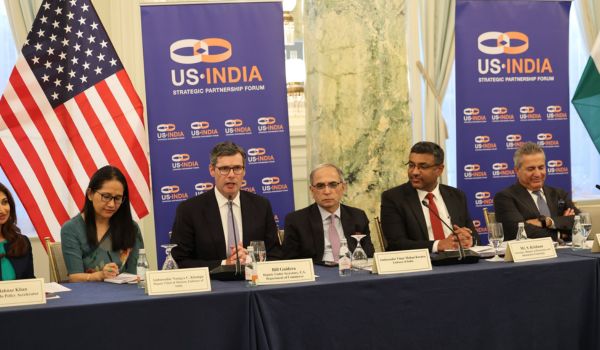
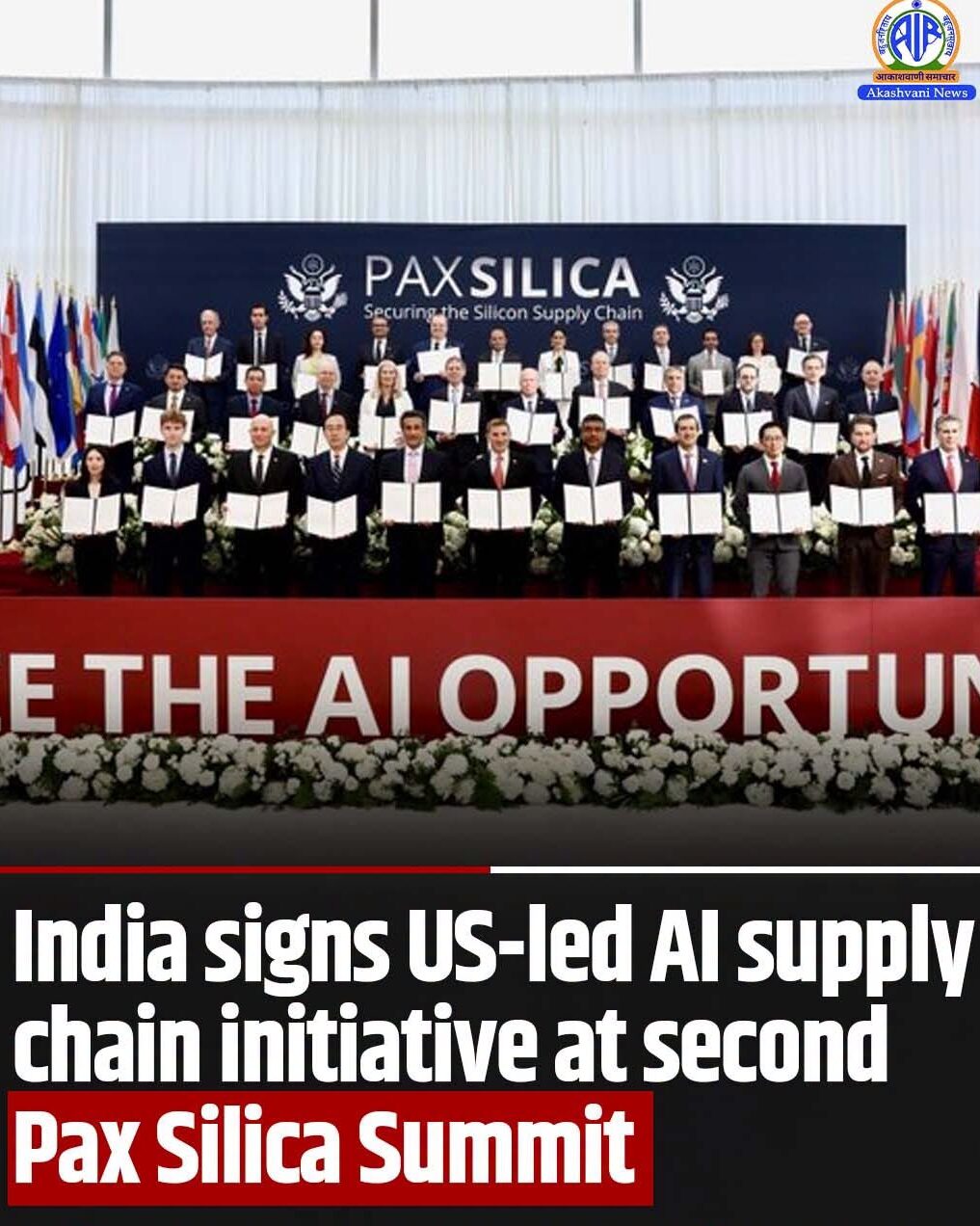
India, along with 34 other countries, has signed a US-led initiative to build trusted and resilient supply chains to support artificial intelligence (AI) technologies at the second Pax Silica Summit held in Washington yesterday.
US Under Secretary of State for Economic Affairs Jacob Helberg said the participating countries endorsed the Joint Statement on AI Opportunity, aligning behind a pro-growth and pro-innovation regulatory approach for the AI era.
Speaking to the media, Mr Helberg said the United States is keen to deepen its partnership with India, describing the bilateral relationship as one of the most consequential of the 21st century. He said key issues relating to bilateral cooperation with India, including the Quad and the TRUST initiative, were discussed.
India was represented at the summit by Secretary in the Ministry of Electronics and Information Technology S. Krishnan, along with representatives from Indian industry. The Indian delegation held discussions with industry leaders on advancing collaboration in semiconductors, artificial intelligence, and resilient technology supply chains.
On the sidelines of the summit, Argentina, Chile, Costa Rica, Germany, Greece, Kazakhstan, the Netherlands, Panama, and the European Union joined the Pax Silica initiative. India had joined the initiative in February this year on the sidelines of the AI Impact Summit held in New Delhi. India, along with 34 other countries, has signed a US-led initiative to build trusted and resilient supply chains to support artificial intelligence (AI) technologies at the second Pax Silica Summit held in Washington yesterday. The US-India AI Partnership is anchored by the US-India TRUST initiative (Transforming the Relationship Utilising Strategic Technology) and India’s participation in the US-led Pax Silica coalition. This strategic alliance positions the world’s oldest and largest democracies to build secure, resilient tech supply chains, co-develop advanced infrastructure, and prevent disruptions in access to critical technology. India has been a federal republic since 1950, governed through a democratic parliamentary system. It is a pluralistic, multilingual and multi-ethnic society. The National Portal of India provides single-window access to information and services offered by the government at all levels. The World Bank and India partner to strengthen policy reforms, institutions, and strategic investments that promote green, resilient, and inclusive. At the second Pax Silica Summit held in Washington, a total of 35 nations endorsed the Joint Statement on AI Opportunity, aligning behind a pro-growth and pro-innovation regulatory framework. India joins 35-country US-led drive for trusted AI supply chains joined 34 other countries in a US-led AI supply chain initiative at the Pax Silica Summit. The move signals wider cooperation on chips, compute capacity and resilient technology networks. Thirty-five countries, including India, have signed on to a US-led initiative to build trusted and resilient supply chains to support artificial intelligence technologies. The announcement was made at the second Pax Silica Summit in Washington on Thursday.
According to Jacob Helberg, US Under Secretary of State for Economic Affairs, the 35 countries signed the Joint Statement on AI Opportunity, backing what he described as a pro-growth and pro-innovation regulatory approach for the AI era. He said the initiative was about “a commitment to trusted supply chains, to mobilising the private sector, and the infrastructure that will power the next century”. Argentina, Germany, the Netherlands, Chile, Costa Rica, Greece, Kazakhstan, Panama and the European Union joined the Pax Silica initiative on the sidelines of the summit. India was represented by S Krishnan, Secretary in the Ministry of Electronics and Information Technology, Nagraj Naidu, Additional Secretary (Americas) in the Ministry of External Affairs, and representatives of Indian industry.
The Indian delegation held discussions with other governments and industry representatives on advancing collaboration in semiconductors, artificial intelligence and resilient technology supply chains. Helberg said, “The future of AI will not be determined by who regulates first. It will be determined by who builds first and builds the most capacity. More energy. More compute. More chips. More talent. More builders. A future where we accelerate innovation and private investment is welcomed.” He also said, “Together, we aspire to build an AI future that serves our peoples, strengthens our economies, and empowers entrepreneurship, innovation, and the rule of law.” Helberg said the Pax Silica Initiative began in December last year with a handful of countries coming together, and that India joined it in February on the sidelines of the AI Impact Summit in New Delhi. The summit on Thursday saw the grouping expand further, with India among the 35 countries now aligned with the initiative on AI supply chains.
Key Pillars of the Agreement
The Pax Silica initiative treats AI not just as software, but as physical, geopolitical infrastructure. The pact focuses on expanding capacity across several foundational verticals: 35 nations including India, sign US-led initiative to build trusted and resilient supply chains to power artificial intelligence (AI) technologies at the second Pax Silica Summit in Washington.
Chips & Semiconductors: Strengthening secure manufacturing loops to prevent coercive global dependencies.
Compute Power & Energy: Building the physical infrastructure and energy inputs necessary to sustain advanced AI models.
Private Investment: Mobilising global private sector capital to accelerate technology deployment.
Talent & Ecosystems: Pooling together cross-border engineering talent and tech resources under the rule of law. Washington: India Among 35 Nations In US-Led Push For Trusted Ai Supply Chains “A commitment to trusted supply chains, to mobilising the private sector, and the infrastructure that will power the next century”: Jacob Helberg Thirty-five countries, including India, have joined a United States-led initiative aimed at building trusted and resilient supply chains for artificial intelligence technologies.
Exploring the Rich Tapestry of South Asian Culture
South Asia, a vast and diverse region encompassing countries like India, Pakistan, Bangladesh, Sri Lanka, Nepal, Bhutan, and the Maldives, is a melting pot of cultures, languages, religions, and traditions. The region boasts ancient histories, vibrant art forms, complex culinary landscapes, and deep spiritual roots. Understanding South Asian culture involves appreciating its incredible diversity, from the bustling megacities to the serene mountain villages, each with its unique customs and perspectives. This rich heritage forms the foundation for the global South Asian diaspora.
The Global South Asian Diaspora Explained
The term ‘South Asian diaspora’ refers to people of South Asian origin who have migrated and settled outside the region, creating communities across the globe. This diaspora is incredibly diverse, encompassing individuals with roots in different South Asian countries, speaking various languages, and practising multiple religions. Their experiences are shaped by factors like the specific country of origin, the destination country, the time of migration, and their socio-economic background. These communities often maintain strong ties to their ancestral homelands while also integrating into their new environments.
Cultural Contributions of the Diaspora
South Asian diaspora communities have made significant contributions to the cultural landscapes of their adopted countries. This includes introducing South Asian cuisine, music, dance, fashion, and festivals to a wider audience. They have influenced various fields, including literature, film, science, technology, medicine, and politics. Their presence enriches the social fabric, fostering cross-cultural understanding and dialogue. Think of the popularity of Bollywood films, the global reach of Indian food, or the impact of South Asian writers and artists worldwide.
Navigating Identity and Belonging
For many members of the South Asian diaspora, particularly second and third generations, navigating identity can be a complex process. They often bridge multiple cultural worlds, blending traditions from their heritage with the norms of their current society. This can lead to unique cultural expressions, sometimes referred to as ‘hybrid’ identities. Issues of language preservation, religious practice, and connecting with ancestral roots are common themes within these communities, often explored through art, literature, and community initiatives. Finding a sense of belonging is a continuous journey.
Connecting with Other Global Diasporas
The experiences of the South Asian diaspora share common threads with other global diaspora communities, such as the African diaspora, the East Asian diaspora, or the Latin American diaspora. They all involve themes of migration, cultural adaptation, identity formation, and maintaining connections to a homeland while building a life elsewhere. Studying these different diasporas can provide valuable insights into the broader dynamics of globalization, cultural exchange, and the human experience of movement and settlement across borders. At the second Pax Silica Summit held in Washington on Thursday, participating nations signed the Joint Statement on AI Opportunity, endorsing a pro-growth and pro-innovation regulatory approach for the AI sector, according to Jacob Helberg.
“A commitment to trusted supply chains, to mobilising the private sector, and the infrastructure that will power the next century,” he said. Countries including Argentina, Germany, the Netherlands, Chile, Costa Rica, Greece, Kazakhstan, Panama, and the European Union joined the Pax Silica initiative on the sidelines of the summit. India was represented by S. Krishnan, secretary, ministry of electronics and information technology, Nagraj Naidu, additional secretary (Americas) in the ministry of external affairs, along with industry representatives. The delegation engaged with participating countries on cooperation in semiconductors, artificial intelligence and resilient technology supply chains. “The future of AI will not be determined by who regulates first. It will be determined by who builds first and builds the most capacity. More energy. More compute. More chips. More talent. More builders. A future where we accelerate innovation and private investment is welcomed,” Helberg said. “Together, we aspire to build an AI future that serves our peoples, strengthens our economies, and empowers entrepreneurship, innovation, and the rule of law,” he added. The US official said the Pax Silica initiative began in December last year with a small group of countries, and India joined it in February on the sidelines of the AI Impact Summit in New Delhi. India joins 35-country US-led drive for trusted AI supply chains initiative at the Pax Silica Summit. The move signals wider cooperation on chips, compute capacity and resilient technology networks. Thirty-five countries, including India, have signed on to a US-led initiative to build trusted and resilient supply chains to support artificial intelligence technologies. The announcement was made at the second Pax Silica Summit in Washington on Thursday.
According to Jacob Helberg, US Under Secretary of State for Economic Affairs, the 35 countries signed the Joint Statement on AI Opportunity, backing what he described as a pro-growth and pro-innovation regulatory approach for the AI era. He said the initiative was about “a commitment to trusted supply chains, to mobilising the private sector, and the infrastructure that will power the next century”. Argentina, Germany, the Netherlands, Chile, Costa Rica, Greece, Kazakhstan, Panama and the European Union joined the Pax Silica initiative on the sidelines of the summit. India was represented by S Krishnan, Secretary in the Ministry of Electronics and Information Technology, Nagraj Naidu, Additional Secretary (Americas) in the Ministry of External Affairs, and representatives of Indian industry.
The Indian delegation held discussions with other governments and industry representatives on advancing collaboration in semiconductors, artificial intelligence and resilient technology supply chains. Helberg said, “The future of AI will not be determined by who regulates first. It will be determined by who builds first and builds the most capacity. More energy. More compute. More chips. More talent. More builders. A future where we accelerate innovation and private investment is welcomed.” He also said, “Together, we aspire to build an AI future that serves our peoples, strengthens our economies, and empowers entrepreneurship, innovation, and the rule of law.” Helberg said the Pax Silica Initiative began in December last year with a handful of countries coming together, and that India joined it in February on the sidelines of the AI Impact Summit in New Delhi. The summit on Thursday saw the grouping expand further, with India among the 35 countries now aligned with the initiative on AI supply chains.
India’s Stance and Representation
The Indian delegation was led by S. Krishnan (Secretary, Ministry of Electronics and Information Technology) and Nagraj Naidu (Additional Secretary, Ministry of External Affairs), alongside prominent Indian industry leaders. During the summit, the Indian delegation engaged in bilateral and multilateral tracks to advance collaboration on semiconductor ecosystems and hardware logistics. How US And India Are Strengthening AI Supply Chains Together United States and India are strengthening their strategic partnership to secure global artificial intelligence supply chains, focusing on critical areas like semiconductor manufacturing and mineral processing through the Pax Silica initiative.
Key Points
- The US and India are aligned on de-risking global AI supply chains to prevent single-point failures.
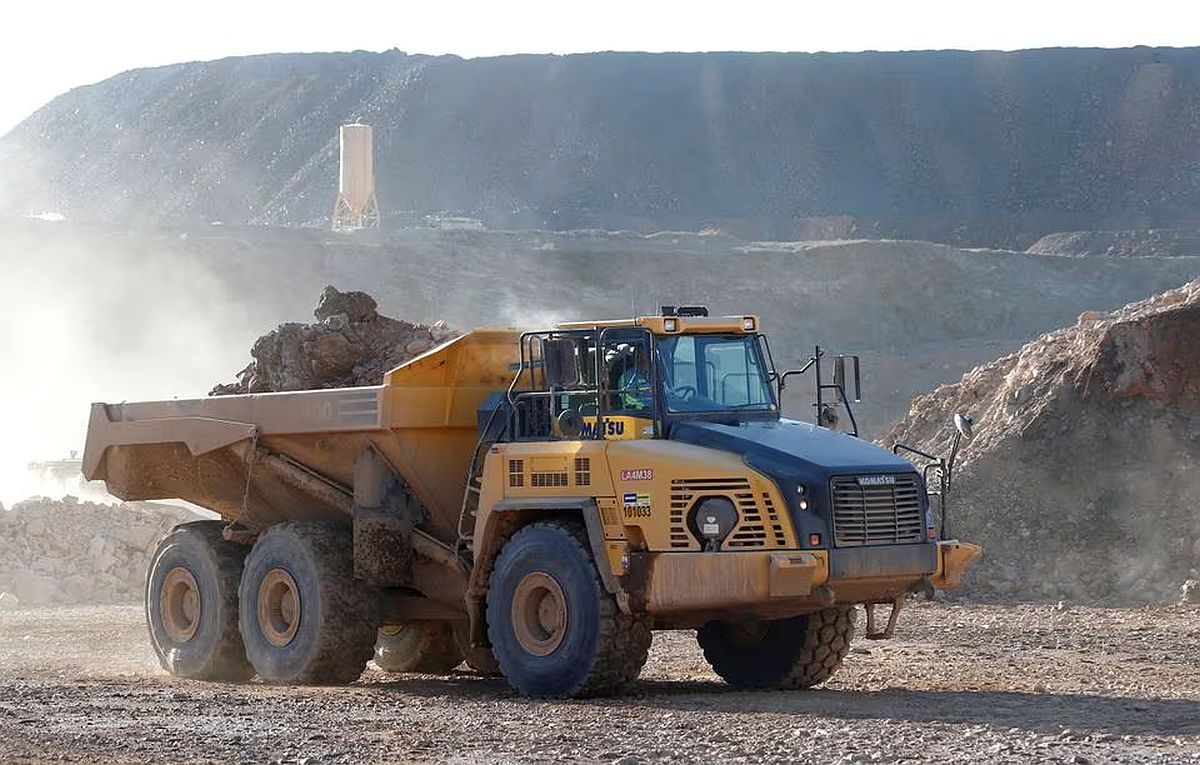
- The Pax Silica initiative facilitates deeper collaboration between the two nations on semiconductor manufacturing and critical minerals processing.
- India’s large youth population presents opportunities for a developer ecosystem and entrepreneurship in AI.
- The initiative addresses the problem of over-concentration in supply chains, which can lead to fragility.
- India actively participated in the Pax Silica Summit, engaging with global experts on resilient technology supply chains.
The US and India are on the same page on the need to de-risk single-point failures in global supply chains powering artificial intelligence technologies, a senior US official said on Friday. Pax Silica, a US-led initiative which brings together allied countries to secure AI supply chains, opens the door to deepen collaboration between India and the US on semiconductor manufacturing and critical minerals processing, US Under Secretary of State for Economic Affairs Jacob Helberg told reporters here.
Helberg said India has the potential to become a comprehensive partner and the governments in Washington and New Delhi were already working together on a whole array of different issues. “We already work together in a whole array of different issues, and Pax Silica opens the door to deepen our collaboration on semiconductor manufacturing, on critical minerals processing,” Helberg said on the sidelines of an event where Kazakhstan, Panama, Chile, Argentina, Costa Rica and El Salvador joined Pax Silica. “Our countries fundamentally share the exact same concerns about the fragility of the status quo in our supply chains,” Helberg said in reply to a question on India.
Strengthening Global AI Supply Chains
He noted that India is home to one of the largest youth populations in the world and the US saw opportunities in terms of promoting a developer ecosystem, entrepreneurship and jobs for the people of the two countries. “So we’re very excited to work with it,” Helberg said. The US official acknowledged that there was a problem of over-concentration of supply chains, and some such issues were not unique to China. “We think about it as a problem of over-concentration in our supply chains, and there are over-concentration issues that are not unique to China, and there are some that are,” he said. “Fundamentally, the issue is the supply chain right now is reliant on single points of failure, whether they be logistical or whether they be industrial,” Helberg said. “We are totally on the same page about the fact that these single points of failure need to be de-risked for the health of the global economy,” the US official said.
India’s Role In Pax Silica Summit
At the two-day second Pax Silica Summit held in Washington on Thursday, 35 nations signed the Joint Statement on AI Opportunity, aligning behind a pro-growth, pro-innovation regulatory approach for the AI era. India is represented at the Summit by S Krishnan, Secretary, Ministry of Electronics and Information Technology, Nagraj Naidu, Additional Secretary (Americas) in the Ministry of External Affairs, and representatives of the Indian industry. The Indian delegation engaged with other governments and industry experts on advancing collaboration in semiconductors, artificial intelligence, and resilient technology supply chains. Notably, India had already laid the groundwork for this alliance by being among the early invitees, originally joining the Pax Silica framework during the AI Impact Summit in New Delhi. Germany is a developed country with a strong economy; it has the largest economy in Europe by nominal GDP. Germany is a country of north-central Europe. Although Germany existed as a loose polity of Germanic-speaking peoples for millennia, a united Germany is a federal parliamentary republic with a chancellor who is the head of government, and a president who is the head of state.
Chile
It is the southernmost country in the world and the closest to Antarctica, extending along a narrow strip of land between the Andes Mountains. Chile, long, narrow country stretching along the western edge of South America, bordered by the Andes Mountains to the east. Chile is a long narrow country which extends like a ribbon down the west coast of South America.
Costa Rica
a country in Central America. It borders Nicaragua to the north, the Caribbean Sea to the northeast, Panama to the southeast. Greece, officially the Hellenic Republic, is a country of 10 million people on the southern tip of the Balkan peninsula in Southeast Europe. Greece is a country that is at once European, Balkan, Mediterranean, and Near Eastern. It lies at the juncture of Europe, Asia, and Africa. Greece has the longest coastline in Europe and is the southernmost country in Europe. The mainland has rugged mountains, forests, and lakes. Kazakhstan is the world’s ninth-largest country by land area and the largest landlocked country. Kazakhstan is the largest country in Central Asian and a former part of the Soviet Union. Kazakhstan is the ninth-largest country in the world, covering some 2.7 million square kilometres. Panama, officially the Republic of Panama, is a country located at the southern end of Central America in North America, bordering South America. This Central American country is bordered by Costa Rica and Colombia, and is situated between the Caribbean Sea and the North Pacific Ocean. Panama is a country in Central America that connects North and South America. India joined 34 other countries in endorsing the Joint Statement on AI Opportunity at the second Pax Silica Summit in Washington, backing a US-led initiative aimed at building trusted and resilient supply chains to support the development of artificial intelligence (AI) technologies.
The declaration reflects a shared commitment to a pro-growth and pro-innovation regulatory approach for the AI era. Announcing the initiative, Jacob Helberg, the US Under Secretary of State for Economic Affairs, said the participating nations had pledged to strengthen trusted supply chains, mobilise private-sector investment, and develop the infrastructure needed to power the next generation of AI. The latest signatories include India, Argentina, Germany, the Netherlands, Chile, Costa Rica, Greece, Kazakhstan, Panama and the European Union, among others.
India’s delegation at the summit was led by S. Krishnan, Secretary in the Ministry of Electronics and Information Technology, along with Nagraj Naidu, Additional Secretary (Americas) in the Ministry of External Affairs, and representatives from Indian industry.
During the summit, the Indian delegation held discussions with governments and industry leaders on expanding cooperation in semiconductors, artificial intelligence, and resilient technology supply chains.
Helberg said the future of AI would be shaped by countries that build the necessary infrastructure and capacity rather than those that regulate first. He stressed the need for greater investments in energy, computing power, semiconductor manufacturing, skilled talent and innovation to accelerate AI development. According to Helberg, the Pax Silica Initiative was launched in December last year by a small group of countries. India became part of the initiative in February during the AI Impact Summit held in New Delhi.
Addressing Tech Access and Security
A major highlight of the recent Washington summit involved strategic bilateral assurances. Amid growing tech competition and US national security reviews regarding advanced AI, US officials reassured India that it would retain unhindered access to critical, next-generation AI technologies and models as they are deployed. The United States also highlighted its broader tech partnership with India, focusing on the joint US-India TRUST initiative to map out long-term infrastructure and data center investments. India has joined 34 other nations at the Pax Silica Summit in the United States, signing the Joint Statement on AI Opportunity to strengthen global cooperation on artificial intelligence and build trusted, resilient technology supply chains.
The initiative focuses on expanding collaboration in key areas including AI infrastructure, semiconductors, advanced computing, energy, talent and private-sector innovation. US officials said the future of AI will depend on countries that build strong capabilities, increase computing capacity and invest in next-generation technologies.
Represented by senior officials from the Ministry of Electronics and Information Technology, the Ministry of External Affairs and Indian industry, India highlighted the importance of partnerships in shaping a secure and innovation-driven AI ecosystem.