
The AI-based toll system, known as Multi-Lane Free Flow (MLFF), is being implemented nationwide across Indian National Highways, with a target completion by the end of 2026. This technology aims to eliminate physical toll plazas and ensure a zero waiting time for vehicles, which can pass through toll points at speeds up to 80 km/h. AI-Based Digital Toll Collection Across India by 2026-End, Says Nitin Gadkari AI-enabled toll system to replace FastTag across India by 2026-end; aims to reduce wait time, save ₹1,500 crore in fuel and increase revenue by ₹6,000 crore.
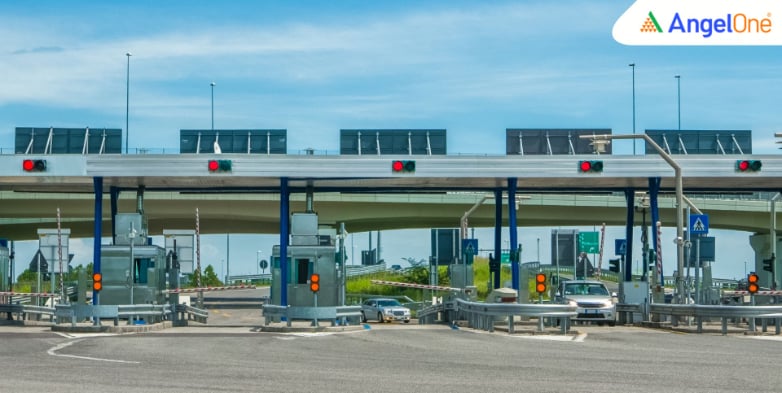
Union Minister Nitin Gadkari has announced that an AI-driven toll collection system will be operational across all national highways in India by the end of 2026.
This technological shift will replace existing FastTag systems with multi-lane free flow tolling, which will identify vehicles using number plate recognition and satellite tracking.
AI Technology Replacing FastTag for Seamless Tolling
The upcoming toll system will eliminate vehicle stoppages at toll plazas entirely. Vehicles will travel through toll points without needing to slow down, maintaining speeds of up to 80 km per hour.
The initiative uses advanced AI for number plate recognition combined with satellite technology to automatically deduct toll charges.
Currently, FastTag has reduced average toll payment time to under 60 seconds. This upgrade is expected to further bring it down to zero stoppage time. This new mechanism will bring in added transparency and significantly eliminate manual intervention along toll points.
Expected Savings and Revenue Increase
According to Nitin Gadkari, implementing the AI-powered tolling system will result in potential fuel savings amounting to ₹1,500 crore annually.
Additionally, it is projected to increase government toll revenue by ₹6,000 crore. The AI model will also minimise chances of toll evasion since the system will automatically recognise number plates and charge accordingly.
Scope of Implementation and Clarification on Roads
The implementation is focused only on national highways, excluding state highways and inner-city roads. The minister pointed out that grievances reported on social media often misidentify local or state roads as national highways.
He clarified that the central government is responsible only for national highways, and the AI toll system will apply to these roads alone.
Conclusion
By the end of 2026, commuters on national highways can expect an AI-based toll system without physical stoppages. This system aims to save travel time, reduce fuel consumption and boost transparency and toll collections.
Disclaimer: This blog has been written exclusively for educational purposes. The securities or companies mentioned are only examples and not recommendations. This does not constitute a personal recommendation or investment advice. It does not aim to influence any individual or entity to make investment decisions. Recipients should conduct their own research and assessments to form an independent opinion about investment decisions.
Investments in the securities market are subject to market risks, read all the related documents carefully before investing.
How the AI Toll System Works
The system is a combination of artificial intelligence, number plate recognition, and existing FASTag technology. AI-based highway management to be rolled out nationwide by 2026 Gadkari Union Road Transport and Highways Minister Nitin Gadkari on Wednesday said that the nationwide rollout of the multi-lane free flow (MLFF) tolling system along with AI-based highway management is expected to be completed by the end of 2026, a move aimed at eliminating waiting time at toll plazas.
Replying to a question in the Rajya Sabha, the Minister said the new system will enable vehicles to pass through toll points without stopping, significantly improving traffic flow and commuter convenience.
The MLFF system will allow vehicles to cross toll plazas at speeds of up to 80 kilometres per hour without any obstruction. Gadkari said the government’s objective is to bring waiting time at toll plazas down to zero minutes.
The system will operate using a combination of artificial intelligence-based number plate recognition, satellite tracking and FASTag integration to automatically identify vehicles and collect toll charges.
Gadkari assured the House that the MLFF scheme will be fully implemented across national highways by 2026. Once operational, it is expected to curb toll revenue leakage, smoothen traffic movement and reduce overall travel time.
Responding to supplementary questions, the Minister said commuters will no longer be required to halt at toll plazas, which will help save fuel and increase government revenue.
He noted that earlier toll payments took between three to ten minutes, which was reduced to under a minute with the introduction of FASTag. The shift to MLFF, he said, would further streamline the process, allowing vehicles to pass toll points at high speeds without stopping.
The Minister also informed the House that the adoption of digital tolling systems has already led to a significant rise in toll revenue, adding that the MLFF system would further enhance efficiency and transparency in highway management.
Automatic Number Plate Recognition (ANPR): High-resolution cameras installed above the highway will capture vehicle number plates as they pass without stopping.
AI and FASTag Integration: Artificial intelligence will process the number plate information and link it with the vehicle’s registered details and active FASTag account.
Automatic Deduction: The applicable toll fee will be automatically debited from the linked bank account or e-wallet.
Distance-Based Tolling: The system is expected to shift the current fixed-charge model to a “pay-as-you-use” system, where commuters are charged based on the actual distance traveled on the highway.
E-Challans for Violators: Vehicles without a FASTag or sufficient balance will be identified, and e-challans will be issued to the owner, potentially leading to penalties or suspension of vehicle-related services. No More Waiting At Toll Plazas: Indian Government To Implement AI-Based Free-Flow Tolling By 2026 The Union Minister for Road Transport and Highways, Nitin Gadkari, has announced that a new multi-lane free-flow tolling (MLFF) system with AI-driven highway management will be implemented across India’s national highways by the end of 2026. The announcement was made during a recent Parliament session. With this new AI-driven technology, commuters will not need to wait at toll plazas. The system will eliminate waiting time, save fuel worth Rs 1,500 crore, and increase the government’s revenue by Rs 6,000 crore. Earlier, with the introduction of FASTag, revenue has increased by at least Rs 5,000 crore, as quoted by the minister. Gadkari also believes that after implementing the multi-lane free-flow toll system, commuters can cross toll plazas at speeds of up to 80 km/h. He also highlighted the benefits of the FASTag system, which has reduced toll waiting time from 3-10 minutes to just 60 seconds. The government is aiming for zero waiting time at Toll Plazas. How does AI-Based Free-Flow Tolling collection work? This new technology will be based on number plate recognition using AI. When a vehicle passes through a toll plaza, the number plates are captured using high-resolution cameras. Then, with the help of AI technology, the number plate and the vehicle are identified along with its FASTag. Then, through automation, the toll fee will be deducted from the linked bank account. The minister also said, “By 2026, we will complete this work 100 per cent. Once this task is complete, fuel savings will reach ₹1,500 crore, our income will increase by ₹6,000 crore, and toll leakage will end. We are trying to make the system transparent and corruption-free. There will be no problems, and people will not have to stop at toll plazas.” This new technology will help travellers save time and fuel while reaching their destinations faster. However, the AI-based toll system will be implemented only on national highways and will not be extended to state highways or city roads. In the future, the government also plans to introduce satellite-based tolling, under which toll charges will be based on the actual distance travelled by the vehicle.
Benefits and Implementation
Union Minister Nitin Gadkari has highlighted several benefits of the new system:
- Zero Waiting Time: The primary goal is to bring the waiting time at toll plazas down to zero minutes, further reducing it from the current average of 47 seconds with FASTags.
- Fuel Savings: Eliminating stoppages is expected to save fuel worth approximately ₹1,500 crore annually.
- Increased Revenue and Transparency: The automated, transparent system is projected to boost government revenue by ₹6,000 crore and curb toll theft/leakage.
- Smoother Traffic Flow: The multi-lane free flow system will ensure seamless movement of traffic, enhancing overall efficiency and reducing congestion.
AI-based digital toll collection to be implemented across country by 2026-end: Gadkari New Delhi: The multi-lane free flow (MLFF) toll system and AI-driven highway management will be completed across the country by 2026-end, and after implementation, these technologies will eliminate wait time at toll plazas for commuters, Union Minister informed the Rajya Sabha on Wednesday. Responding to supplementaries during the question hour, the road transport minister said the new technology will be AI-based. Commuters will not have to wait any longer at toll plazas, and this will help save fuel worth Rs 1,500 crore and add Rs 6,000 to the government revenue.
“The multi-lane free flow toll (MLFF) is a very good facility. Earlier, we had to pay at the toll, and it would take 3 to 10 minutes then, due to FastTag, the time has come down to 60 seconds or less. Our income has increased by at least Rs 5,000 crore. After MLFF came, replacing FastTag, cars can now cross the toll at a maximum of 80 km per hour, and no one will be stopped at the toll,” he said in the House. “Our attempt is to make it to zero minutes, and this would involve number plate recognition through satellite with AI and FastTag,” he added.
“By 2026, we will complete this work 100 per cent, and once this task is complete, our income will help save Rs 1,500 crore, and our income will further rise by another Rs 6,000 crore, and toll theft will end. There will be no problems, and people will not have to stop at the toll plaza,” Gadkari told the members.
He said the new technology will certainly help people, and travel time will certainly be reduced. The minister said the government was, however, only responsible for national highways and not state highways or city roads. But, many times on social media, there are problems on state and city roads and are dubbed as if they happened on national highways, he said.
“We are trying to make the system transparent and corruption-free,” the minister told members. The system is currently in a pilot project phase on select national highways, with nationwide implementation targeted by the end of 2026, depending on the success and efficacy of the pilot outcomes. Clarification on Launch of Satellite-based Tolling System from 1st May 2025 Some sections of the media have reported that a Satellite-based Tolling System will be launched from 1st May 2025 and will replace the existing FASTag-based toll collection system. This is to clarify that no such decision has been taken by the Ministry of Road Transport and Highways or National Highways Authority of India (NHAI) regarding the nationwide implementation of satellite-based tolling from 1st May 2025.
In order to enable seamless, barrier-free movement of vehicles through toll plazas and reduce travel time ‘ANPR-FASTag-based Barrier-Less Tolling System’ will be implemented at selected toll plazas.
The advanced tolling system will combine ‘Automatic Number Plate Recognition’ (ANPR) technology, that will identify vehicles by reading their number plates, and the existing ‘FASTag system’ that uses Radio-Frequency Identification (RFID) for toll deduction. Under this, vehicles will be charged based on their identification through high performance ANPR cameras and FASTag Readers, without needing to stop at the toll plazas. In case of non-compliance, E-Notices will be served to the violators, non-payment of which may result in suspension of FASTag and other VAHAN related penalties.
NHAI has invited bids for the implementation of ‘ANPR-FASTag-based Barrier-Less Tolling System’ that will be installed at selected toll plazas. Based on the performance, efficiency, and user response to this system, a decision will be made regarding its implementation across the country. AI toll system: There’s great news for those troubled by long lines at toll plazas on highways across the country. Union Road Transport and Highways Minister Nitin Gadkari announced in the Rajya Sabha that the government will soon implement a Multi-Lane Free-Flow (MLFF) toll system and AI-based highway management. The AI-based Multi-Lane Free-Flow (MLFF) toll system is not yet operational nationwide in India but is planned for full implementation across all national highways by the end of 2026. Union Minister Nitin Gadkari recently announced this timeline in the Rajya Sabha, emphasizing the goal of achieving zero waiting time at toll plazas. The multi-lane free flow (MLFF) toll system and AI-driven highway management will be completed across the country by 2026-end, and after implementation, these technologies will eliminate wait time at toll plazas for commuters.
Union Road Transport and Highways Minister Nitin Gadkari informed the Rajya Sabha that India is on the verge of a major transformation in highway travel. Responding during Question Hour, he explained that the upcoming MLFF system will replace existing toll mechanisms and ensure seamless movement without stopping at toll plazas.
According to Gadkari, while FASTag has already reduced waiting time to under a minute, the MLFF system aims to bring it down to zero. Vehicles will be able to cross toll points at speeds of up to 80 km per hour using a combination of satellite-based number plate recognition, AI technology, and FASTag integration. The system will automatically deduct toll charges, completely eliminating queues and congestion.
The minister highlighted the economic impact of this transition, stating that commuters will save fuel worth nearly ₹1,500 crore annually, while government revenue is expected to rise by an additional ₹6,000 crore. He also noted that toll leakage and theft would be effectively eliminated.
Beyond financial gains, Gadkari emphasized that reduced travel time will significantly improve productivity and driving experience on national highways. With full nationwide implementation targeted by the end of 2026, the MLFF initiative represents a decisive step toward smarter, faster, and more efficient road infrastructure in India.
Key Details of the New System
Scope: This new system will only apply to national highways, as the central government is not responsible for state highways or city roads.
Zero Waiting Time: The primary goal is to eliminate all wait times at toll plazas, allowing vehicles to pass through at speeds up to 80 km/h without stopping.
Technology: The system will use a combination of Artificial Intelligence (AI), satellite-based tracking, and automatic number plate recognition (ANPR) integrated with the existing FASTag system.
Automatic Deduction: Toll charges will be automatically debited from the vehicle owner’s linked bank account or FASTag account as they pass through the toll point.
Benefits:
Annual fuel savings for commuters estimated at around ₹1,500 crore.
Increased government revenue by an additional ₹6,000 crore annually due to reduced leakage and theft.
Enhanced transparency and a corruption-free collection process.
Scope: This new system will only apply to national highways, as the central government is not responsible for state highways or city roads.
Description
The Union Government aims to implement the multi-lane free flow (MLFF) tolling system across India, along with artificial intelligence-enabled highway management, by the end of 2026. The initiative is designed to eliminate delays at toll plazas and significantly improve travel efficiency on national highways.
Zero Waiting Time at Toll Plazas
Union Road Transport and Highways Minister Nitin Gadkari informed the Rajya Sabha that the MLFF system will allow vehicles to pass through toll points without stopping. The system targets zero waiting time, enabling vehicles to cross toll locations at speeds of up to 80 km/h. This will ensure smooth traffic flow and greater convenience for commuters.
Technology Behind MLFF
The MLFF system will leverage a combination of AI-based number plate recognition, satellite tracking, and FASTag integration to automatically identify vehicles and deduct toll charges. This fully digital mechanism is intended to reduce manual intervention, prevent errors, and streamline toll collection processes.
Benefits for Traffic and Revenue
According to the Minister, the system will enhance traffic movement, reduce travel time, and save fuel by eliminating stoppages at toll plazas. It is also expected to curb revenue leakage and enhance transparency. While FASTag has already reduced toll payment times from 3–10 minutes to under a minute, the MLFF system is set to take efficiency even further.
Advancing Digital Highway Management
Minister Gadkari highlighted that digital tolling has already contributed to a significant increase in toll revenue. With the introduction of MLFF, highway management is expected to become more efficient and transparent, reinforcing India’s transition towards technology-driven and smart transport infrastructure.
Welcome to Notopedia.com, your free learning platform that caters to the diverse needs of students and aspirants across a spectrum of entrance exams and educational endeavors. Whether you’re preparing for highly anticipated exams like CAT, NEET, JEE Main, or bank job vacancies, our platform offers a wealth of resources to guide you towards success. Stay up-to-date with the latest exam dates, announcements, and results for various government recruitment exams, including SSC CGL, CHSL, NDA, and UPSC. Explore comprehensive study materials, sample papers, and exam patterns to hone your skills and boost your confidence. From important dates like CBSE Class 10 and 12 date sheets to exam-specific information like JEE Main application form date, we cover it all. Notopedia.com is your go-to source for everything from admissions and admit cards to scholarships and college information. Whether you’re aiming for a career in defense, government, banking, or higher education, our free learning platform equips you with the knowledge and resources you need to excel. Join us in your educational journey and unlock a world of opportunities, guidance, and comprehensive support.
Currently, pilot projects for the ANPR system are underway in around 10 locations across the country. The existing FASTag system has already reduced average waiting times from several minutes to under 60 seconds, and the MLFF system is the next step towards a fully seamless experience. The multi-lane free flow (MLFF) toll system and AI-driven highway management will be completed across the country by 2026-end, and after implementation, these technologies will eliminate wait time at toll plazas for commuters.
Union Road Transport and Highways Minister Nitin Gadkari informed the Rajya Sabha that India is on the verge of a major transformation in highway travel. Responding during Question Hour, he explained that the upcoming MLFF system will replace existing toll mechanisms and ensure seamless movement without stopping at toll plazas.
According to Gadkari, while FASTag has already reduced waiting time to under a minute, the MLFF system aims to bring it down to zero. Vehicles will be able to cross toll points at speeds of up to 80 km per hour using a combination of satellite-based number plate recognition, AI technology, and FASTag integration. The system will automatically deduct toll charges, completely eliminating queues and congestion.
The minister highlighted the economic impact of this transition, stating that commuters will save fuel worth nearly ₹1,500 crore annually, while government revenue is expected to rise by an additional ₹6,000 crore. He also noted that toll leakage and theft would be effectively eliminated.
Beyond financial gains, Gadkari emphasized that reduced travel time will significantly improve productivity and driving experience on national highways. With full nationwide implementation targeted by the end of 2026, the MLFF initiative represents a decisive step toward smarter, faster, and more efficient road infrastructure in India. The government is set to roll out an advanced, AI-driven digital toll collection system across India by the end of 2026, a move aimed at eliminating waiting time at toll plazas and improving travel efficiency on national highways.
Why Acuvisor Insurance ?
Acuvisor Insurance Brokerage sets itself apart with a combination of technology-driven solutions, expert guidance, and customer-centric services. Acuvisor integrates Artificial Intelligence (AI) to simplify the insurance journey. Our AI-driven chatbot, Acubunny, provides real-time support, instant policy recommendations, and seamless customer interactions, making insurance more accessible and hassle-free. Acuvisor isn’t just about selling insurance—it’s about empowering customers with the right knowledge, tools, and support to make smart insurance decisions effortlessly.
When you choose Acuvisor, you’re choosing a trusted leader in the insurance industry. We believe in reliability over cheap options, offering tailored solutions that meet your specific needs. We value customer trust above all else and are committed to being your partner throughout your insurance journey. We honor that trust with every step we take. Acuvisor Dashboard: Your Insurance Management Hub
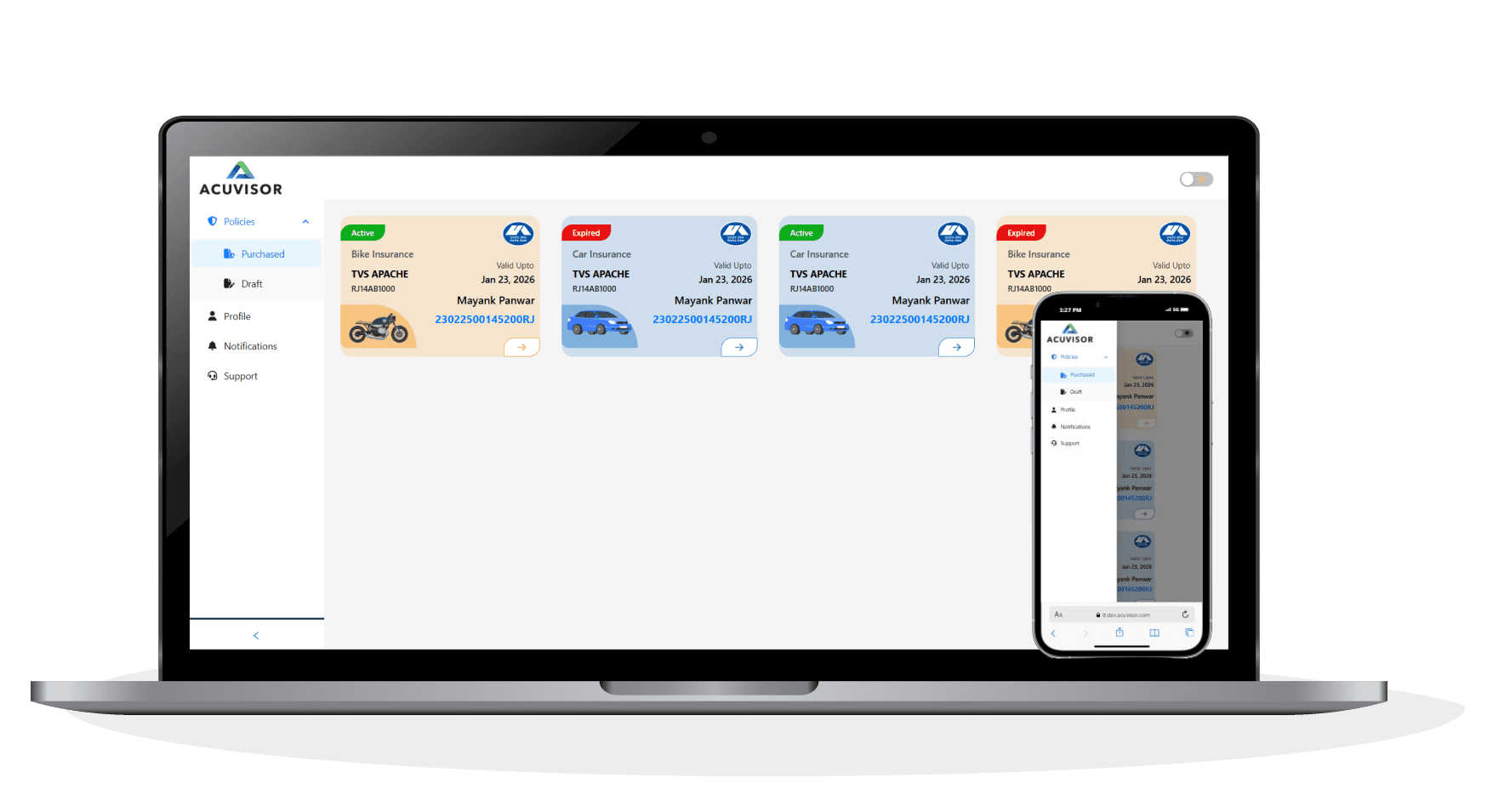
With the Acuvisor Dashboard, you have the tools to take control of your financial security with confidence and ease. This all-in-one platform allows you to effortlessly manage your insurance policies. Key features include:
Manage Policies
Easily view and track all your active, expired, and pending policies in one convenient location. Support access timely assistance for any inquiries or claims, ensuring you receive the help you need when you need it. Notification stay informed with alerts about policy renewals and expirations, helping you maintain continuous coverage.
Human Life Value (HLV)
Human life value or HLV is an indicator of your insurance requirement based on your income and its future worth. It is defined as the present value of your future earnings, liabilities, savings, and investments. Based on your HLV, you can gauge the finances your dependents will need to fund their expenses in your absence or unfortunate demise. Basically, you should insure a cover that is equivalent to your HLV for the people that depend on you to sustain their lifestyle.
To Start as a POSP
A POSP (Point of Sales Person) in the insurance industry is a trained advisor who helps customers find and purchase insurance policies from reliable providers. POSP agents simplify policy options, provide expert advice, and create a seamless buying process that prioritizes trust and transparency.
Acuvisor Insurance Brokers that will enable training of aspiring insurance professionals and will also sell specifically designed products.
It aims to create an army of well-trained point of sale persons (PoSPs) in insurance who would be allowed to sell only specifically designed insurance products.
Acuvisor seeks to expand its geographical footprint across most tier-II and tier-III cities, and the rural areas across India with a targeted PoSP salesforce of 100,000.
Commenting on the launch, Chief Mentor of Acuvisor Vasant Pandit said, “We hope to provide an opportunity for many youths looking for a career in sales and marketing to learn basic marketing skills for free, and provide a bridge to take them over the knowledge gap that so many of them face.”
The app will also have a presentation for prospective clients and help them identify their insurance needs. This would enable PoSPs to calculate the human life value and recommend suitable insurance policies for free. Electric Vehicles Drop in Price, but Most Remain Unprofitable The automotive industry is under pressure to reduce emissions, both from government regulations and from consumers who are growing more conscious about the environmental impact of their vehicles. Electrified powertrains are a promising avenue to reduce or eliminate vehicle emissions for automakers.
Lux Research is a trusted advisor to innovation, technology, and insights leaders at the world’s biggest brands.
We cut through the hype to drive business results, leveraging deep expertise in emerging technologies, market dynamics, policy shifts, and consumer behavior — empowering clients to validate near-term opportunities, accelerate product development, uncover new markets, and transform business models.
In 2016, there were 210 million electric bikes worldwide used daily. In China, plug-in electric vehicles, together with hybrid electric vehicles are called new energy vehicles (NEVs) However, in the United States, (NEVs) are battery electric vehicles that are legally limited to roads with posted speed limits no higher than 45 miles per hour (72 km/h), are usually built to have a top speed of 30 miles per hour (48 km/h), and have a maximum loaded weight of 3,000 pounds (1,400 kg). There is still a long way to go if comparing it to petroleum-based fuels and biofuels, however (gasoline having an energy density of 34.2 MJ/L -38x to 12.92x higher- and ethanol having an energy of 24 MJ/L -26x to 9.12x higher-). This is partially offset by higher conversion efficiency of electric motors – BEVs travel roughly 3x further than similar-size internal combustion vehicles per MJ of stored energy. Battery electric trams eliminate the need for overhead wires, which can be beneficial in historic city centers or where overhead wires are not desirable otherwise.
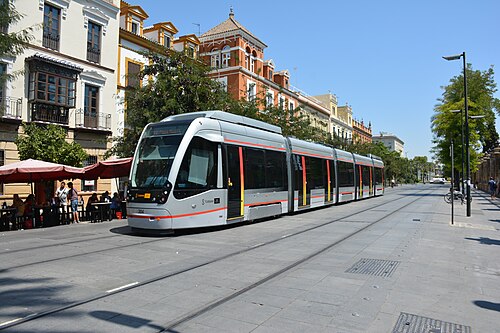
Due to the frequent stops of trams, the batteries can be charged at every stop, where energy is rapidly stored in a combination of supercapacitors and batteries. The bus was one of four the district ordered. This battery-electric school bus, which has four sodium nickel batteries, is the first modern electric school bus approved for student transportation by any state. In 2016, including the light heavy-duty vehicles, there were roughly 1.5 million heavy-duty vehicles in California.
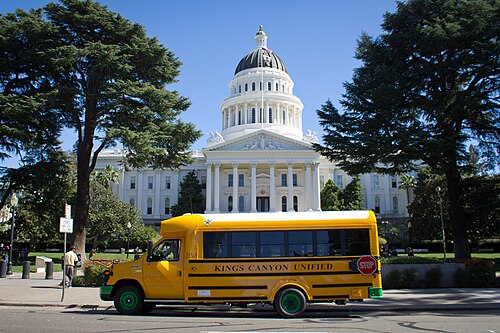
The same technology is used to power the Mountain View Community Shuttles. This technology was supported by the California Energy Commission, and the shuttle program is being supported by Google.
The Formula E championship is currently contested by ten teams with two drivers each (after the withdrawal of Team Trulli, there are temporarily only nine teams competing). Racing generally takes place on temporary city-center street circuits which are approximately 2 to 3.4 kilometres (1.2 to 2.1 mi) long. Currently, only the Mexico City ePrix takes place on a road course, a modified version of the Autódromo Hermanos Rodríguez. India is the world’s biggest market for bicycles at 22 million units per year. By 2024, electric two-wheelers will be a $2 billion market with over 3 million units being sold in India. The Indian government is launching schemes and incentives to promote the adoption of electric vehicles in the country, and is aiming to be a manufacturing hub for electric vehicles within the next five years. China has experienced an explosive growth of sales of non-assisted e-bikes including the scooter type, with annual sales jumping from 56,000 units in 1998 to over 21 million in 2008, and reaching an estimated 120 million e-bikes on the road in early 2010. China is the world’s leading manufacturer of e-bikes, with 22.2 million units produced in 2009.

Vehicle construction
GHGs are also emitted when the electric vehicle is being manufactured. The lithium-ion batteries used in the vehicle take more materials and energy to produce because of the extraction process of the lithium and cobalt essential to the battery. This means the bigger the electric vehicle, the more carbon dioxide emitted. The same size-to-emission relationship applies to manufacturing of all products.
Terrestrial Mining
The mines that are used to produce the lithium and cobalt used in the battery are also creating problems for the environment, as fish are dying up to 240 km (150 mi) downstream from mining operations due to chemical leaks and the chemicals also leak into the water sources the people that live near the mines use, creating health problems for the animals and people that live nearby.
Multi-Lane Free Flow Toll System to Enable Zero Waiting at National Highways
The Union Government has announced plans to complete the nationwide rollout of the Multi-Lane Free Flow (MLFF) tolling system , integrated with artificial intelligence-based highway management , by the end of 2026 . The initiative marks a major shift in India’s road infrastructure strategy, aiming to eliminate congestion at toll plazas and significantly improve travel efficiency on national highways.
Zero Waiting Time at Toll Plazas
Union Minister for Road Transport and Highways Nitin Gadkari , while responding in the Rajya Sabha, stated that the MLFF system will allow vehicles to cross toll points without stopping . The goal is to bring waiting time at toll plazas down to zero minutes . Under this system, vehicles will be able to pass through toll locations at speeds of up to 80 kmph , ensuring uninterrupted traffic flow and a smoother driving experience for commuters.
Technology Framework Behind MLFF
The MLFF tolling mechanism will function through a robust, integrated digital framework. It will combine AI-based number plate recognition (ANPR) , satellite tracking , and FASTag integration . This technology will automatically identify vehicles, calculate toll charges, and deduct fees without any physical barriers or manual checks. The system is designed to reduce human intervention, minimise errors, and enhance operational reliability.
Traffic Efficiency and Revenue Gains
According to the Minister, MLFF is expected to substantially reduce travel time and fuel consumption by removing frequent stoppages at toll plazas. It will also help curb toll revenue leakage and improve transparency in toll collection. Gadkari noted that FASTag had already reduced toll payment time from 3–10 minutes to under one minute , and MLFF would take efficiency to an even higher level.
What to Note for Exams?
- MLFF stands for Multi-Lane Free Flow tolling system.
- Nationwide rollout target: by the end of 2026 .
- Uses AI, satellite tracking and FASTag technologies.
- Vehicles can cross toll points at speeds of up to 80 kmph .
Digital Highway Management Vision
The government highlighted that digital tolling has already resulted in a significant rise in toll revenues. With the introduction of MLFF and AI-driven highway management, India is expected to achieve greater efficiency, transparency and sustainability in road transport, reinforcing the shift towards smart and technology-enabled national highways .
Key Details of the New AI Toll System
- Zero Waiting Time: The primary goal is to completely eliminate queues and congestion at toll plazas, which the current FASTag system has already reduced to under a minute.
- Technology: The system will integrate AI-based number plate recognition (ANPR) cameras, satellite tracking, and existing FASTag technology. Toll charges will be automatically deducted as the vehicle passes the toll point.
- Nationwide Rollout: The government is aiming for 100% implementation across all national highways by the end of 2026. Pilot programs have already been successfully conducted at 10 locations.
- Benefits: Union Minister Nitin Gadkari highlighted several advantages:
- Fuel Savings: Commuters are expected to save fuel worth around ₹1,500 crore annually due to the elimination of stoppages.
- Increased Revenue: Government revenue from tolls is projected to rise by an additional ₹6,000 crore annually.
- Reduced Theft: The transparent, automated system is expected to curb toll leakage and theft.
- Efficiency: Travel time will be significantly reduced, and the overall commuting experience on national highways will be improved.
Multi-Lane Free Flow (MLFF) Tolling System
News: The Union Road Transport Minister informed the Rajya Sabha about the nationwide rollout of the MLFF tolling system by 2026.
About Multi-Lane Free Flow (MLFF) Tolling System

- The Multi-Lane Free Flow tolling system is a barrier-free digital toll collection system that allows vehicles to pass toll points without stopping.
- Initiated by: The system has been initiated by the National Highways Authority of India through its subsidiary Indian Highways Management Company Limited.
- Technologies used : Each tolling point will be equipped with:
- Automatic Number Plate Recognition (ANPR) cameras at the front and rear to capture license plates.
- High-performance RFID readers that detect and authenticate FASTag information.
- Artificial intelligence-enabled software for precise optical character recognition and data validation.
- LiDAR-based sensors for accurate vehicle classification.
- Working mechanism
- When a vehicle passes through a toll, its registration number and FASTag details are automatically identified, verified, and processed for real-time toll deduction through the NPCI network.
- Each site will have a bank or financial entity partnered with a system integrator to manage and operate the tolling system.
About Indian Highways Management Company Limited
- Indian Highways Management Company Limited was incorporated jointly by NHAI, its concessionaires, and financial institutions.
- It was established on 26 December 2012.
- The shareholding pattern of stakeholders is NHAI-41.38%, Concessionaires-33.81% and Financial Institutions 24.81%.
- The company was formed under the Companies Act, 1956 to carry out electronic tolling and allied works of NHAI.
- Functions
- IHMCL implements the FASTag-based Electronic Toll Collection system and deploys Intelligent Transport Systems, including GIS-based tracking and AI-driven traffic management, on national highways.
- It manages the 1033 toll-free helpline and the toll clearinghouse, and has moved toward data monetisation to share insights with enforcement agencies.
