
A glimpse into India’s heart
In the heart of India lies a realm where history whispers through ancient corridors, where nature’s beauty reigns supreme, and where vibrant cultures flourish in harmony with the land. Madhya Pradesh, a state steeped in captivating narratives, stands as a testament to the richness of India’s heritage and the magnificence of its diverse landscapes. The state boasts of three UNESCO World Heritage sites that serve as living testimonies to its historical significance.
Unveiling one of the oldest stone structures in India
56 kilometres northwest of bustling Bhopal, Sanchi Stupa emerges as an enchanting marvel of historical architecture. Recognised as a UNESCO World Heritage Site since 1989, this sacred enclave cradles the revered relics of Buddha and his devoted followers, and stands as an unparalleled testament to Buddhist art and architecture. The magnificence of Sanchi transcends mere architectural grandeur; its intricately carved doorways narrate the sacred tales of Lord Buddha’s life and the profound teachings encapsulated in Buddhist Jataka stories. Adorning the stupas are majestic toranas, symbolic of harmony, faith, and bravery, infusing the surroundings with spiritual reverence.
The tale of Sanchi Stupa unfolds in the 3rd century BCE when the visionary Mauryan Emperor Ashoka ordered its construction, an ode to Buddhism following the horrors of war, thereby illustrating an impressive testament of spiritual devotion. Over centuries, from a modest brick structure to an exquisite masterpiece, Sanchi evolved. Rulers like the Satavahanas, Guptas, and Kushanas left their mark, adding stone casings, intricately carved railings, and mesmerising gateways, enhancing its beauty—testaments to ancient India’s exquisite craftsmanship.
Sanchi Stupa received a resurgence of interest when Sir Alexander Cunningham discovered its remains during a 19th-century archaeological expedition. Through tireless excavation and restoration efforts, it now magnetises visitors globally, drawing them to experience the spiritual energy within its ancient walls.
The gateway to Buddha’s life and learnings
Immerse in the splendour of Sanchi Stupa’s four torana gateways, each a blend of architectural brilliance and rich symbolism, representing courage, peace, love, and trust. Explore their history as their carvings echo tales from Buddha’s life, offering insights into ancient art forms and spiritual practices.
The toranas and balustrades, adorned with intricate carvings added during the Satavahana reign, divulge the stupa’s journey through time. Scenes from Buddha’s life, depicted with remarkable detail, grace these ancient structures. Symbolic representations of the Buddha, including the tree, wheel, throne, and footprint, create an ethereal atmosphere, inviting contemplation of his teachings’ profound essence.
Another wonderful piece of sculpture is pillar of finely polished sandstone, the Ashoka Pillar, stands beside the main torana gateway of the Sanchi Stupa. Though its lower part remains at the site, the upper parts, including the capital with four lions, are housed in the nearby Sanchi Archaeological Museum. The pillar, originally about 42 feet tall, featured a monolithic shaft with a bell-shaped capital, an abacus adorned with flame palmette designs and geese, and four back-to-back lions supporting a Wheel of Law. The pillar bears inscriptions in early Brahmi and ornamental Sankha Lipi from the Gupta period. Crafted from sandstone quarried at Chunar, the pillar’s transportation over several hundred miles likely involved rafts on rivers during the rainy season, showcasing the remarkable engineering and sculptural skills of the time.
A world of experiences
Visiting the Sanchi Stupa complex offers you multi-layered experiences catering to varied interests. Leisurely strolls through its structures such as temples and monasteries offer glimpses into history, while admiring intricate architectural features adorning both stupa and toranas showcases ancient craftsmanship. Picnicking or relaxing by central pools amidst the tranquil ambience provides solace. Delve deeper into Buddhist history and culture with guided tours, attending Buddhist prayer ceremonies to immerse in the serene atmosphere. Capture these poignant moments, preserving memories of a journey into the past.
Beyond marvelling at its vast expanse containing three stupas designed by monks for worship, another highlight is the Great Bowl, a monumental stone vessel symbolising centuries-old traditions of communal blessings and food sharing among devout monks, fostering a sense of community spirit. Its very presence inspires unity and compassion among followers! The stupa’s unique hemispherical shape and square pedestal carry cosmic significance, embodying the ancient belief in Earth supporting Heaven and Heaven enveloping Earth, reflecting upon the interconnectedness of all things. Look out for the awe-inspiring statues of Yakshas, mystical beings believed to come to life at night, adding enchantment to the surroundings.

Unearthing the stories from 30,000 years ago
A UNESCO World Heritage Site that consists of seven hills and over 750 rock shelters distributed over 10 km, Bhimbetka caves are a treasure trove of natural beauty and ancient history. The stunning rock paintings of Bhimbetka, which date back to the Mesolithic, Paleolithic, and Neolithic periods are unmissable.
Located 45 kms from Bhopal near the small village of Bhiyapura, along the beautiful Bhopal-Hoshangabad highway, these rock shelters exist as a natural formation and, at the same time, exist like sets for monumental storytelling of human civilisation. According to the legend, the name “Bhimbetka” is derived from the sitting place of Bhima during Pandavas’ exile, an episode from the famous Mahabharata.
The Bhimbetka Rock Shelters do much more than guard the humans they once served; the rocks present canvasses for a stunning picture of ancient artistry. With paintings up to 30,000 years old, this is a direct line to our ancestors: the Upper Paleolithic humans who roamed the land. The vibrant scenes depicted in these ancient murals give us a peek into the daily lives of early humans here. From hunting and gathering to rituals and celebrations, the rich reds, and calming whites of natural pigments pull you into a narrative told by the early artists who chose these caves as their canvas.
Marvel at the vision of ancient architects
Surrounded by towering quartzite formations visible from several kilometres away, the most imposing of all the towering rock formations of Bhimbetka is the Auditorium Cave, the largest shelter at Bhimbetka. As you step inside this prehistoric wonder, you’ll be transported to a world of awe and wonder, where Gothic arches and soaring spaces create a “cathedral-like” atmosphere that is truly magnificent. A central and distinctive structure at the cave’s entrance is a boulder with a near-vertical panel, which only from the point of view of archaeology, and not historical evidence, is dubbed as the “Chief’s Rock” or “King’s Rock”.

Madhya Pradesh is also called the ‘Tiger State of India,’ a title well-deserved as its national parks and wildlife reserves provide a sanctuary for these majestic creatures. Within its sprawling forests and lush landscapes, the elusive tigers roam freely, embodying the untamed spirit of the wild and adding to the state’s allure as a biodiversity hotspot.

Sanchi Stupa
A mosaic of time and temples
Madhya Pradesh is a canvas on which the strokes of time are painted in hues of architectural splendour and spiritual reverence. The state proudly boasts of magnificent temples that stand as symbols of devotion and architectural brilliance. From the intricate carvings of Khajuraho Group of Monuments, a UNESCO World Heritage Site, to the spiritual aura of Ujjain’s Mahakaleshwar Temple, each structure narrates a tale of faith and artistic prowess.Venture further into this state of rich culture and history, and you’ll uncover more gems that adorn the landscape.
From captivating historical sites to vibrant local experiences
In the Bundelkhand region of Madhya Pradesh, ‘Orchha’, whose name means a hidden gem, is a UNESCO World Heritage City. Rudra Pratap Singh founded the kingdom of Orchha in the 15th century, but Akbar under the Mughal Empire captured it. Jahangir later gifted it to Vir Singh Bundela in the 16th century as a token of loyalty. Under the Bundela reign, Orchha flourished with its unique Indo-Muslim architectural style monuments, resulting from the cultural amalgamation of the Rajput kingdom in the Mughal era.

Orchha Fort
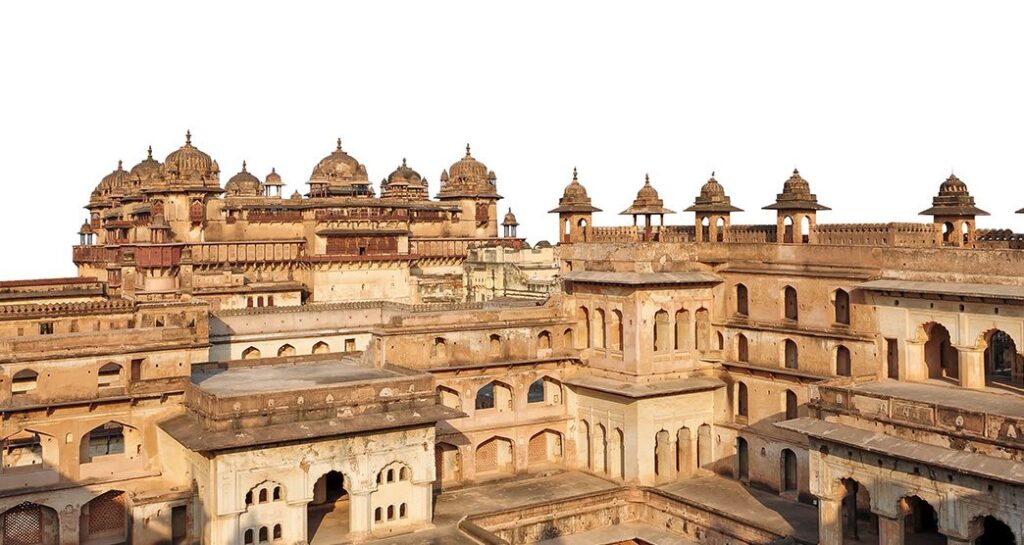
At its heart, the Orchha Fort complex has three magnificent palaces.
A fusion of Mughal and Rajput architecture
Within the grand fort complex and adjacent to the iconic Jahangir Mahal stands the Raja Mahal as an impressive testament of exquisite craftsmanship from another age. Built by Madhukar Shah during the 16th century, this architectural marvel offers you an enjoyable and peaceful experience adorned with captivating architecture that allows you to immerse in timeless beauty. As soon as you step inside the Raja Mahal, its stunning blend of Mughal and Rajput architecture will captivate your attention. Its elegant arches demonstrate the craftsmanship and skill of its architects and artisans and leave you spellbound by its beauty.
The palace’s rich history and cultural significance make it a beloved landmark of the region, drawing visitors from near and far. Step inside its grand Durbar Hall where its towering arches support massive pillars. Step through and discover its mesmerising murals featuring scenes from Hindu mythology which create a mesmerising visual spectacle. Over the years, Raja Mahal has undergone meticulous conservation efforts and restoration, returning it to its former splendour. The State Archaeological Department has played an essential role in protecting this architectural masterpiece and assuring its continued significance as both cultural and historical landmark.
Incredible tales of Raja Mahal
Raja Mahal is not just an architectural feat, its walls are full of captivating tales. Bundela Rajput King Madhukar Shah was an avid devotee of Lord Krishna while Rani Ganesh Kunwari, Madhukar Shah’s wife was dedicated to Lord Rama. According to legend, one day both King (Raja) and Queen (Rani) decided to undertake pilgrimages, the king preferred Mathura while Queen Ganesh Kunwari insisted upon visiting Ayodhya. After engaging in a heated debate over their pilgrimages’ destinations, neither could change either party’s mind. After becoming frustrated with the situation, the King became very infuriated and told the Queen to travel alone to Ayodhya and bring back her deity within 72 hours or face being barred entry at Raja Mahal.
The queen made her way to Ayodhya and began praying earnestly, yet Lord Rama did not appear after two to three months of waiting. Feeling despaired, she considered suicide by leaping into the Saryu River yet miraculously as soon as she made contact with water, Lord Rama appeared before her and expressed his pleasure with her devotion. Then Lord Rama agreed to accompany her but placed three conditions upon this offer.
At first, Ayodhya to Orchha had to be travelled on foot for 24 hours during Pushya Nakshatra when the queen brought Lord Rama to Orchha. Pushya Nakshatra proved most auspicious for this purpose. The second condition was that wherever Lord Rama dwelt, he should be treated as a monarch. At Orchha, Raja Madhukar Shah gave Lord Rama his crown and conducted his royal coronation ceremony; thus, creating this unique temple where Lord Rama is worshipped as an actual monarch with guards of honour being placed around it.
At last, Lord Rama’s first seat in Orchha would become his temple. According to legend, Madhukar Shah began construction of Chaturbhuj Temple for Lord Rama; however, when Queen Arundhati arrived the construction remained incomplete, and she placed Lord Rama in her kitchen instead as per Hindu tradition where kitchens are seen as holy after temples are completed – thus giving Orchha its divine capital status and becoming home for Ram Raja Temple in kitchen.
Narmadapuram is a city and a municipality in Narmadapuram district in the Indian state of Madhya Pradesh. It is a city in the central India region. Narmadapuram Division is one of the administrative divisions in the Indian state of Madhya Pradesh. Its capital is in Hoshangabad, officially Narmadapuram. Narmadapuram is a city and a municipality in Narmadapuram district in the Indian state of Madhya Pradesh. It is a city in the central India region. Bhopal Division is an administrative geographical unit of Madhya Pradesh state of central India. Bhopal is the administrative headquarters of the division. Bhopal railway division was formed on 1 July 1987 as part of then the Central Railway. It is the second largest division of West Central Railway. Gwalior is a city in Madhya Pradesh, India. Explore its rich history and culture, with beautiful monuments like the Gwalior Fort and Sas-Bahu Temples. District At a Glance (As Per Census 2011) · Area: 4560 Sq. Km. · Population:2032036 · Urban Population :1273792 · Rural Population :758244 · Male: 1090327. Morena is the administrative headquarters of the division. As of 2012, the division consists of the three districts of Bhind, Morena and Sheopur. The three districts of Madhya Pradesh Sheopur, Morena and Bhind are under Chambal division. Moisture arriving from the Arabian Sea and the Bay of Bengal, coupled with a Western Disturbance, is driving this turbulent weather. The Heatwave Contrast: Despite the incoming rain, temperatures remain intensely high across the state before the storms hit. MP weather update: Thunderstorm alert for 11 districts while heatwave intensifies in Bhopal, Indore, and Jabalpur
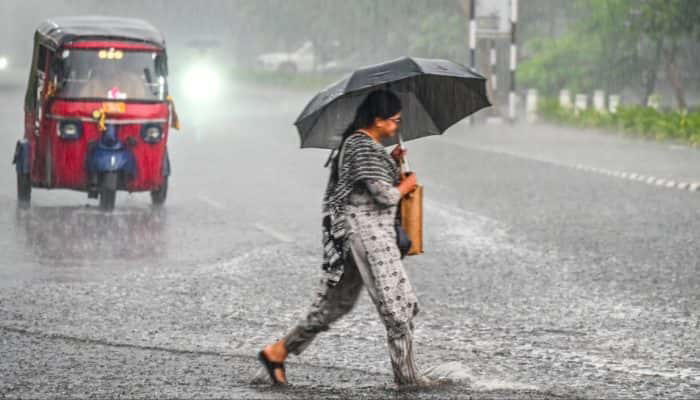
Thunderstorm alert for 11 districts while heatwave intensifies in Bhopal, Indore, and Jabalpur
MP weather update: The Meteorological Centre in Bhopal has reported a sharp contrast in weather conditions across Madhya Pradesh. While thunderstorms and rainfall were recorded at isolated places in the Gwalior, Chambal, and Jabalpur divisions over the past 24 hours, most other regions remained dry. The weather office in Bhopal has predicted that moderate thunderstorms accompanied by lightning and wind speeds of up to 60 kmph are likely over Sheopur Kalan, Kuno National Park, and southern parts of Morena district during the evening hours on Thursday.
Light thunderstorms accompanied by lightning are also likely over Betul, Chhindwara, Pandhurna, Pench, southern parts of the Seoni district, western parts of the Gwalior district, Shivpuri, and northern parts of the Guna district.
Maximum temperatures showed little change but remained significantly below normal in several divisions.
Gwalior and Rewa districts recorded departures of up to 5.8 degrees Celsius below normal, while the Bhopal, Indore, and Jabalpur divisions reported temperatures ranging from 1.6 to 2.9 degrees below average.
Minimum temperatures also dipped, with Bhopal recording temperatures 5.3 degrees below normal. The lowest minimum temperature was recorded in Amarkantak at 16.1 degrees Celsius, while Sheopur registered the highest minimum temperature at 26.2 degrees Celsius, according to the weather bulletin issued on Thursday.
Narsinghpur recorded the state’s highest maximum temperature at 42.2 degrees Celsius, while Amarkantak remained the coolest place at 33 degrees Celsius.
Rainfall was recorded in Gohad (9.5 mm), Balaghat (9.4 mm), and Waraseoni (7.2 mm). Gusty winds reached 67 kmph at Gwalior Airport and 30 kmph in Betul.
Looking ahead, the India Meteorological Department (IMD) has issued alerts for thunderstorms, lightning, and gusty winds with speeds of 40-50 kmph in 11 districts, including Gwalior, Morena, Bhind, Datia, Niwari, Tikamgarh, Chhatarpur, Panna, Satna, Rewa, and Mauganj.
These regions are expected to experience spells of rain and strong winds on Thursday. The department attributed the turbulent weather conditions to the combined impact of a western disturbance, cyclonic circulation, and a trough line. Meanwhile, heat conditions continue to trouble residents in most other districts.
Daytime temperatures are expected to rise to 42-43 degrees Celsius in 44 districts, including Bhopal, Indore, Ujjain, and Jabalpur.
A rapid rise in temperatures has specifically been forecast for Niwari, Chhatarpur, Tikamgarh, Narmadapuram, Ratlam, Neemuch, and Mandsaur districts.
Meteorologists have warned that while thunderstorms and light rain may persist in northern and eastern districts for the next two days, the intensity of heat is likely to increase significantly from May 9 and 10.
A fresh weather system is likely to become active from May 10, with its impact becoming more visible over the subsequent two days. Residents have been advised to remain cautious, stay hydrated, and avoid prolonged exposure during peak afternoon hours as the state braces for a mix of thunderstorms in some regions and intensifying heat in others. The Nautapa Shift: Traditionally known as the hottest 9 days of the year, Nautapa’s extreme heat is expected to face resistance from these pre-monsoon showers this year, potentially dropping daytime temperatures by 3°C to 5°C in affected rain zones. MP residents, get your umbrellas ready? Weather department alert for Nautapa, with thunderstorms and rain expected from Betul to Chambal. Nautapa begins in Madhya Pradesh on May 25th. Moisture from the Arabian Sea and a western disturbance are expected to reduce the heat this time. The Meteorological Department has issued a storm and rain alert from Betul to Chambal. In Bhopal, Nautapa hasn’t been as intense as it used to be in the past 14 years. Nautapa typically spans nine hottest days between May 25th and June 2nd each year. Temperatures reach their peak during this time, and severe heat waves can occur. It is believed that when the sun enters the Rohini constellation, intense heat sets in. This astronomical event is particularly noticeable in central India.
Nautapa has a direct impact on public life.
Nautapa has long been a symbol of summer for the people of Madhya Pradesh, but changing weather has challenged this tradition. While less heat will bring relief, erratic rainfall could impact agriculture and electricity demand. Experts say that climate change could exacerbate such erratic patterns in the future.
Safety Guidelines for Residents
- Carry Protective Gear: Keep umbrellas, raincoats, and hats handy to cope with sudden shifts between extreme heat and heavy downpours.
- Avoid Peak Sun Hours: Stay indoors between 11:00 AM and 4:00 PM when heatwave conditions and UV intensity are at their highest.
- Stay Hydrated: Keep ORS, lemon water, and plenty of fluids with you to avoid heatstroke and severe dehydration.
- Farmer Advisory: Farmers in the Betul-to-Chambal belt are strictly advised to take immediate measures to protect harvested and standing crops from sudden water logging and wind damage.
MP residents, get your umbrellas ready? Weather department alert for Nautapa, with thunderstorms and rain expected from Betul to Chambal. Nautapa begins in Madhya Pradesh on May 25th. Moisture from the Arabian Sea and a western disturbance are expected to reduce the heat this time. The Meteorological Department has issued a storm and rain alert from Betul to Chambal. In Bhopal, Nautapa hasn’t been as intense as it used to be in the past 14 years. Nautapa typically spans nine hottest days between May 25th and June 2nd each year. Temperatures reach their peak during this time, and severe heat waves can occur. It is believed that when the sun enters the Rohini constellation, intense heat sets in. This astronomical event is particularly noticeable in central India. The mood of Nautapa in Madhya Pradesh appears to have completely changed. The Meteorological Department says that this time Nautapa may prove to be a season to be prepared with an umbrella. Instead of intense heat, a combination of storms and rain will bring relief to life, but caution is necessary. This time, moisture coming from the Arabian Sea and the activation of western disturbances may break the cycle of intense heat during Nautapa, which begins on May 25th. From Betul to Gwalior-Chambal, a period of storms and rain is expected, which is likely to dampen the rising temperatures. According to weather experts, it will be hot for the first three to four days, but the remaining days may see a drop in temperatures due to increased pre-monsoon activity.
