
China Critical Minerals: China holds the keys to almost the entire world. It is rapidly gaining control over ports, mines, and refineries. This Chinese plan has the entire world worried. India is also becoming increasingly worried. New Delhi: The use of artificial intelligence (AI) is rapidly increasing worldwide. This is the focus of everyone’s attention. Language models based on this AI promise to increase personal and business productivity. Meanwhile, the United States is using this technology to improve battlefield analysis in Iran. The US is using cloud-based systems. However, another race is underway: a race for control of critical minerals between China and the US, including the Western world. India’s dependence on imports of critical minerals and rare earths makes it particularly vulnerable. India has also participated in this race. Let’s understand this race in Wednesday’s Big Ticket.

China is rapidly controlling these three things
China is rapidly gaining control of mines, refineries, and ports around the world, from lithium to rare earth minerals, which power AI, electric vehicles (EVs), and defense systems. By seizing these three things, China is building another “wall” around the world, establishing its dominance over the entire world.
Know what is China’s dangerous plan?
There is a growing competition between the West and China for control of critical minerals and their supply chains. This means, from the mines where rare earth and critical minerals are extracted, to the refineries where they are processed, and to the shipping channels that transport them globally. China is rapidly expanding its control in all these areas. It is investing heavily in these three areas in many countries around the world.
Lithium-cobalt and AI: What is this nexus?
- Critical minerals such as lithium, cobalt and nickel, and particularly the subcategory of rare earth minerals, are part of the foundation enabling the development of artificial intelligence and are the foundation of related industries such as microelectronics, batteries and semiconductors that power these systems.
- The list of critical minerals changes over time. But what makes them “critical” is that emerging technologies, such as artificial intelligence, rely on hardware components made from these resources.
- There is also a focus on clean energy, particularly the use of electric transport platforms to reduce dependence on fossil fuels, which pollute the air and water resources and are becoming increasingly scarce.
Strategic advantage in weapons development
Control of these minerals provides a country with a strategic advantage not only in the race for economic development and the creation of next-generation technology, but also in weapons development, as the US did against Iran. They are also used to refine existing military protocols to inflict greater damage in war.
What does this competition mean for India and the entire world?
The next great global technological competition will be won neither in laboratories nor in boardrooms. The winner will be neither the newest invention nor the most ruthless corporate giant. The winner will be the country (or company) that best controls the mines, refineries, and ports. And right now, China leads the race.
How is China acquiring vital minerals?
- A report by the US-based Center for Strategic and International Studies last week said that “ownership of strategically important mineral deposits is changing hands” and Chinese companies are “acquiring an increasingly large share of assets that could meet future demand for rare minerals”.
- In 2024, Chinese acquisitions reached their highest level in a decade, with at least 10 deals valued at more than $100 million. And in 2025, public and private companies spent even more. Chinese companies further strengthened their already stronghold by purchasing mines, mining operations, and refineries in South America and Africa.
These figures from China are a cause of concern for the world.
- These figures are staggering. In December 2025, the Africa Centre for Strategic Studies stated that Beijing “now controls more than half of global critical minerals production,” including 70 percent of rare earth minerals (REEs) and an estimated 87 percent of all processing and refining.
- Acquisitions during 2023-26 have exceeded $6.5 billion, including the $2 billion purchase of an Argentine lithium mine and the $1.73 billion purchase of a Botswana copper mine.
China is now in a position to suppress rival countries
Beijing’s willingness to act first and spend heavily has given it the leverage to establish control over critical and rare minerals at a time when these resources are increasingly under pressure. This means it can restrict or suppress exports to rival countries or even outcompete other suppliers.
When China taught America a lesson
- The US learned exactly this lesson in 2024. In a sharp retaliatory trade tariff exchange, China blocked the supply of rare minerals that American manufacturers desperately needed.
- Beijing’s move was a lesson in using strategic blockades as a weapon, a lesson Washington has been taught again after Tehran closed the Strait of Hormuz to weaponize oil flows.
55 countries stood up against China
- The US and other Western countries understand the importance of critical minerals. According to a Reuters report, in February, US Vice President JD Vance unveiled a plan to organize allies into a preferential trade bloc to help Washington loosen Beijing’s grip on these materials. He said, “We want to eliminate the problem where people are flooding our markets with cheap critical minerals, harming our domestic manufacturers.”
- Reuters also reported that the US has launched an initiative to stockpile critical minerals. The Trump administration named it “Project Vault” and set aside $10 billion in initial funding. Fifty-five countries, including India and Japan, were present at Vance’s meeting in February.
What is Project Vault?
- Project Vault is a public-private partnership project funded by a $10 billion loan from the US Export-Import Bank (EXIM) and approximately $2 billion in capital from the private sector.
- This will be a physical mineral reserve for civilian use. The purpose of this reserve is to protect the private sector from supply-chain disruptions and price fluctuations.
The stakes are huge for India
- The sharp decline in oil and gas imports due to the Iran war has forced the Indian government to increase prices significantly to compensate for the losses incurred by oil and gas marketing companies (increased crude oil prices, shipping and risk premiums).
- The war has highlighted not only the need to diversify sources but also the need to move beyond fossil fuels to clean energy. This expansion path depends heavily on a steady supply of critical minerals, which India lacks control over. Global AI development is also predicated on this.
India’s import dependence is very high has found a solution to West Asia; it is going to hold a summit with 54 countries, where oil and rare earth reserves will be found! India will hold its fourth summit with 54 African countries in May, its first since 2015. Africa is crucial for energy, mineral, and strategic partnerships. To reduce dependence on West Asia, increase trade, and balance China’s influence, India must strengthen investment, defense cooperation, and long-term diplomatic ties.
Ranjit Kumar: India is hosting its fourth summit with Africa at the end of May. Heads of state from all 54 countries on the continent are expected to participate in this massive diplomatic event. The last summit took place 11 years ago in 2015, and engagement has stalled since then. Deepening diplomatic and economic ties with Africa, which is rich in resources such as oil and gas, uranium, rare earths, and critical minerals, is crucial for India.

Lessons from the conflict: India’s recollection of Africa after a decade is remarkable. It wouldn’t be wrong to link this to the current situation in West Asia. This conflict has taught us a significant lesson: it’s not wise to place all our bets on one platform. India imports more than half of its oil needs and two-thirds of its gas from the Gulf, while African countries could also become significant sources of these.
Cheaper Deal: India imports only 15% of its total oil needs from Africa. The situation in West Asia, which saw the Strait of Hormuz blocked, does not arise in Africa. African countries like Angola, Nigeria, Algeria, Libya, and Egypt are considered major oil producers. The African continent produces 10% of the world’s oil and gas, while West Asian countries account for 29% of the world’s share. By importing more from Africa, India will not have to buy expensive oil from the US.
Prepare for Options: 87% of the country’s oil needs are dependent on imports. Therefore, even a minor disruption negatively impacts the domestic economy. In light of this, it is necessary to ensure that even if supplies from one region are disrupted, the country has other options available.
Growing Trade: Intensive efforts to strengthen economic and diplomatic ties with African countries first began in 2008. The first India-Africa Summit was held in New Delhi. The second summit was held in Addis Ababa, the capital of Ethiopia, in 2011. Thanks to all these efforts, the bilateral market with Africa has reached $100 billion. However, this is significantly less than China’s $300 billion.
New Avenues: The India-Africa Summit, now being held in India, will explore new avenues for cooperation. The emphasis will be on strengthening economic and strategic ties. African countries have been dependent on China for defense equipment, so Indian defense products will need to be promoted there.
Historical Relationship: India has a historic and emotional relationship with Africa. Approximately 3 million people of Indian origin live there. India supported Africa in its struggle for independence. Even after independence, India helped African countries progress.
Hope from India: African countries looked to India with hope for their social and economic development. They invited teachers from India. Indian films also contribute to a deep affection for India in Africa. India’s cultural influence there has been far greater than China’s. However, today China is attracting African youth by offering affordable and quality medical and engineering education, along with a good academic environment in its institutions.
Chinese Investment: India played a key role in helping the 54-nation African Union become a member of the G20 in 2023. This enhanced its credibility. Chinese investors have purchased large tracts of agricultural land in Africa. They have made significant investments in rare earth and critical minerals. Many smaller African countries are drawn to China due to their development needs.
Expectations from the Meeting: India also needs essential resources like rare earth and critical minerals, which Africa has significant reserves of. Therefore, India will need to develop a strong mining and investment strategy there. China began this work in 2000 and has been holding summits with African leaders every three years. India also initiated this initiative, but paused midway. We hope that the series of summits that will begin now will strengthen bilateral relations. The value of these and related imports exceeded a staggering $8 billion in 2023-24. In 2024-25, India imported approximately 54,000 tonnes of rare earth magnets, 93 percent of which were imported from China.
India found a solution to China’s move
This is called diplomacy… In a crisis, India has joined hands with the US for critical minerals; Rubio will visit in May. US-India: Amidst the ongoing US-Iran peace talks in Islamabad regarding the West Asia crisis, India has also made a significant move. It has engaged with the US on critical minerals, trade, and the Quad.
New Delhi: Amidst the US-Iran peace talks in Pakistan’s capital, Islamabad, events are rapidly changing in India as well. While External Affairs Minister S. Jaishankar is on a visit to the United Arab Emirates, Foreign Secretary Vikram Misri is also on a visit to the US. Amid the ever-changing developments during the West Asian crisis, India has begun rapidly expanding its relations with the US. In this connection, US Secretary of State Marco Rubio will visit India in May. This information was given by US Ambassador to India Sergio Gor. Rubio also met Indian Foreign Secretary Vikram Misri, who is on a visit to the US. This will be Rubio’s first visit to India since Donald Trump became President for the second time.

Talk on Critical Minerals and Quad
- Welcoming Misri to the White House, US Ambassador Sergio Gor said on social media: “The Secretary of State had a productive conversation with Rubio.”
- The two discussed bilateral relations, including trade, critical minerals, defense, and the Quad. Gore said Secretary Rubio will visit India next month.
The dramatic framing of your query strongly mirrors the sensationalized clickbait headlines commonly found in viral social media videos, particularly on YouTube or regional news forums. China, country of East Asia. It is the largest of all Asian countries. Occupying nearly the entire East Asian landmass, it covers approximately one-fourteenth. Get all the latest news, live updates and content about China from across the BBC. Jiankou: China’s remote and dangerous Great Wall
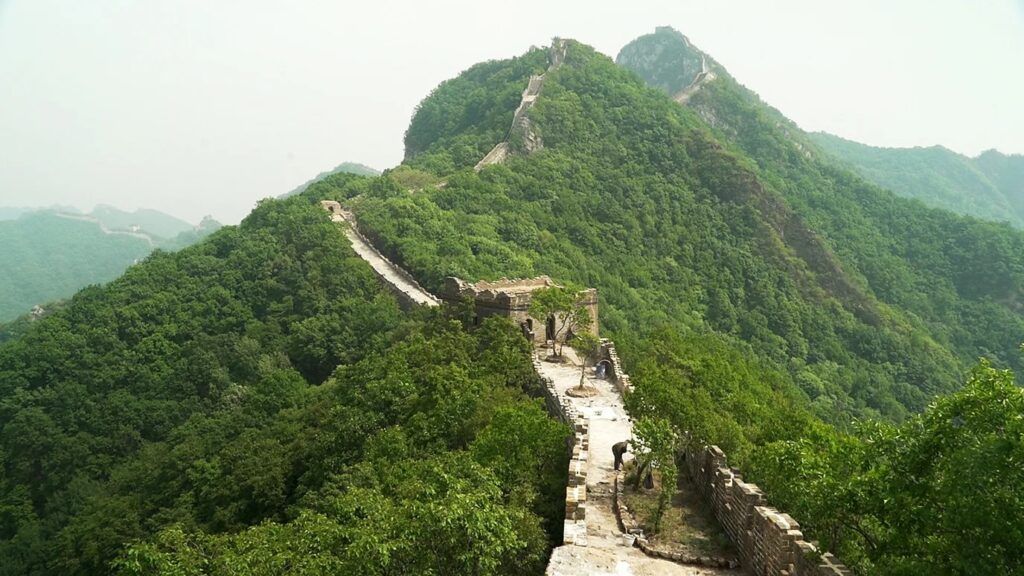
While a remote part of the Great Wall may soon attract more visitors, it remains a striking reminder of the centuries that shaped not only the fortification, but China itself. The Great Wall of China, which winds for 21,000km across the north of the country, is one of humanity’s most renowned creations. Great Wall of China
Liaoning, Jilin, Heilongjiang, Hebei, Beijing, Tianjin, Shanxi, Inner Mongolia, Shaanxi, Ningxia Hui Autonomous Region, Gansu, Xinjiang, Shandong, Henan & Qinghai. In total 15 provinces including 404 counties, People’s Republic of China
The Great Wall of China is a series of fortifications made of stone, brick, tamped earth, wood, and other materials, generally built along an east-to-west line across the historical northern borders of China to protect the Chinese states and empires against the raids and invasions of the various nomadic groups of the Eurasian Steppe. Several walls were being built as early as the 7th century BC; these, later joined together and made bigger and stronger, are now collectively referred to as the Great Wall. Especially famous is the wall built 220–206 BC by Qin Shi Huang, the first Emperor of China. Little of that wall remains. Since then, the Great Wall has on and off been rebuilt, maintained, and enhanced; the majority of the existing wall is from the Ming Dynasty.
Other purposes of the Great Wall have included border controls, allowing the imposition of duties on goods transported along the Silk Road, regulation or encouragement of trade and the control of immigration and emigration. Furthermore, the defensive characteristics of the Great Wall were enhanced by the construction of watch towers, troop barracks, garrison stations, signaling capabilities through the means of smoke or fire, and the fact that the path of the Great Wall also served as a transportation corridor.
The Great Wall stretches from Dandong in the east, to Lop Lake in the west, along an arc that roughly delineates the southern edge of Inner Mongolia. A comprehensive archaeological survey, using advanced technologies, has concluded that the Ming walls measure 8,850 km (5,500 mi). This is made up of 6,259 km (3,889 mi) sections of actual wall, 359 km (223 mi) of trenches and 2,232 km (1,387 mi) of natural defensive barriers such as hills and rivers. Another archaeological survey found that the entire wall with all of its branches measure out to be 21,196 km (13,171 mi).
The Great Wall
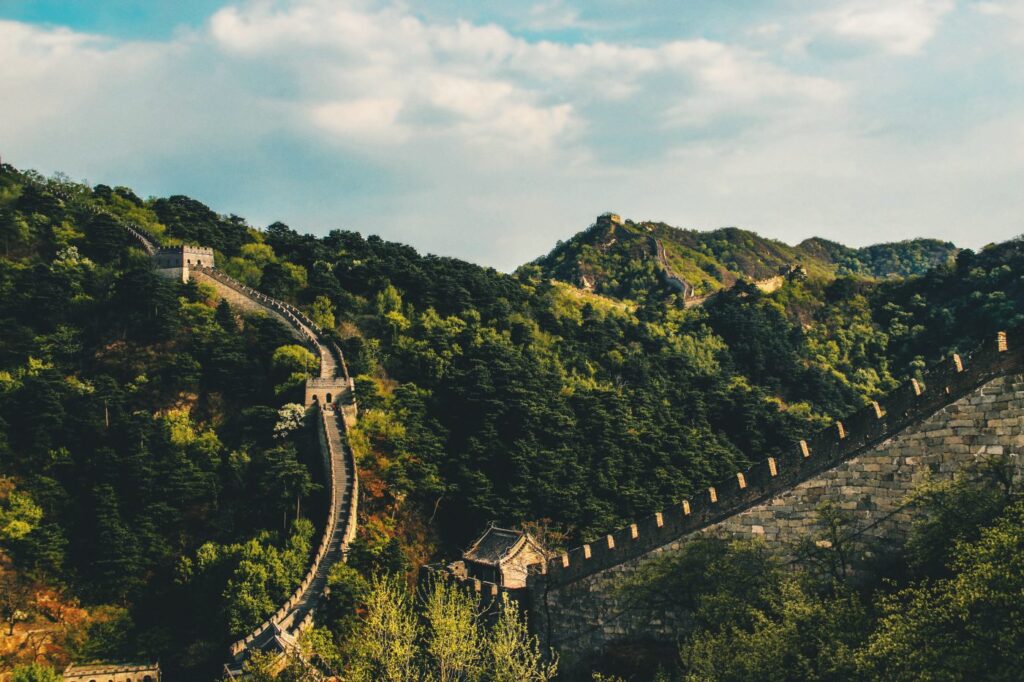
In c. 220 B.C., under Qin Shi Huang, sections of earlier fortifications were joined together to form a united defence system against invasions from the north. Construction continued up to the Ming dynasty (1368–1644), when the Great Wall became the world’s largest military structure. Its historic and strategic importance is matched only by its architectural significance.
Outstanding Universal Value
Brief synthesis
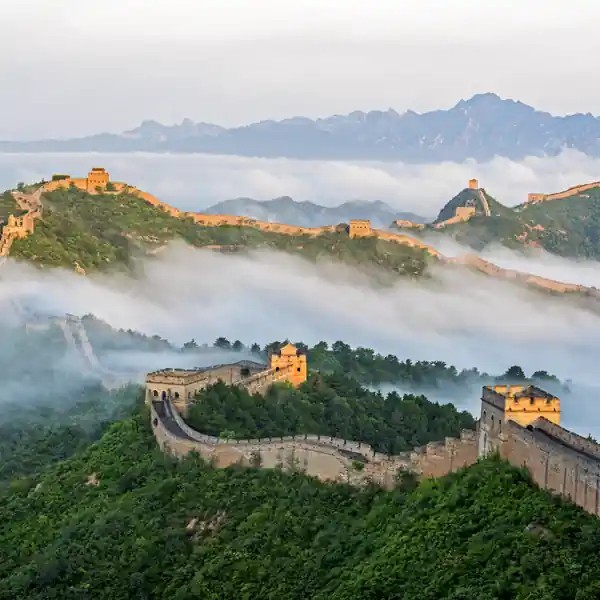
The Great Wall was continuously built from the 3rd century BC to the 17th century AD on the northern border of the country as the great military defence project of successive Chinese Empires, with a total length of more than 20,000 kilometers. The Great Wall begins in the east at Shanhaiguan in Hebei province and ends at Jiayuguan in Gansu province to the west. Its main body consists of walls, horse tracks, watch towers, and shelters on the wall, and includes fortresses and passes along the Wall.
The Great Wall reflects collision and exchanges between agricultural civilizations and nomadic civilizations in ancient China. It provides significant physical evidence of the far-sighted political strategic thinking and mighty military and national defence forces of central empires in ancient China, and is an outstanding example of the superb military architecture, technology and art of ancient China. It embodies unparalleled significance as the national symbol for safeguarding the security of the country and its people.
Criterion (i): The Great Wall of the Ming is, not only because of the ambitious character of the undertaking but also the perfection of its construction, an absolute masterpiece. The only work built by human hands on this planet that can be seen from the moon, the Wall constitutes, on the vast scale of a continent, a perfect example of architecture integrated into the landscape.
Criterion (ii): During the Chunqiu period, the Chinese imposed their models of construction and organization of space in building the defence works along the northern frontier. The spread of Sinicism was accentuated by the population transfers necessitated by the Great Wall.
Criterion (iii): That the Great Wall bear exceptional testimony to the civilizations of ancient China is illustrated as much by the rammed-earth sections of fortifications dating from the Western Han that are conserved in the Gansu province as by the admirable and universally acclaimed masonry of the Ming period.
Criterion (iv): This complex and diachronic cultural property is an outstanding and unique example of a military architectural ensemble which served a single strategic purpose for 2000 years, but whose construction history illustrates successive advances in defence techniques and adaptation to changing political contexts.
Criterion (vi): The Great Wall has an incomparable symbolic significance in the history of China. Its purpose was to protect China from outside aggression, but also to preserve its culture from the customs of foreign barbarians. Because its construction implied suffering, it is one of the essential references in Chinese literature, being found in works like the “Soldier’s Ballad” of Tch’en Lin (c. 200 A.D.) or the poems of Tu Fu (712-770) and the popular novels of the Ming period.
Integrity
The Great Wall integrally preserves all the material and spiritual elements and historical and cultural information that carry its outstanding universal value. The complete route of the Great Wall over 20,000 kilometers, as well as elements constructed in different historical periods which constitute the complicated defence system of the property, including walls, fortresses, passes and beacon towers, have been preserved to the present day. The building methods of the Great Wall in different times and places have been integrally maintained, while the unparalleled national and cultural significance of the Great Wall to China is still recognised today. The visual integrity of the Wall at Badaling has been impacted negatively by construction of tourist facilities and a cable car.
Authenticity
The existing elements of the Great Wall retain their original location, material, form, technology and structure. The original layout and composition of various constituents of the Great Wall defence system are maintained, while the perfect integration of the Great Wall with the topography, to form a meandering landscape feature, and the military concepts it embodies have all been authentically preserved. The authenticity of the setting of the Great Wall is vulnerable to construction of inappropriate tourism facilities.
Protection and management requirements
The various components of the Great Wall have all been listed as state or provincial priority protected sites under the Law of the People’s Republic of China on the Protection of Cultural Relics. The Regulations on the Protection of the Great Wall promulgated in 2006 is the specific legal document for the conservation and management of the Great Wall. The series of Great Wall Conservation Plans, which is being constantly extended and improved and covers various levels from master plan to provincial plans and specific plans, is an important guarantee of the comprehensive conservation and management of the Great Wall. China’s national administration on cultural heritage, and provincial cultural heritage administrations where sections of the Great Wall are located, are responsible for guiding the local governments on the implementation of conservation and management measures for the Great Wall.
The Outstanding Universal Value of the Great Wall and all its attributes must be protected as a whole, so as to fulfill authentic, integral and permanent preservation of the property. To this end, considering the characteristics of the Great Wall, including its massive scale, transprovincial distribution and complicated conditions for its protection and conservation, management procedures and regulations, conservation interventions for the original fabric and setting, and tourism management shall be more systematic, scientific, classified, and prioritized. An efficient comprehensive management system, as well as specific conservation measures for the original fabric and setting will be established, while a harmonious relationship featuring sustainable development between heritage protection and social economy and culture can be formed. Meanwhile, the study and dissemination of the rich connotation of the property’s Outstanding Universal Value shall be enhanced, so as to fully and sustainably realize the social and cultural benefits of the Great Wall. When tourists come to Beijing, they head by busload to the wall’s most famous outposts.
Few of them come here.
The Jiankou section of the wall ribbons over the top of jagged green mountains for 20km. From the valley below, it looks like icing piped onto each peak.
It is located just 100km north of Beijing. But it is completely different from its better-known neighbours, like Badaling or Mutianyu. There is no souvenir shop or Starbucks, no cable car or gondola. No one is waiting to sell you tickets. No one is there to make your visit easier, either: to access this section of the wall, you must hike 45 minutes up a mountain.
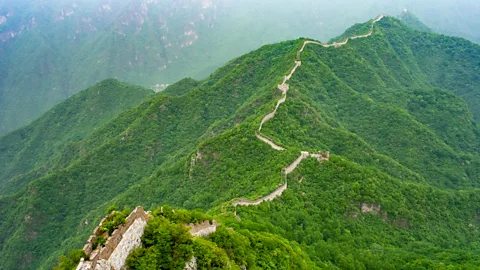
The lack of work on the wall made it picturesque, but dangerous “Some from hiking and falling down, dead. And some from being hit by lightning.
The technology helped us to repair the wall as traditionally as possible
In order to prevent further tragedy – and to preserve the Jiankou wall for future generations – restoration began in 2015. This intensive phase, focusing on a 750m-long section, wrapped up in 2019.
On a sunny spring day towards the project’s end, I sat on the wall with Ma. We were surrounded by fortification-topped peaks as far as the eye could see. “You can see the mountains here. The machines can’t come here. We have to use people,” he told me. “But we should use technologies to help these people to do this work better.” For the 2019 phase of the project, that technology included drones, 3D mapping and a computer algorithm that could tell engineers whether they had to remove that tree or fix this crack – or whether they could safely leave them as they were, reminders of when the wall had once been wild.
“The technology helped us to repair the wall as traditionally as possible,” Ma said. Snaking across northern China, from Manchuria to the Gobi Desert to the Yellow Sea, the Great Wall is vast. Its history is equally epic: it was built over more than 2,000 years, from the 3rd Century BC up to the 17th Century AD, by 16 different dynasties. The longest and most famous section belongs to the Ming dynasty, who built (and rebuilt) the wall from 1368 to 1644, including the Jiankou section. Great Wall of China ‘even longer’
 The structure is a series of walls first linked up more than 2,000 years ago
The Great Wall of China is even greater than previously thought, according to the first detailed survey to establish the length of the ancient barricade.
A two-year government mapping study found that the wall spans 8,850km (5,500 miles) – until now, the length was commonly put at about 5,000km.
Previous estimates of its length were mainly based on historical records.
Infra-red and GPS technologies helped locate some areas concealed over time by sandstorms, state media said.
The project found that there were wall sections of 6,259km, 359km of trenches, and 2,232km of natural defensive barriers such as hills and rivers.
The study was carried out by the State Administration of Cultural Heritage and the State Bureau of Surveying and Mapping.
Barricade
Experts said the newly-discovered sections of the wall were built during the Ming Dynasty (1368-1644), and stretch from Hu Mountain in northern Liaoning province to Jiayu Pass in western Gansu province.

The project will continue for another 18 months in order to map sections of the wall built during the Qin (221-206BC) and Han (206BC-9AD) Dynasties, the report said.
The wall, the world’s largest man-made structure, was built to protect the northern border of the Chinese Empire.
Archaeologists had lobbied for the survey to be done to provide scholars with an accurate understanding of the construction.
Known to the Chinese as the “long Wall of 10,000 Li”, the Great Wall is in fact a series of walls and earthen works begun in the 5th Century BC and first linked up under Qin Shi Huang in about 220BC.
It was listed as a Unesco world heritage site in 1987. Far from one line from A to B, the network includes loops, double walls, parallel walls and spurs.
Today, about one-third of the original Ming fortifications have vanished. Only about 8% are considered to be well preserved. The threats have been many: natural erosion from wind and rain; human destruction from construction; and even people selling bricks. And, of course, the damage caused by footfall. That’s true even at Jiankou, despite having so many fewer visitors than stretches like Badaling.
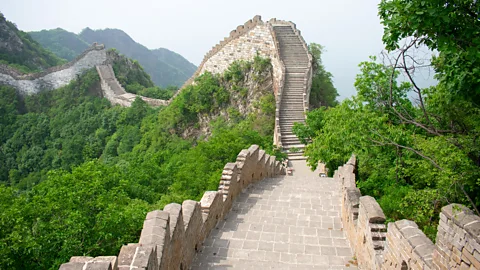
Built in the 1500s and early 1600s, the Jiankou section was left untouched for centuries “Just over the hill there are 20 million people,” said historian and conservationist William Lindesay, referring to Beijing. “So, the ‘leave nothing but footprints’ [advice] – even footprints can actually damage the wall.”
Lindesay has devoted his life to researching, writing about and fighting for conservation of the wall. Originally from England, Lindesay saw it on a map as a boy in 1967 and decided he had to explore it. In 1987, three years after a run of Hadrian’s Wall that inspired him to revive his childhood fascination, he walked the Great Wall on foot. One man’s mission to walk the Great Wall of China with a drone William Lindesay has been obsessed with the Great Wall of China since seeing it in a school atlas as a child in England, and last year embarked on an epic journey to fulfil a lifelong ambition – to film the wall in its entirety from the air. He told the BBC’s Anna Jones about this quest.
“The Great Wall is an amazing sight, and it deserves to be seen in its best light,” says William from his home in Beijing.
Unable to shake his childhood fascination, he moved to China from Wallasey on Merseyside in 1986 “for the wall”, and has since researched it extensively, writing several books and gaining an OBE for his work. Chinese officials criticised over ‘ugly’ Great Wall repairs. Chinese officials have come under fire after repairs to the Great Wall left part of the ancient structure smoothed and resembling a concrete path.
A five-mile (8km) stretch of the Unesco world heritage site was repaired to protect it from exposure to the elements.
The ancient stone wall was repaired with materials reported to include sand and concrete.
“It really was an ugly repair job,” a local official admitted.
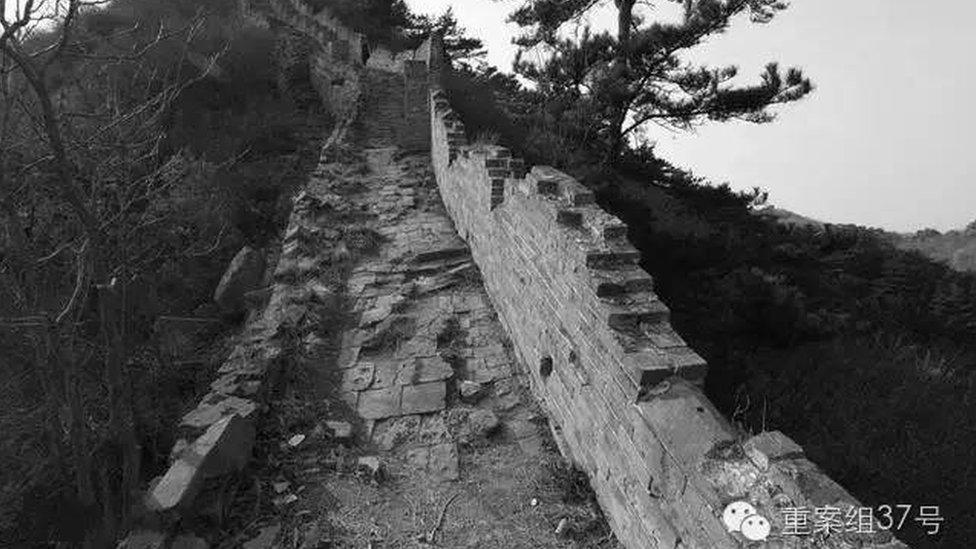 Image source,zhonganzu37
Image caption,The original stone surface was uneven brickwork
Ding Hui, the head of the Liaoning Provincial Antiquities Bureau, said the repairs to the 635-year-old structure took place in 2014.
He said the repairs filled broken gaps, and added an additional protective layer on the top surface “like a hat”, but admitted “the surface does not look ideal”.
The repairs have only now come to light from photos posted to Chinese social media platform Weibo, where thousands of users criticised the renovation work.
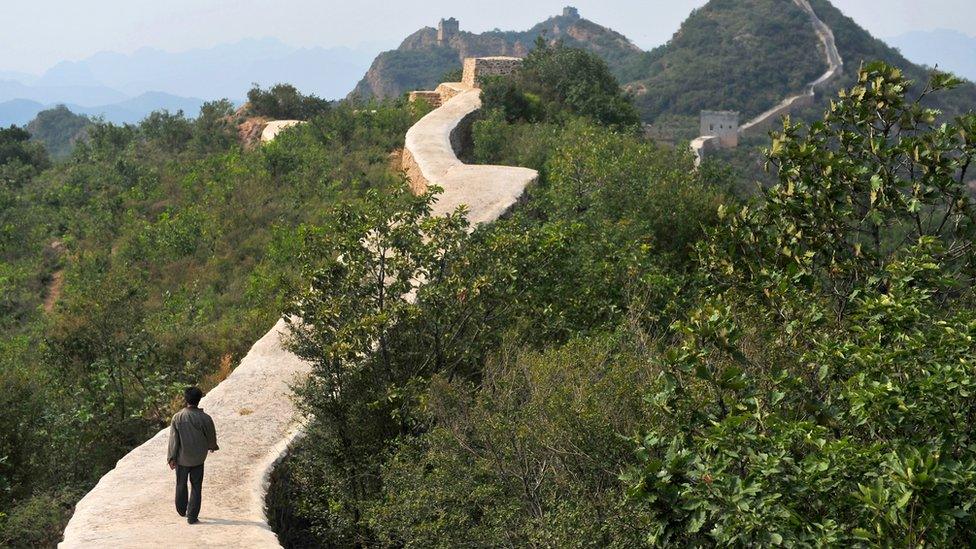 Image source,AP
Image caption,A range of materials, from sand to concrete, are reported to have been used
However, an official survey said the stretch of wall was in danger of falling apart and being washed away by the rain.
The affected section of the Great Wall lies in Suizhong county, along the border with Hebei province.
Local news outlets reported a wide variety of materials had been used, including sand, lime and cement. The work was labelled “basic and crude” by Dong Yaohui, vice-chairman of the Great Wall Studies Society.
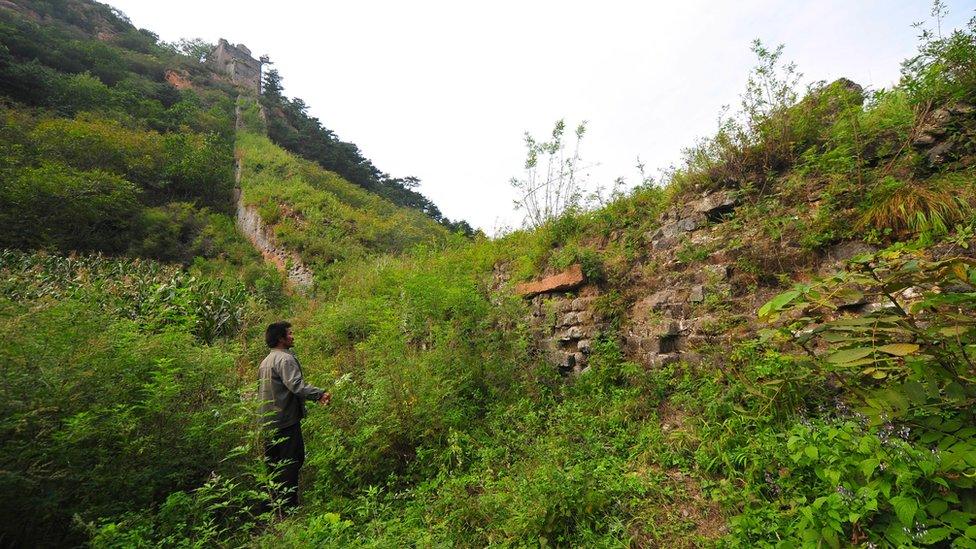 Image source,AP
Image caption,The repair work is widely seen as being out of character with the original design
The Chinese government has specific regulations on the preservation of the Great Wall, which is crumbling in many remote locations. Some stretches have been damaged or demolished over the years.
The law for damaging a cultural relic is strict, with those found guilty facing up to 10 years in prison.
The Great Wall, a Unesco world heritage site since 1987, was built and rebuilt on a continual basis from around 220 BC until the Ming Dynasty in the 1600s, when it was the world’s largest military structure.
Designed to protect the Chinese empire from northern invasions, it once stretched 20,000km (12,400 miles).

Tutankhamun: Egypt museum staff face trial over botched beard Egyptian media say prosecutors have referred eight museum employees for trial over the botched reattachment of the beard on the burial mask of the pharaoh, Tutankhamun.
It comes a year after officials opened an investigation into how the blue and gold braided beard came to be detached and then hastily glued back on.
The accused face charges of negligence and violating professional standards.
The 3,000-year-old artefact is one of Cairo’s biggest tourist attractions.
Conservators at the Egyptian Museum had given differing accounts of the circumstances of the beard becoming detached.
One suggestion was that it had been knocked off accidentally, another that it had been removed after becoming loose.
Prosecutors said workers then “recklessly” tried to cover up the mistake, using large amounts of inappropriate glue in an effort to fix it.
In all, they made four attempts to reattach the beard, on the later three occasions also trying to remove evidence of their earlier failed efforts.
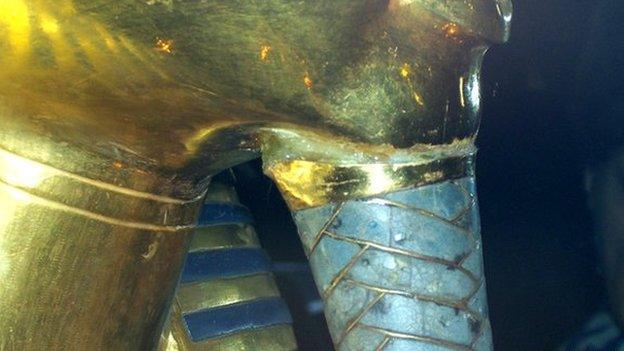 Image source,Al-Araby Al-Jadeed
Image caption,The botched effort to reattach the beard was painfully obvious when viewed close up
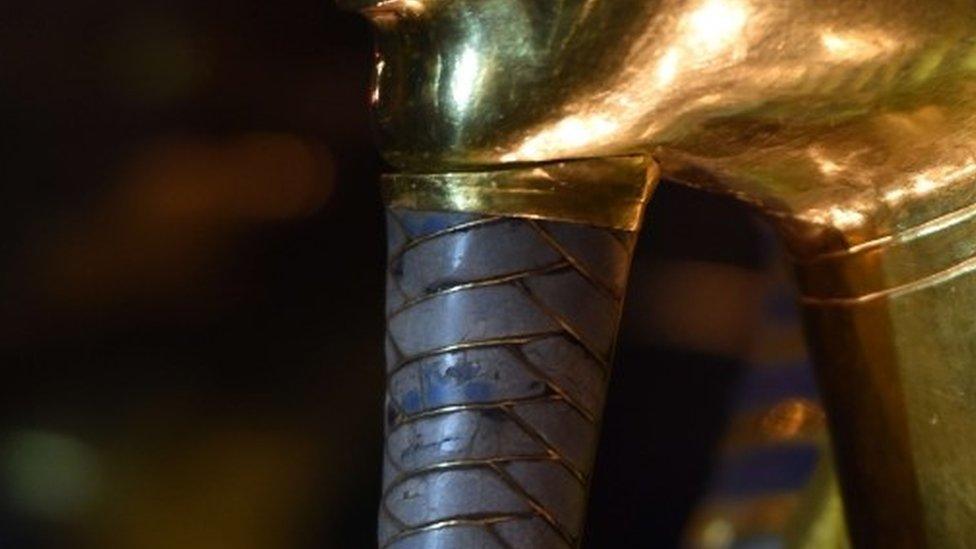 Image source,AFP
Image caption,Restoration work by German experts removed traces of the glue
Those due to face trial include a former director of the museum and a former director of restoration.
Last October, a team of conservators led by German experts began work to remove the damage and reattach the beard professionally.
Following successful restoration, the mask was put back on public display in December. 8 antiquities’ employees referred to trial over damage to Tutankamun mask. The Administrative Prosecution (AP) referred eight employees from the Egyptian Museum to trial over the “shocking” handling of the famous gold mask of King Tutankamun. The suspects are accused of unrefined restoration of the mask and negligence of the artifact. The issue under investigation concerns the improper gluing of the mask’s beard, on display and under the responsibility of the museum.
AP issued a statement Saturday revealing that scientific and professional methods were violated during the handling of the priceless golden mask and accused the suspects of destroying the product of one of the oldest civilisations of human history. The statement described the violation as a “reckless action”, reaching its peak when suspects attempted to cover up the mistake by trying to fix it over four times.
“Ignoring all scientific methods of restoration, the suspects tried to conceal their crime by using sharp metal tools to remove parts of the glue that became visible, thus damaging the 3,000-year-old piece without a moment of conscience,” according to the statement.
The suspects include two restorers, four senior restoration experts, former director of restoration, and the former director of the museum. According to AP, the first two suspects were careless with the technical procedures of lifting the mask from the museum’s showroom on 12 August 2014, which resulted in the damage to the beard.
According to the technical report of the official representatives of the committee of antiquities, the issue initially began with an electric disruption of the round base that lit the mask.
The report said that, at first, the mask had been successfully lifted and the electricity problem fixed. But then, the employees who were to replace the mask in its displayed carried it incorrectly. The face of the mask was carried inside instead of being face-up to avoid any friction.
Their mistreatment resulted in damage to the beard. Subsequently, the suspects tried to reattach the beard but failed to adhere to the protocols of antiquities’ restoration, which require the mask that the ask be taken to a conservation lab.
Naturally their operation was unsuccessful, the AP said, which pushed them to repeat the attempts. The suspects excessively used epoxy glue, which is not what is professionally used. The suspects struggled to erase the visible glue traces, on 30 October and a second time on 2 November 2014.
The museum’s former restoration director neglected her supervisory role and disregarded procedures to document the status of the mask before and after repair work.
The museum’s former director is being accused of allowing the continuation of the mask’s restoration on 30 October and 2 November 2014, AP said.
It was not until January 2015 that the Minister of Antiquities publicly admitted the fiasco. The AP’s statement explained that the suspects’ will be penalised for their attempts to conceal their actions without informing superiors, let alone the ministry. The AP’s harsh statement concluded that the visible marks on the mask – scratches which resulted from attempts to remove the glue – will remain as a “witness to the crime committee”. Bizarrely, the monkey-like do-over has brought in tens of thousands of admiring pilgrims since its creation in 2012, helping to ease the town’s recession. It’s a miracle.
Not so botched, perhaps. The “scandalous” restoration of a castle in Spain: an accidental stroke of genius?
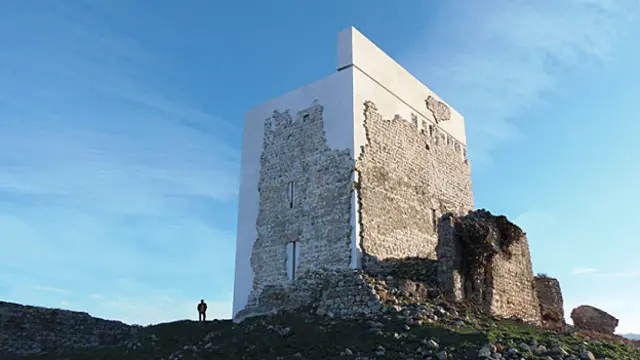 Image source,Carquero Architecture
This is the work that sparked so much criticism. But the architect responsible for the project, Carlos Quevedo, said he was “surprised by the controversy,” as he told BBC Mundo.
Quevedo chose to use new materials to consolidate the old stone and to restore the castle to its original shape and dimensions. Spanish fresco restoration botched by amateur An elderly parishioner has stunned Spanish cultural officials with an alarming and unauthorised attempt to restore a prized Jesus Christ fresco.
Ecce Homo (Behold the Man) by Elias Garcia Martinez has held pride of place in the Sanctuary of Mercy Church near Zaragoza for more than 100 years.
The woman took her brush to it after years of deterioration due to moisture.
Cultural officials said she had the best intentions and hoped it could be properly restored.
Donation
Cecilia Gimenez, who is in her 80s, was reportedly upset at the way the fresco had deteriorated and took it on herself to “restore” the image.
She claimed to have had the permission of the priest to carry out the job.
“(The) priest knew it! He did! How could you do something like that without permission? He knew it!”
BBC Europe correspondent Christian Fraser says the delicate brush strokes of Elias Garcia Martinez have been buried under a haphazard splattering of paint.
The once-dignified portrait now resembles a crayon sketch of a very hairy monkey in an ill-fitting tunic, he says.
The woman appears to have realised she was out of her depth and contacted Juan Maria Ojeda, the city councillor in charge of cultural affairs.
Teresa Garcia, granddaughter of Elias Garcia Martinez, said the woman had painted the tunic before, but the fresco got disfigured when she painted Christ’s head.
‘Good intentions’
Art historians are expected to meet at the church soon to discuss how to proceed.
Mr Ojeda said: “I think she had good intentions. Next week she will meet with a repairer and explain what kind of materials she used.
“If we can’t fix it, we will probably cover the wall with a photo of the painting.”
The fresco is not thought to be very valuable, but has a high sentimental value for local people.
Our correspondent says that to make matters worse, the local centre that works to preserve artworks had just received a donation from the painter’s granddaughter which they had planned to use to restore the original fresco. “But there’s more to the wall than that,” says William, who trained as a geographer.
“Before the tourist wall that people flock to, there were many other ‘Great Walls of China’.”
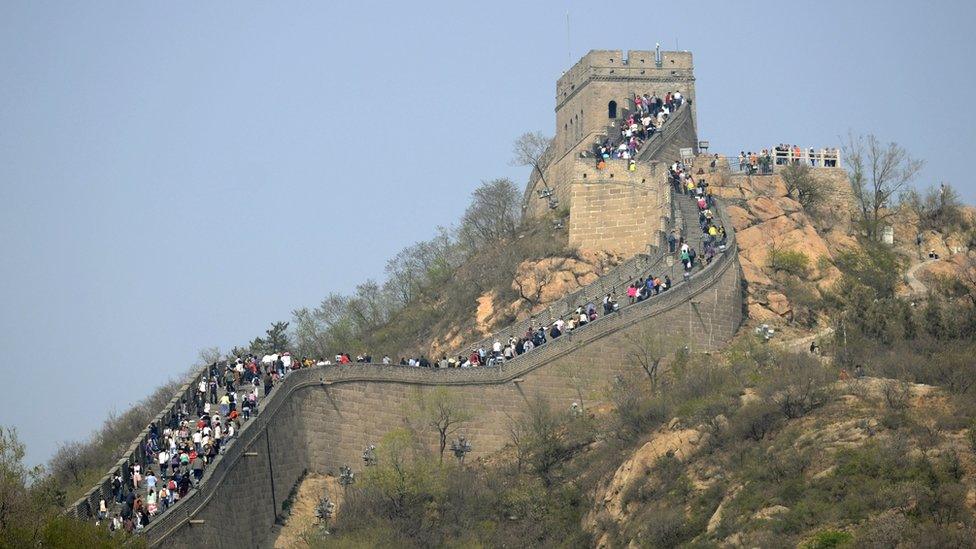 Image source,Getty Images
Image caption,Few tourists see more of the wall than the manicured sections near Beijing
Sprawled across northern China and into Mongolia, the creation of these various walls spanned centuries and ruling dynasties. The oldest parts date back more than 2,000 years.
In some places towering stone and in others heaped-up earth, the walls have variously served as highways, defensive fortresses, a communication network and even a fence to contain migrating animals.
“Over the past 30 years I’ve been looking at all of these walls, as far as possible,” says William. “My travels have taken me all over northern China, even as far as Mongolia.”
In the 1990s, he and his wife, Wu Qi, bought a farmhouse at the foot of the wall, and would spend most weekends there exploring it. In the 1990s, he and his wife, Wu Qi, bought a farmhouse at the foot of the wall, and would spend most weekends there exploring it.
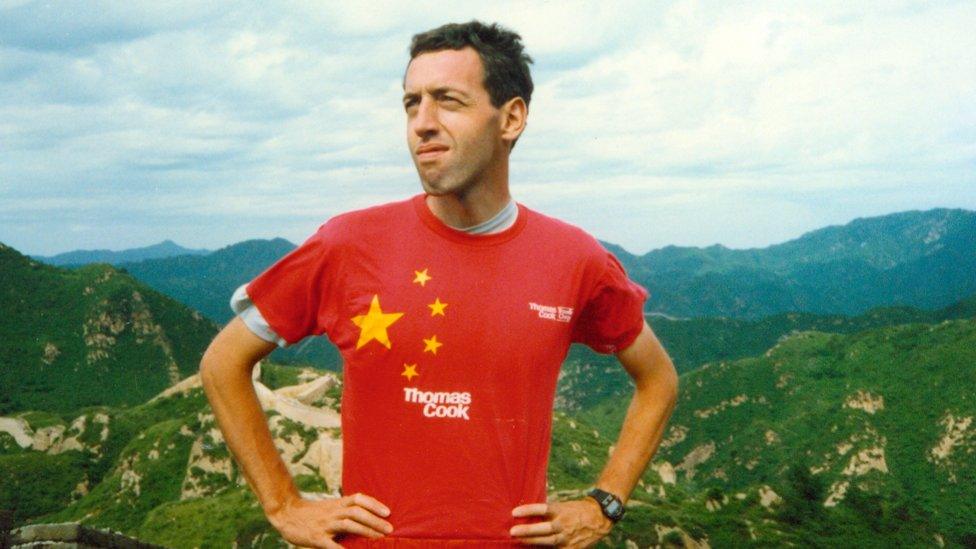 Image source,William Lindesay
Image caption,William Lindesay has been exploring the wall since the mid-1980s
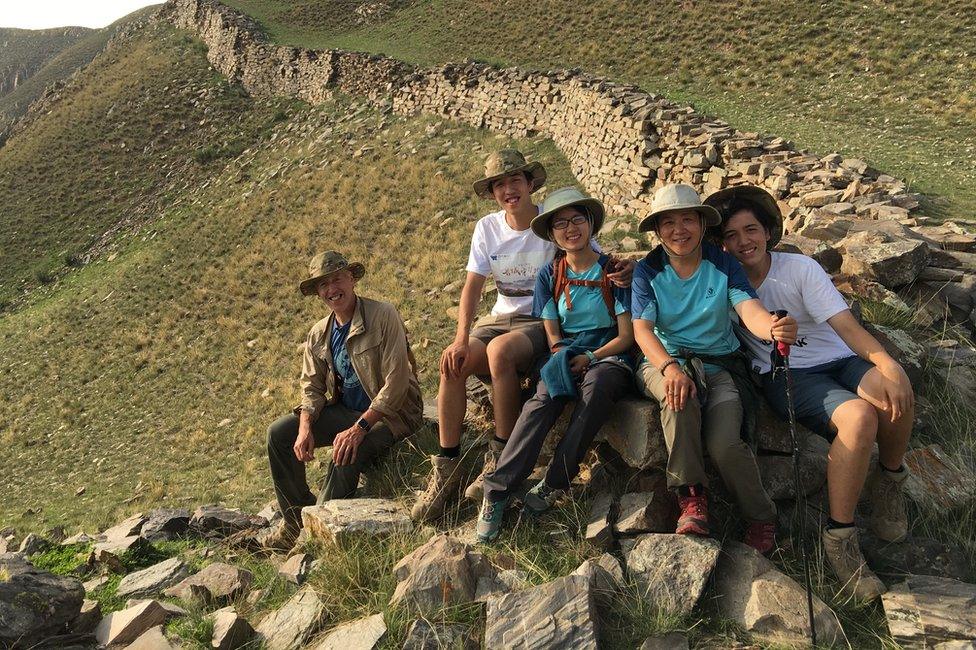 Image source,William Lindesay
Image caption,William and Wu Qi have brought their sons up in the shadow of the Great Wall
Photography has always been important, says William, whether the images were “just beautiful or whether the architecture, the design features had a meaning that I wanted to explain in my writing”.
But in 2016 his sons, Jim and Tommy, had a suggestion for seeing the wall in a whole new way, and began, as they put it, pestering him to buy them a drone.
“I was very concerned they’d come back from the first trip without the drone,” says William. He eventually caved, and the results, coupled with some self-taught editing flair from his sons, have been “out of this world”.
“Over the years, publishers and filmmakers have come to me and said, let’s do the Great Wall from the air,” he says.
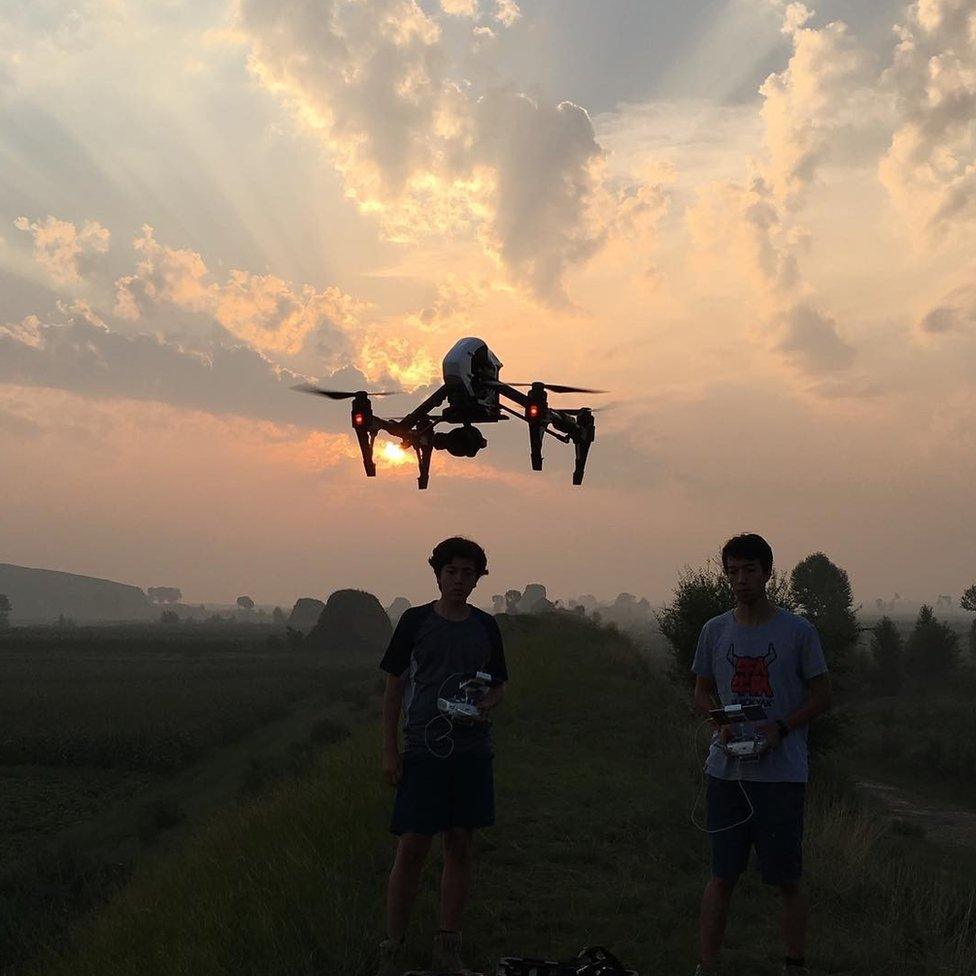 Image source,Wild Wall
“My typical reply was that unless you’ve got millions and millions of dollars, and high-level contacts with the government and the armed forces, who control the skies, then forget it.
“In this way drone technology is a godsend.”
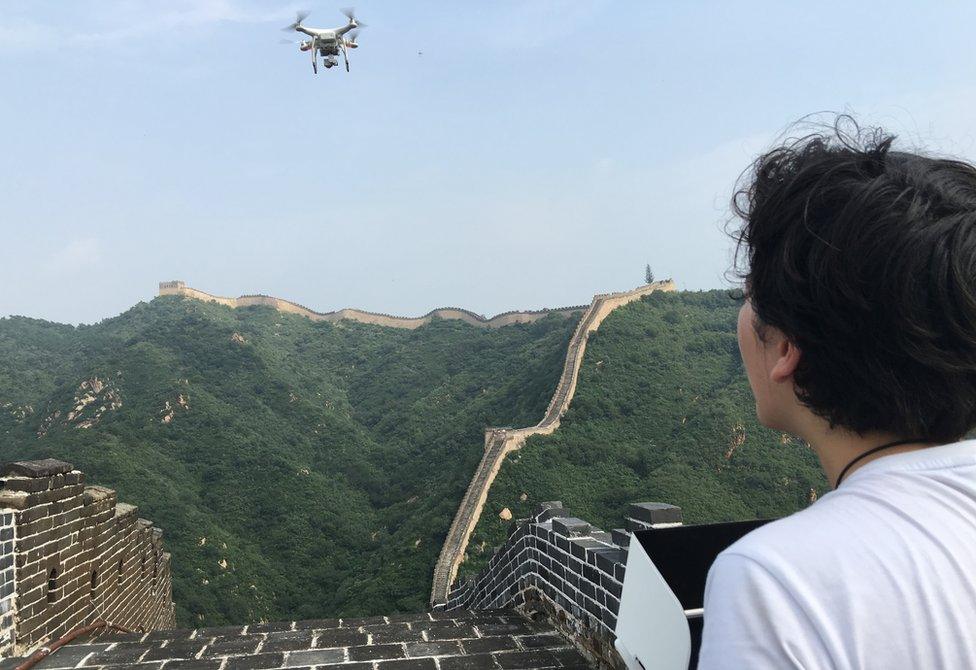 Image source,William Lindesay
So armed with their drone and with a travel agency sponsor, the family spent a total of 60 days tracing the walls in 2016, celebrating William’s 60th birthday and his 30th year of living in China “for the wall”.
They began in July at the Old Dragon’s Head, the point where the Ming dynasty-era Great Wall meets the sea in the east, and followed it westwards, branching off to explore the older Zhao wall, dating back to 300BC, then hundreds of kilometres further west, the Han dynasty wall.
